How to Start a Skincare/Cosmetics Business in India

Starting a D2C skincare or cosmetics business in India is not just about making a nice product and designing a pretty label. It is about building a brand that customers trust with their skin, setting up the right regulatory and manufacturing foundations, creating a repeatable product and marketing system, and making sure the business can actually fulfill orders, handle customer questions, and grow without chaos.
A skincare business can look simple from the outside, but the real work starts when founders ignore formulation, compliance, packaging, inventory control, and customer service. This guide covers both the brand-building side and the business side, including where systems like CRM, finance, operations, HR, project management, and training fit into a D2C skincare setup.
Table of Contents
- Choose your skincare niche and category
- Decide your business model
- Understand regulations, licenses, and compliance
- Build or source your products
- Create branding, packaging, and pricing
- Set up operations, inventory, and fulfillment
- Plan your launch and customer acquisition
- Handle customer service, repeat sales, and retention
- Build a basic team and workflow structure
- How Zopkit supports a D2C skincare business
- Prepare for scale and long-term growth
- Conclusion and CTA
1. Choose your skincare niche and category
The first decision is what kind of skincare or cosmetics business you are building. D2C is crowded, so your niche should be specific enough to stand out but broad enough to grow.
Good starting niches include:
- Acne care
- Sensitive skin products
- Brightening or glow-focused skincare
- Men’s grooming and skincare
- Ayurvedic or herbal skincare
- Baby and gentle care products
- Minimal, science-led skincare
- Makeup or cosmetics for a specific audience
Your niche should answer a few simple questions:
- Who is the product for?
- What skin concern or beauty need does it solve?
- Why would someone trust your brand over dozens of others?
- Is the positioning premium, affordable, natural, clinical, or lifestyle-led?
The clearer your niche, the easier it becomes to choose product formats, packaging style, marketing tone, and customer acquisition strategy.
2. Decide your business model
There are several ways to start a D2C skincare business, and the model you choose affects cost, control, and speed.
Common models include:
- Contract manufacturing with your own branding
- Private label products from an existing manufacturer
- In-house formulation and manufacturing
- Hybrid model with a few hero SKUs manufactured externally and some products developed later in-house
For most first-time founders, contract manufacturing or private label is the most practical starting point. It lets you focus on product-market fit, branding, and sales before investing heavily in production infrastructure.
Things to decide early:
- Will you launch with 1–3 hero products or a full range?
- Will you start with skincare only, cosmetics only, or both?
- Will you sell only on your own website or also on marketplaces and offline?
- Will you test one city first or go pan-India from day one?
A lean, focused launch usually works better than a broad catalog with no clear identity.
3. Understand regulations, licenses, and compliance
Skincare and cosmetics are trust-based products, so compliance matters more than in many other D2C categories.
Before launch, you need to understand the applicable requirements around:
- Business registration
- GST registration, where applicable
- Trademark filing for your brand name and logo
- Cosmetics-related manufacturing, labeling, and product compliance
- Proper invoices and billing systems
- Batch coding, expiry, and traceability rules
- Import-related approvals if you source from outside India
If you are manufacturing through a third party, confirm that your manufacturer follows the relevant regulations, maintains documentation, and can support labeling and batch-level traceability.
You should also plan for:
- Product liability and customer safety concerns
- Clear ingredient disclosures
- Claims that can be supported, such as “helps reduce acne-prone skin appearance” rather than exaggerated promises
- Terms and return policies that fit the nature of skincare and cosmetics products
This is a category where trust, transparency, and proper labeling are not optional.
4. Build or source your products
Your product is the center of the business, so this step needs patience and testing.
Key decisions include:
- What ingredients or formulations will define your brand?
- Will the products be natural, science-led, ayurvedic, vegan, fragrance-free, or performance-focused?
- What skin types and concerns are you targeting?
- What texture, scent, and packaging experience should customers have?
If you are working with a manufacturer or formulator, create a simple product brief for each SKU:
- Product name and purpose
- Target customer
- Skin type or concern
- Desired texture and feel
- Ingredient preferences or exclusions
- Price band
- Packaging type
- Shelf life and storage expectations
Do not rush into too many SKUs at launch. It is better to start with a tight range of hero products that actually solve one clear problem well.
You should also test:
- Packaging durability
- Shelf stability
- Drop tests and leakage risk
- Customer reaction to scent, texture, and usage experience
- How the product looks on camera and in unboxing content
For D2C, the product must work in real life and look good in content.

5. Create branding, packaging, and pricing
In skincare and cosmetics, packaging and branding are not just design elements. They are part of the trust signal.
Your brand should have:
- A clear visual identity
- A memorable name
- A consistent color system
- Packaging that feels premium, safe, and useful
- Labeling that is clean and easy to read
The packaging should answer:
- What does the product do?
- Who is it for?
- How is it different?
- Why should the customer trust it?
Pricing should be built carefully. Don’t price only based on cost plus margin. Price based on:
- Customer perception
- Competitor benchmarks
- Brand positioning
- Acquisition cost
- Shipping and packaging cost
- Return/refund risk
- Contribution margin after discounts and marketing
If your brand is premium, the product must look and feel premium. If your brand is affordable, the value must be obvious and the funnel must be efficient.
A D2C skincare business lives or dies on whether the customer feels the packaging, product, and brand message all belong together.
6. Set up operations, inventory, and fulfillment
A skincare business can grow fast, and that means operations need to be built early.
You need basic systems for:
- Inventory tracking by SKU and batch
- Purchase orders and stock planning
- Order fulfillment and dispatch
- Returns, replacements, and damaged shipment handling
- Customer support and order tracking
- Vendor and payment follow-up
Common mistakes at this stage:
- Buying too much stock too early
- Running out of hero SKUs during a campaign
- Not tracking expiry or batch movement
- Handling fulfillment manually through multiple chats and sheets
- Losing visibility into pending orders, returns, and customer complaints
You should build a simple operating rhythm:
- Weekly stock review
- Daily order dispatch review
- Monthly purchase and restock planning
- Batch and expiry tracking
- Return and complaint review
As orders increase, systems like finance, operations, and project management become important for keeping launches, restocks, promotions, and vendor work under control.

7. Plan your launch and customer acquisition
A D2C skincare launch should feel focused, not noisy.
Before launch, decide:
- What is the core launch message?
- What problem does the brand solve?
- What are the first 1–3 hero products?
- Which customer segment are you targeting first?
- Which channel will drive the first wave of attention?
Core channels usually include:
- Influencer and creator marketing
- Meta ads
- Google search and shopping, where relevant
- WhatsApp and SMS follow-up
- Referral and loyalty offers
Content should show:
- The problem you solve
- Product texture and application
- Ingredient education
- Customer testimonials
- Before/after usage journeys, where honest and compliant
- Founder story and brand mission
A lot of D2C skincare businesses fail because they talk too much about the brand and not enough about the problem, product proof, and reason to trust them.
You want your launch to feel like the beginning of a customer relationship, not a one-day announcement.
8. Handle customer service, repeat sales, and retention
Skincare is not usually a one-time purchase. That makes retention extremely important.
Customers need:
- Product usage guidance
- Clear expectations about results and timelines
- Help choosing the right product for their skin type
- Fast answers about shipping, returns, and ingredient queries
This is where a good CRM helps a lot. You can keep track of:
- Customer profiles
- Skin concerns and preferences
- Purchase history
- Repeat order timing
- Campaign responses
- Loyalty and subscription behavior
Retention ideas:
- Follow up after first use with education and support
- Remind customers when products are likely to run out
- Create replenishment campaigns
- Bundle complementary products
- Segment customers by concern or buying behavior
A skincare business becomes much stronger when repeat customers are treated like a relationship, not a transaction.
9. Build a basic team and workflow structure
Even a small D2C skincare business needs structure.
You may start with a founder-led setup, but eventually you’ll need support in:
- Operations
- Content and marketing
- Customer support
- Finance and bookkeeping
- Supply coordination
- Design or product development
- Warehouse or fulfillment management
Common early-stage issues include:
- Tasks living in WhatsApp chats
- No clear launch checklist
- Customer issues not tracked properly
- Finance and payments not reviewed regularly
- Team members not knowing who owns what
A simple workflow structure helps:
- Create one owner for each function
- Set weekly review meetings
- Keep launch, campaign, and stock tasks in one system
- Maintain training notes for product knowledge and customer response
- Separate personal work from brand work
As the business grows, structured systems become the difference between controlled growth and constant firefighting.
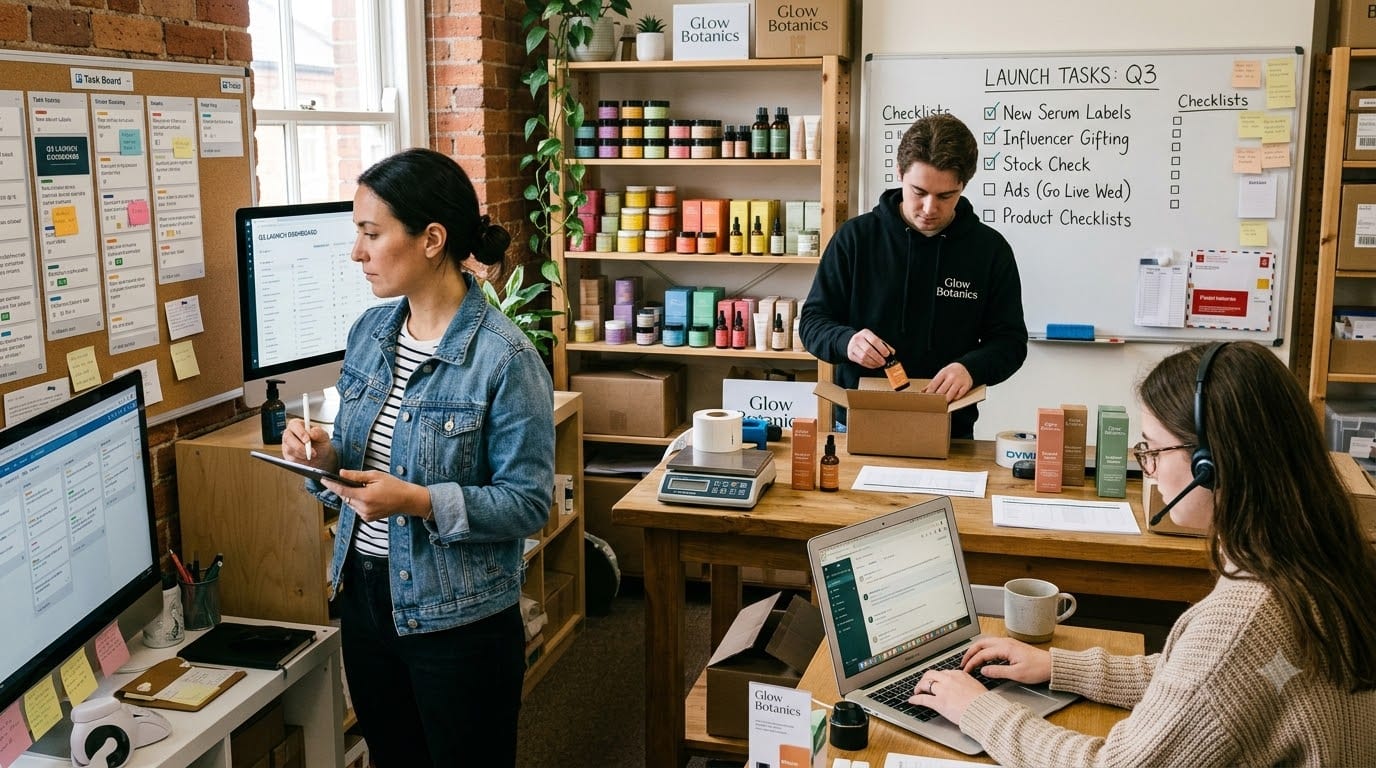
10. How Zopkit supports a D2C skincare business
A D2C skincare business has multiple moving parts from day one: customers, money, inventory, launches, and team coordination. That’s exactly where a connected system matters.
Zopkit can help across these areas:
- Zopkit CRM → Store customer profiles, skin preferences, purchase history, repeat behavior, and campaign responses.
- Zopkit Finance → Track billing, expenses, vendor payments, collections, and cash flow.
- Zopkit Project Management → Run launches, influencer campaigns, product shoots, restock tasks, and marketing calendars in one place.
- Zopkit HRMS → Manage team onboarding, attendance, payroll, and role clarity as the business grows.
- Zopkit Academy → Train customer support and sales teams on product knowledge, usage instructions, and customer handling.
Instead of keeping everything in separate sheets, chats, and reminders, the business can operate in a more structured way from the beginning.
11. Prepare for scale and long-term growth
Once the brand has product-market fit, a repeatable launch engine, and consistent customer demand, you can think about scale.
Scale for a D2C skincare business may mean:
- Expanding into more SKUs
- Adding new customer segments
- Increasing ad spend profitably
- Entering marketplaces
- Moving into retail or offline channels
- Launching subscriptions, bundles, or refill programs
- Expanding into international markets
Before scaling, make sure you have:
- Reliable demand data
- Stable production and supplier relationships
- Good gross margins
- Clean customer feedback loops
- Strong retention economics
- A way to manage product, operations, finance, and marketing together
Scaling without structure can make a good skincare business feel chaotic very quickly. The stronger your systems are before growth, the safer expansion becomes.
Conclusion
Starting a D2C skincare or cosmetics business in India is a mix of product science, brand trust, compliance, and operational discipline. If you choose a focused niche, launch with strong hero products, build credible branding, manage inventory and fulfillment properly, and treat retention as a core growth engine, you give your business a much better chance of long-term success.
The earlier you treat the business like a real company—with clean records, clear roles, and connected systems—the easier it is to grow later. That is why many D2C brands eventually need a strong backbone across customers, finance, operations, projects, and training, so the business can scale without losing control.
Explore how to build that structure at zopkit.com.