How to Scale a Skincare/Cosmetics Business in India

Starting a D2C skincare or cosmetics business in India begins with choosing the right niche, developing trustworthy products, understanding compliance, and building a brand customers feel confident buying.
If you are still planning your business, selecting a niche, choosing a manufacturing model, working on formulations, or preparing for your first launch, begin with the guide below.

Related Guide:
How to Start a D2C Skincare/Cosmetics Business in India
Use this guide to understand:
- Niche and product selection
- Manufacturing and private-label models
- Cosmetics compliance and labeling
- Branding, packaging, and pricing
- Inventory and fulfillment
- Launch planning
Once the business is launched, the next challenge is growth. Growing a skincare brand means improving repeat purchases, strengthening the product portfolio, creating content that builds trust, improving margins, and making inventory and fulfillment more reliable.
If your business is already operating but you are struggling with acquisition, retention, product performance, cash flow, or day-to-day operations, refer to the guide below before thinking about scale.
Related Guide:
How to Grow a D2C Skincare/Cosmetics Business in India
Use this guide to understand:
- How to identify what is already working
- How to improve your product portfolio
- How to build repeat-purchase systems
- How to improve content and creator campaigns
- How to manage pricing and margins
- How to strengthen inventory and fulfillment
- How to create better team workflows
After starting and growing the business, the next question is how to scale it without losing control.
Scaling a D2C skincare or cosmetics business is not simply about increasing ad spend, launching more products, or joining more marketplaces. It means building a repeatable business that can handle more customers, orders, creators, channels, and team members while protecting product quality, customer trust, margins, and cash flow.
The Indian D2C beauty market is becoming more competitive, and brands are expanding through owned websites, marketplaces, social commerce, creator partnerships, quick commerce, and offline retail. The brands that scale sustainably are usually the ones that connect acquisition with retention, marketing with inventory, and revenue with profitability.
This guide explains how to move from a growing founder-led skincare business to a more structured and scalable brand.
Table of Contents
- Confirm that your business is ready to scale
- Build a scalable product portfolio
- Create a repeat-purchase engine
- Scale content and creator acquisition
- Expand across channels carefully
- Strengthen inventory, supply chain, and fulfillment
- Protect margins and cash flow
- Build a team-led operating structure
- How Zopkit supports D2C scale
- Build a phased scaling roadmap
- Conclusion and CTA
1. Confirm That Your Business Is Ready to Scale
Scaling too early can multiply problems. Before increasing ad spend, expanding the product range, or entering new channels, confirm that the existing business model is working.
You should already have:
- One or more products with consistent demand.
- Repeat customers who return without heavy discounts.
- Reliable manufacturers or suppliers.
- Consistent product quality across batches.
- A basic understanding of customer acquisition cost.
- Healthy contribution margin after shipping, discounts, commissions, and marketing.
- Reliable order fulfillment.
- A clear process for complaints, returns, and replacements.
Review several months of performance instead of relying on one successful campaign.
Metric | What it tells you |
|---|---|
Repeat purchase rate | Whether customers are finding enough value to return |
Contribution margin | Whether orders remain profitable after variable costs |
Customer acquisition cost | How much it costs to bring in a new customer |
Average order value | Whether bundles and upsells are working |
Stockout rate | Whether supply is keeping up with demand |
Return and replacement rate | Whether product or fulfillment issues are affecting trust |
Cash available | Whether you can fund the next production and marketing cycle |
There is a difference between traction and scale-readiness. A viral Reel or one successful influencer campaign can create traction. Scale-readiness means demand, supply, margins, and operations continue to work across multiple campaigns and customer cohorts.
If you do not yet have repeat demand, reliable supply, and healthy unit economics, focus on those areas first. Scaling should amplify a strong business, not hide a weak one.
2. Build a Scalable Product Portfolio
A skincare brand cannot scale efficiently if every new product creates confusion across formulation, packaging, compliance, marketing, inventory, and customer support.
Build your portfolio around clear roles.
Hero products
These attract new customers and represent the brand. They should solve a clear problem, be easy to explain, and have reliable supply.
Supporting products
These complement the hero products and help customers create a routine.
Bundles
Bundles can increase average order value while making product selection easier.
Replenishment products
Daily-use products can create predictable repeat demand and support subscriptions.
Premium products
Premium products can improve margins and brand perception when the experience supports the price.
Review every product using four questions:
- Does it attract new customers?
- Does it encourage repeat purchases?
- Does it contribute healthy margin?
- Does it strengthen the brand?
Do not add SKUs simply because competitors have them. Every SKU requires product development, packaging, labeling, content, inventory, customer education, and support.
A better approach is to expand around problems your existing customers already have. If your brand is known for sensitive-skin care, build a deeper sensitive-skin routine before moving into unrelated categories.
Create a product roadmap with:
- Customer problem
- Product concept
- Manufacturer or formulator
- Expected cost
- Packaging needs
- Compliance checklist
- Content requirements
- Launch date
- Success metrics
Zopkit Project Management can help organize formulation, packaging, supplier coordination, product shoots, launch activities, and post-launch reviews in one workflow.
3. Create a Repeat-Purchase Engine
For skincare, repeat sales are one of the most important drivers of sustainable scale.
The customer relationship should continue after the first order.
After the first purchase
Send:
- Usage instructions
- Storage guidance
- Product education
- Realistic expectations
- Customer support information
During product usage
Share:
- Application tips
- Routine recommendations
- Answers to common questions
- Relevant complementary products
- Feedback requests
Before replenishment
Use expected usage periods to send:
- Reorder reminders
- Bundle recommendations
- Subscription options
- Loyalty benefits
- Early access to new products
Segment customers based on their products, skin concerns, order frequency, average order value, last purchase date, campaign response, and support history.
A customer who purchased a 30-day serum should receive different communication from someone who purchased a one-time makeup product. Relevant communication is more useful than sending the same discount to everyone.
Track:
- First-to-second-order conversion
- Second-to-third-order conversion
- Average time between orders
- Repeat purchase rate by SKU
- Customer lifetime value
- Revenue from retention campaigns
- Inactive customer rate
Zopkit CRM can help organize customer profiles, purchase history, segments, follow-ups, and campaign responses. This gives the brand a structured retention process instead of relying on spreadsheets and scattered messages.
4. Scale Content and Creator Acquisition
Scaling acquisition means turning content and creators into repeatable channels instead of one-time experiments.
Your content should help customers understand:
- What problem the product solves
- Who should use it
- How it should be applied
- What results they can realistically expect
- Which ingredients or features matter
- How it fits into a routine
- Why they should trust the brand
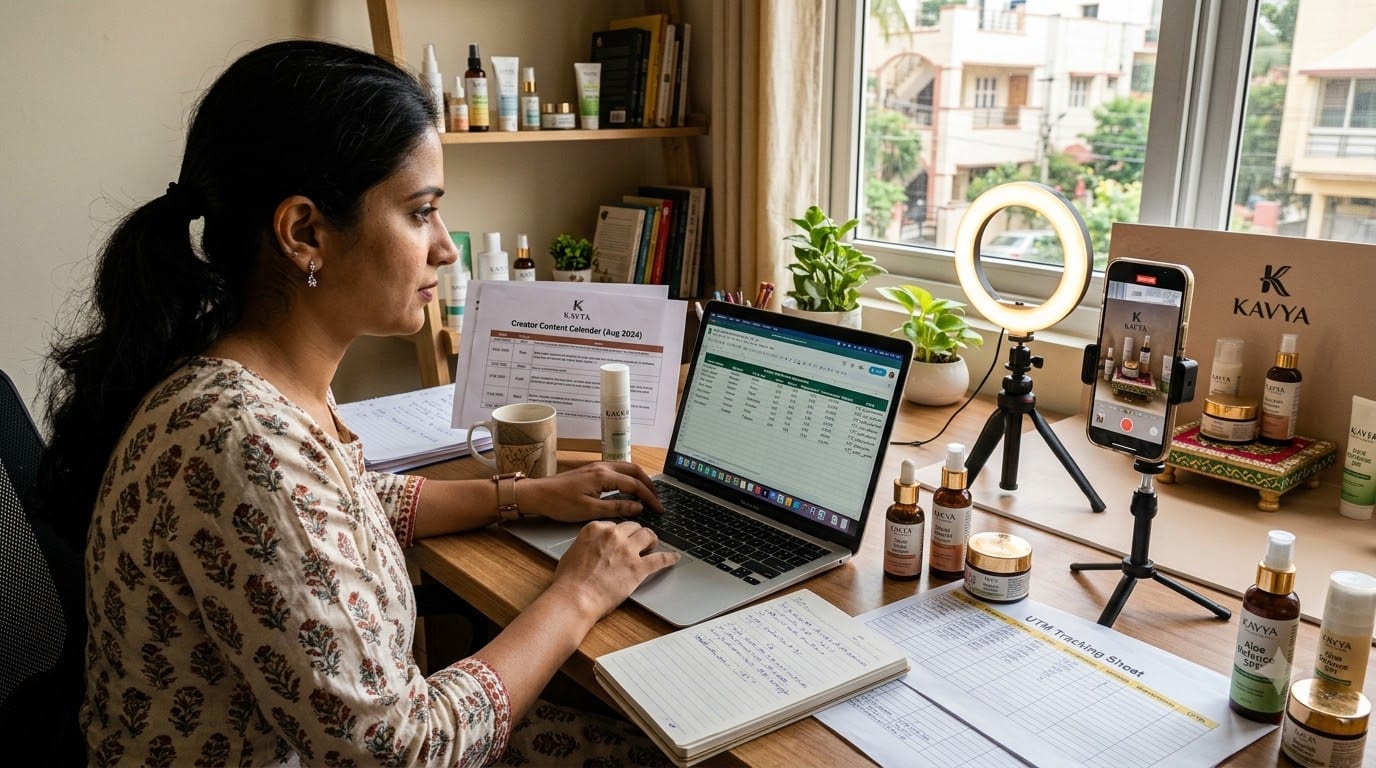
Useful formats include ingredient explainers, application videos, texture demonstrations, founder-led education, testimonials, routine guides, FAQs, and honest usage journeys.
As the brand grows, creator partnerships should become more structured.
Select creators based on:
- Audience relevance
- Content quality
- Trust and engagement
- Previous collaboration results
- Conversion potential
- Cost per deliverable
Create a clear workflow:
- Discover and shortlist creators.
- Review their audience and content.
- Share a brief and deliverables.
- Allocate products.
- Track content submission.
- Approve or request changes.
- Use tracking links or codes.
- Review conversions and commissions.
Zopkit’s Affiliate and Influencer Management capabilities can support creator campaigns, product promotion, tracking links, attribution, deliverables, commission rules, and payout management. This becomes useful when influencer marketing turns into a regular acquisition channel rather than occasional collaboration.
Judge campaigns on more than views. Track clicks, orders, new customers, repeat purchases, commission cost, sample cost, and reusable content.
5. Expand Across Channels Carefully
A D2C brand may begin with its website and social media before considering marketplaces, quick commerce, pharmacies, salons, beauty stores, or physical retail.
Each channel has a different role:
Channel | Main opportunity |
|---|---|
Own website | Education, first-party data, bundles, subscriptions, retention |
Marketplaces | Search discovery, reviews, and existing customer traffic |
Social commerce | Community, creators, demonstrations, and direct conversations |
Quick commerce | Fast replenishment and high-frequency products |
Offline retail | Trial, consultation, and physical trust-building |
Do not enter every channel at the same time. Evaluate:
- Product suitability
- Margin after fees and discounts
- Fulfillment capability
- Inventory requirements
- Reporting access
- Customer behavior
- Operational complexity
Protect your pricing architecture across channels. Excessive discounting on marketplaces can train customers to wait for offers and weaken your owned-channel business.
Maintain one central view of:
- Product catalog
- Pricing
- Promotions
- Inventory
- Orders
- Returns
- Channel profitability
The objective is not simply to be present everywhere. It is to create a consistent experience wherever customers discover and purchase the product.
6. Strengthen Inventory, Supply Chain, and Fulfillment
Scaling demand without strengthening supply can damage a skincare brand quickly.
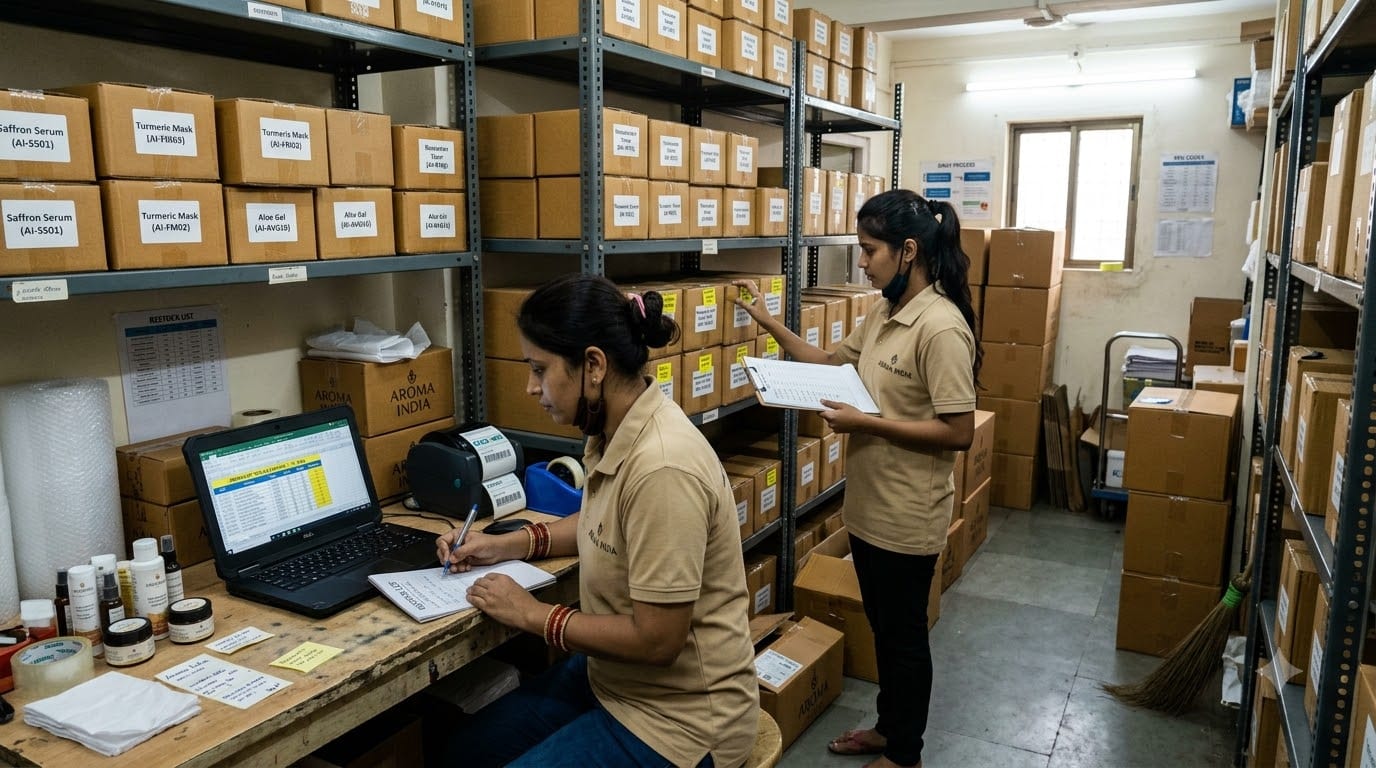
You need visibility into:
- Raw materials
- Packaging components
- Finished products
- Batches and expiry
- Stock by warehouse and channel
- Production lead times
- Purchase order status
- Vendor performance
Create rules for:
- Minimum stock
- Reorder points
- Safety stock
- Maximum stock
- Campaign reserves
- Slow-moving inventory
- Expiry-risk inventory
Before launching a major campaign, confirm product availability, packaging stock, dispatch capacity, customer support readiness, replacement stock, and replenishment time.
Track fulfillment metrics such as:
- Order processing time
- Dispatch time
- Delivery success rate
- Return rate
- Replacement rate
- Stockout rate
- Fulfillment cost per order
A strong marketing campaign can expose weak operations very quickly. If customers cannot receive the product on time, the campaign may increase complaints instead of loyalty.
Zopkit Finance can help connect purchase orders, vendor bills, payments, and business expenses, while Zopkit Project Management can coordinate restocks, packaging changes, campaign preparation, and fulfillment tasks.
7. Protect Margins and Cash Flow
Scaling revenue does not always mean scaling profit.
Review the full cost of every order:
- Manufacturing
- Packaging
- Warehousing
- Shipping
- Payment gateway fees
- Advertising
- Influencer commissions
- Discounts
- Samples
- Returns and replacements
- Customer support
Track:
- Revenue per order
- Gross margin
- Contribution margin
- Customer acquisition cost
- Customer lifetime value
- Average order value
- Repeat revenue
- Refund and replacement cost
A product can appear profitable before marketing and shipping, then become unprofitable after discounts, commissions, and returns.
Create controls for campaign budgets, purchase approvals, discount limits, creator payments, vendor schedules, refunds, and inventory purchases.
Run a monthly finance review covering:
- Profit and loss
- Cash position
- Vendor dues
- Inventory value
- Marketing spend
- Budget versus actual
- Upcoming production needs
Zopkit Finance supports invoicing, vendor bills, purchase orders, payments, cash-flow visibility, budgeting, profitability, and financial reporting, helping founders evaluate whether growth is creating healthy cash generation.
8. Build a Team-Led Operating Structure
A founder can manage a small skincare business personally, but scaling requires delegation.
As the business grows, create clear ownership for:
- Product development
- Quality and compliance
- Supply chain
- Marketing and content
- Creator partnerships
- Customer support
- Finance
- Fulfillment
- Human resources
Define who approves products, confirms stock, manages creators, handles complaints, approves discounts, reviews performance, and trains new employees.
Use simple operating rhythms:
- Daily dispatch review
- Weekly campaign review
- Weekly inventory review
- Monthly finance review
- Monthly customer feedback review
- Quarterly product review
Zopkit HRMS can help organize employee records, onboarding, attendance, payroll, and role information. Zopkit Academy can support training on product knowledge, customer support, usage guidance, internal SOPs, and complaint handling.
The goal is to make responsibility visible so the founder is not the only person holding the business together.
9. How Zopkit Supports D2C Scale
A scaling D2C skincare business has connected needs across customers, money, campaigns, creators, people, and training.
Zopkit CRM
Use CRM for customer profiles, purchase history, skin concerns, product preferences, repeat-purchase segments, follow-ups, campaign responses, and customer support records.
Zopkit Finance
Use Finance for invoices, vendor bills, purchase orders, payments, collections, budgets, cash flow, profitability, and tax workflows where applicable.
Zopkit Project Management
Use Project Management for new product launches, packaging changes, product shoots, creator campaigns, marketplace onboarding, seasonal promotions, restocking, and website updates.
Affiliate and Influencer Management
Use it for creator discovery, campaign briefs, tracking links, attribution, deliverables, commissions, payouts, and campaign reporting.
Zopkit HRMS
Use HRMS for employee records, onboarding, attendance, payroll, roles, and team documentation.
Zopkit Academy
Use Academy for product training, ingredient education, customer-support scripts, complaint handling, internal SOPs, and new-hire onboarding.
Together, these modules help connect the work that is often scattered across separate tools. The brand can manage customers, money, campaigns, creators, employees, and training through a more organized operating backbone.
Explore more at zopkit.com.
10. Build a Phased Scaling Roadmap
Do not attempt every form of expansion at once.
Phase 1: Stabilize the core
Focus on hero products, reliable manufacturing, repeat purchases, healthy margins, and consistent fulfillment.
Phase 2: Strengthen owned channels
Improve website conversion, customer education, email and WhatsApp retention, reviews, bundles, and subscriptions.
Phase 3: Scale creators and paid acquisition
Build repeatable creator campaigns, affiliate tracking, controlled advertising, and clear campaign profitability.
Phase 4: Expand the product system
Launch products connected to proven customer needs, create routines, develop bundles, and improve customer lifetime value.
Phase 5: Add selective channels
Test marketplaces, quick commerce, retail partnerships, pop-ups, and offline pilots with channel-level profitability tracking.
Phase 6: Build the brand operating system
Standardize roles, reporting, finance, training, projects, customer data, inventory, and launch processes.
The right time to move to the next phase is when the previous phase is stable and repeatable.
Conclusion and CTA
Scaling a D2C skincare or cosmetics business in India is not about chasing every new channel or launching products without a plan. It is about building a business that can handle more demand without losing trust, margin, product quality, or operational control.
The strongest brands connect marketing with inventory, customer acquisition with retention, creator campaigns with attribution, and revenue with profitability.
Zopkit supports this transition through CRM, Finance, Project Management, Affiliate and Influencer Management, HRMS, and Academy. These modules help a growing skincare brand organize customers, money, campaigns, creators, employees, and training as the business moves from early traction to structured scale.
If your D2C skincare/cosmetics business is ready for the next stage, explore how Zopkit can support your growth at zopkit.com.