How to Scale a Pet Supplies/Pet Care Store in India

Scaling a pet supplies or pet care store in India is not just about opening more outlets or listing more products online. It means turning a working shop into a repeatable, multi‑location and multi‑channel business with structured categories, predictable demand, disciplined inventory and cash flow, stronger service offerings, and a team and systems that can handle growth without collapsing under pressure.
If you are still choosing your store model, researching your local pet market, arranging registrations and licences, planning investment, and setting up suppliers, start with the “How to Start” guide first. If you are still fixing product mix, merchandising, average bill value, customer relationships, and basic operations, use the “How to Grow” guide before thinking about scale.
Related Guide:
How to Start a Pet Supplies/Pet Care Store in India
Use that guide to understand:
- Store models and product mix
- Local market and customer research
- Location, rental, and store layout
- Business registration, licences, and compliance
- Startup investment and working capital
- Supplier and service planning
- Basic inventory, pricing, and billing setup

Related Guide:
How to Grow a Pet Supplies/Pet Care Store in India
Use that guide to understand:
- Store performance and product mix
- Average bill value and logical bundles
- Customer relationships and loyalty basics
- Services and community footfall
- Merchandising and in‑store experience
- Early online and convenience layers
- Supplier, inventory, and cash flow tightening
- Team roles and routines
Scaling starts where growth leaves off. Once you have a stable, reasonably profitable shop with repeat customers and known demand patterns, you can think about multiplying that model.
This guide explains how to move from a single, growing pet supplies/pet care store to a more structured, multi‑location and multi‑channel business.
Table of Contents
- Confirm that the core store is ready for scale
- Standardize the customer and store experience
- Build a scalable catalog and category structure
- Centralize inventory, suppliers, and data
- Design a repeatable seasonal and service playbook
- Expand into institutional, bulk, and B2B sales
- Develop online and omnichannel presence at scale
- Strengthen loyalty, referrals, and community
- Protect margins, cash flow, and brand risk
- Use Zopkit and a Retail ERP backbone to manage scale
- Confirm That the Core Store Is Ready for Scale
Scaling multiplies whatever your current store is. If the base is weak, scale just spreads problems.
Check whether your existing store has:
- Consistent monthly sales across key categories (food, essentials, grooming, health, toys)
- Recognizable demand patterns (festivals, vacations, local events)
- Reasonable gross margins and manageable expenses
- Repeat customers and positive word of mouth
- Reliable suppliers and basic inventory accuracy
- Staff that can handle daily operations with simple supervision
Review:
- Category‑wise sales and margins for at least six to twelve months
- Average bill value and units per bill
- Stock ageing, focusing on very slow‑moving products and lines
- Return and complaint reasons (wrong product, quality issues, service gaps)
- Cash flow cycles: when money comes in from customers and goes out to suppliers and rent
If the store still struggles with basic tracking, frequent stockouts of essentials, heavy dead stock, or chaotic daily routines, focus on growth and stabilization before scale. Scaling should extend a working pattern, not multiply chaos.

2. Standardize the Customer and Store Experience
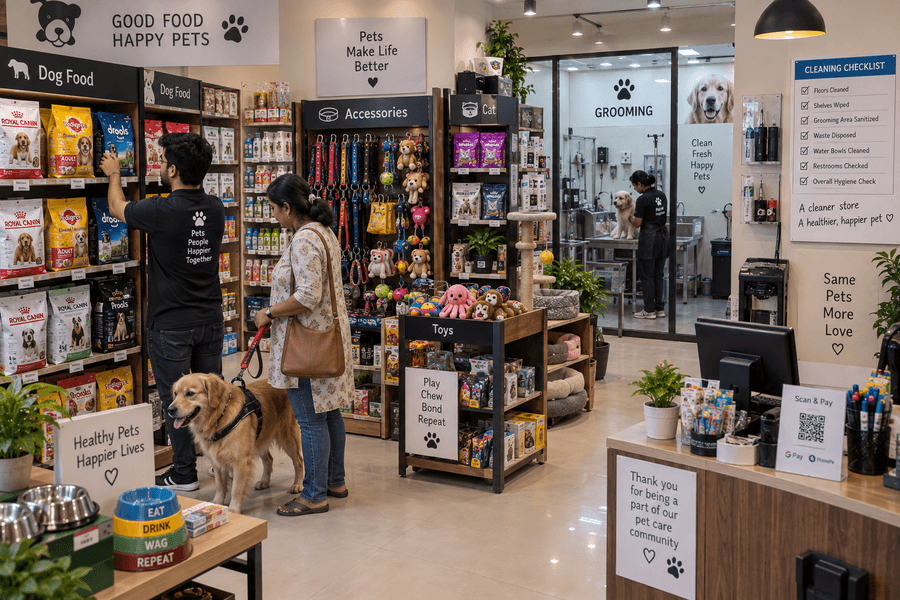
A scalable pet supplies or pet care business needs a consistent experience, whether a customer walks into your first shop, your third shop, or interacts online.
Standardize:
- Section naming and layout: food, treats, toys, accessories, grooming, health, essentials
- Shelf labeling and signage style
- How staff greet customers and ask about their pets
- How special orders and home deliveries are handled
- How billing, packing, and receipts are presented
- How returns and small complaints are dealt with within policy
Document simple scripts and behaviours:
- Asking “What pet do you have, and what is the main need today?”
- Suggesting logical add‑ons (bowls, leashes, grooming products) without being pushy
- Noting special requests, repeated questions, and patterns
Aim for:
- Familiar layout and feel across outlets
- Predictable service even when different staff are on duty
- Clear rules on discounts, returns, and special orders
Once the experience is standardized, you can train new staff and open new locations without reinventing customer handling each time.
Zopkit Project Management can help you turn these experience pieces into tasks, checklists, and recurring reviews so they remain consistent over time.
3. Build a Scalable Catalog and Category Structure
Scaling is not just filling more shelves. It is about having a catalog that can be replicated, updated, and understood across outlets and channels.
Create a structured catalog:
- For products: brand, product name, category (food, treats, toys, accessories, grooming, health, essentials), pet type (dog, cat, bird, fish, small pet), size or variant, price band
- For services: grooming packages, training support, workshops, and any other offerings with clear scope and pricing
Define:
- Core assortments for different store types (pet dense residential, mixed use, service heavy)
- Seasonal assortments for festivals, summer, monsoon, winter care
- Optional assortments for local community interests and premium segments
Use this catalog to:
- Plan stock for each outlet based on catchment area and pet profile
- Replicate successful assortments when opening new shops
- Update items centrally when products change or discontinue
- Keep pricing aligned, with room for local offers where needed
A clear catalog structure makes it easier to manage multiple locations and online listings, and to train staff on what the store actually sells.
4. Centralize Inventory, Suppliers, and Data
As you add outlets or channels, you must know what stock is where, who supplied it, and how it is moving.
Build a central view of:
- Inventory by product code, location, and category
- Supplier‑wise purchase history and payment status
- Key brands and variants and where they are placed
- Essentials and health products levels per outlet
Separate stock into:
- Available stock ready for sale
- Reserved stock for confirmed orders or deliveries
- Returns awaiting assessment
- Damaged or obsolete stock
- Display or sample stock
Implement routines:
- Regular stock checks for high‑value or high‑velocity items
- Monthly ageing reviews for products to catch dead stock
- Central updates for product changes and replacements
- Basic alerts when key items fall below minimum thresholds
Controlled inventory makes it possible to promise availability, reroute stock between outlets when needed, and reduce wasteful purchases.
Zopkit Finance and CRM together can track suppliers, purchases, and stock‑related customer commitments so data lives in one connected spine instead of scattered registers.
5. Design a Repeatable Seasonal and Service Playbook
Much of a pet supplies or pet care business’s growth potential lies in repeating strong seasonal cycles and service packages year after year.
Create a “season and service” playbook for:
- Festive and seasonal drives: festival offers, summer care, monsoon care, winter care
- Grooming and health packages: standard, premium, and seasonal grooming plans, tick and flea prevention drives, dental care campaigns
- New pet parent programs: starter kits, basic guidance sessions, and follow‑up check‑ins
Each playbook should include:
- Forecasts based on previous years and local patterns
- Supplier ordering schedules and minimum stock levels
- Shelf and display plans inside the stores
- Communication plans to customers via messaging, social media, and in‑store signage
- Simplified billing, delivery, and post‑season clean‑up steps
With such playbooks, scaling means rolling out tested patterns in new areas or channels rather than improvising each time.
Zopkit Project Management can hold these playbooks as projects with tasks, dates, and responsibilities, making seasonal and service execution more reliable.
6. Expand Into Institutional, Bulk, and B2B Sales
Scaling is not only more walk‑in customers; it often includes deeper relationships with housing societies, shelters, vet clinics, and organizations.
For housing societies and communities:
- Build relationships with apartment associations and pet groups
- Offer to prepare society‑wide food and supply drives or group orders
- Create simple ordering and delivery processes for residents
- Manage timelines carefully so orders arrive when needed
For shelters and rescue groups:
- Understand their regular needs for food, bedding, and basic supplies
- Design standard support packs or donation structures
- Offer scheduled deliveries and simple billing where applicable
For vet clinics and groomers:
- Align on product recommendations and referrals
- Offer to stock specific brands or products they trust
- Keep records of past orders so reordering becomes painless
Institutional and bulk business can:
- Smooth revenue fluctuations across the year
- Improve stock planning through known lists and schedules
- Strengthen your brand as a reliable partner, not only a retail shop
Use Zopkit CRM to track institutional contacts, agreements, order history, and follow‑ups, and Zopkit Finance to manage invoices, payments, and credit limits systematically.
7. Develop Online and Omnichannel Presence at Scale
As you scale, a simple online or omnichannel layer can help both walk‑in customers and new buyers.
Build:
- A basic website or online catalog showcasing key categories, curated lists, and seasonal sets
- Clear channels for inquiry and ordering (phone, messaging, forms)
- Options for store pickup and local delivery where feasible
- Synchronization between in‑store stock and online availability as much as possible
Use online presence to:
- Share updated seasonal care tips and product recommendations
- Highlight grooming packages and service bookings
- Offer information about store events and community activities
- Allow regular customers to reorder standard items without visiting
If you expand to more outlets, ensure:
- The brand name, visual style, and messaging stay consistent
- Working hours, addresses, and contact details are clearly presented per outlet
- Online channels route customers correctly to their nearest or preferred store
Omnichannel scaling should feel like multiple doors into one coherent business, not a collection of disconnected experiments.
8. Strengthen Loyalty, Referrals, and Community
Scaling is easier when you carry forward a strong base of loyal customers and a clear community presence.
Formalize loyalty:
- Simple points or stamp‑based systems for regular purchases
- Occasional member‑only previews of new products or service packages
- Small seasonal benefits for long‑standing customers
Encourage referrals:
- Make it easy for customers to recommend your store to friends and colleagues
- Recognize and thank customers who consistently bring others in, in ways that fit your brand tone
Deepen community:
- Continue or expand workshops, care sessions, and pet meetups
- Collaborate with local vets, shelters, and pet groups for educational activities
- Use events to gather feedback on needs in new areas as you expand
Community and loyalty help maintain strength even when competition increases or new players arrive, making scaling less dependent on constant paid promotions.
Zopkit CRM can store loyalty data, referral notes, and community engagement history so you see patterns rather than isolated moments.
9. Protect Margins, Cash Flow, and Brand Risk
Growth without discipline can quickly damage profits and reputation.
Protect margins:
- Regularly review category‑wise margins and adjust buying or pricing where necessary
- Avoid blanket discount strategies that erode value; target specific clean‑up or promotional items
- Watch for slow‑moving stock that quietly eats profit through space and capital
Guard cash flow:
- Track receivables from institutional clients and ensure follow‑up on delayed payments
- Plan stock purchases ahead of major seasons with realistic budgets
- Maintain a buffer for unexpected shortfalls or opportunities
Manage brand risk:
- Ensure product quality and safety across outlets
- Keep service standards consistent, especially for grooming and health related offerings
- Apply consistent customer‑facing policies across locations so experiences feel fair and predictable
Scaling should make the business sturdier, not more fragile. Numbers and policies must be as strong as shelves and relationships.
Zopkit Finance provides the visibility and simple analysis you need to spot margin and cash flow issues early and take corrective action.
10. Use Zopkit and a Retail ERP Backbone to Manage Scale
Once you are operating across seasons, categories, institutions, outlets, and channels, a clear backbone becomes essential.
A practical backbone should connect:
- Product catalog and category structure
- Inventory across all shops and any warehousing
- Supplier data, purchase cycles, and payment status
- Customer profiles, segments, loyalty, and community relations
- Seasonal projects, service packages, and events
- Staff records, roles, attendance, and training status
- Core financial flows: sales, expenses, margins, and cash
Zopkit can be that backbone:
- Zopkit CRM keeps customer, pet, and community information structured and usable
- Zopkit Finance tracks invoices, supplier bills, expenses, cash flow, budgets, and profitability
- Zopkit Project Management organizes seasonal campaigns, store openings, catalog updates, and events
- Zopkit HRMS manages staff hierarchy, attendance, and payroll as you hire more people
- Zopkit Academy provides training content for store operations, customer service, and product and pet care basics
With systems like this, scaling becomes about repeating well‑understood patterns, not improvising under pressure.

Conclusion
Scaling a pet supplies or pet care business in India is not just about opening more shops or listing more items online. It is about confirming that your base store is healthy, standardizing service and layout, building a structured catalog, centralizing inventory and supplier data, designing seasonal and service playbooks, entering institutional and omnichannel spaces carefully, strengthening loyalty and community, and protecting margins and cash flow as volume increases.
When this expansion is supported by a connected backbone for customers, finance, projects, people, and training, the business becomes easier to multiply and sustain.
Zopkit supports this wider operating system through CRM, Finance, Project Management, HRMS, and Academy, helping pet supplies and pet care businesses manage customers, stock, suppliers, payments, staff, and learning as they scale.
Explore how Zopkit can support your pet supplies and pet care business at zopkit.com.