How to Scale a Jewellery Business in India
Starting a jewellery business in India is only the first step. Growing it into a scaled, multi-outlet, multi-channel brand is a different challenge altogether.
Jewellery retail in India has a few unique traits:
- High-value, slow-moving inventory (gold, diamond, gemstones).
- Deep local trust, family-led customer relationships, and design loyalty.
- Complex stock valuation (weight, purity, stones, making charges, live rates).
- Sensitivity to security, audit, and compliance.
Many jewellers reach a point where one or two stores are doing reasonably well, but the owner is still the “system”: they personally manage inventory decisions, key customers, karigar work, design approvals, staff issues, and cash flow. To scale beyond that, you need professionalized operations, centralized data, and repeatable processes, not just more outlets or more designs.
If you’re still focused on improving design mix, customer experience, local marketing, and store operations, refer to your “grow” guide before you think about expansion.
Related Guide:
How to Start a Jewellery Business in India
Use this guide to understand:
- Jewellery business models.
- Niche and customer selection.
- Registrations and hallmarking.
- Investment and working capital.
- Supplier selection.
- Inventory and security.
- Showroom and online setup.
Once the business is running, the next challenge is growth. Growing a jewellery business means improving product turnover, increasing average order value, building repeat customers, creating stronger collections, improving online and offline sales, controlling high-value inventory, and offering a better customer experience.
This guide explains how to move from a functioning jewellery business to a more profitable, trusted, and organized brand.

Related Guide:
How to Grow a Jewellery Business in India
Use that guide to understand:
- Store performance and product mix
- Gold, diamond, and design planning
- Local customer trust and loyalty
- Repairs, sizing, and made-to-order work
- Inventory discipline and valuation
- Cash-flow management and basic reporting
- Daily team workflows and store operations
Once you have a growing and somewhat stable jewellery store, the next question is how to scale without losing control or customer intimacy.
Scaling a jewellery business is not simply about opening more branches or adding more categories. It means building a repeatable retail and operations system that can manage inventory (metal, stones, designs), prices, tags, karigar work, repairs, staff, and customers across multiple stores and sales channels.
This guide explains how to move from a successful jewellery store to a more organized, multi-location, omni-channel, and system-driven jewellery business.
Table of Contents
- Confirm that the first store is ready
- Standardize the customer experience
- Build a profitable product and service mix
- Centralize inventory, tags, and valuation
- Create a stronger after-sales and customization system
- Connect online and offline jewellery sales
- Strengthen suppliers, margins, and cash flow
- Build a team-led management structure
- Use a Jewellery Retail ERP to manage scale
- Plan a phased expansion roadmap
1. Confirm That the First Store Is Ready
Opening another jewellery outlet before the first one is truly stable can multiply risks instead of profits.
Before expanding, check whether your first store has:
- Consistent monthly sales and footfall.
- Predictable cash flow and basic profit visibility.
- Clean stock records: tags, weights, purity, and stones are accurate.
- Controlled repair, resize, and custom-order processes.
- Stable repeat customers and families who trust your brand.
- Reliable suppliers for gold, stones, and finished jewellery.
- Trained sales staff and at least one senior person who can run daily operations without you on the floor all day.
Look beyond turnover:
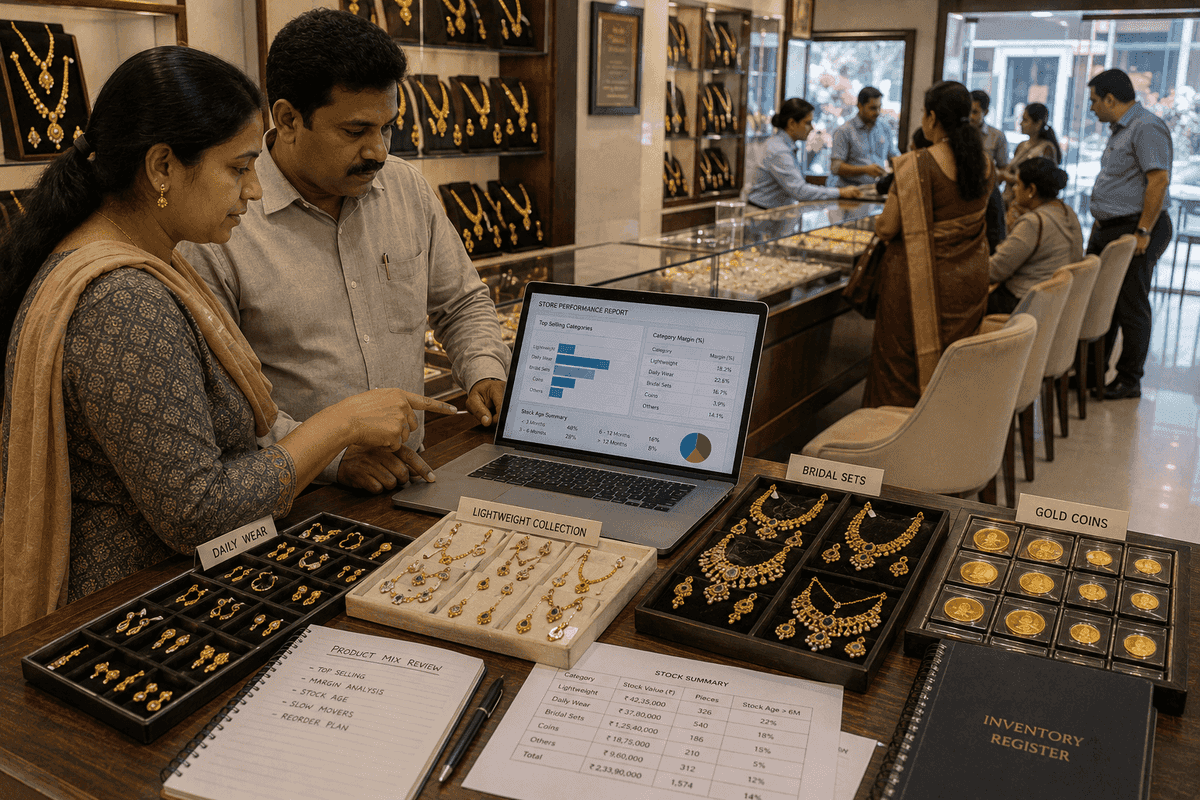
- Product mix (daily wear vs bridal vs investment pieces).
- Margin by category (plain gold vs diamond vs lightweight vs silver).
- Stock age and slow-moving designs.
- Repair and remake volumes.
- Karigar work timelines and quality.
- Customer complaints and remake disputes.
- Vendor dues and metal/stones payable.
- Cash vs digital vs credit sales.
If stock is not reconciled properly, tags are inconsistent, or customer complaints around design or weight are frequent, opening another store will extend those issues, not solve them.
You should scale a working model, not multiply unresolved problems.

2. Standardize the Customer Experience
Jewellery is emotional, high-value, and trust-heavy. A scaled jewellery brand needs a consistent customer experience, regardless of which outlet or salesperson the customer meets.
Document how staff should handle:
- Greeting and understanding occasion (wedding, festival, daily wear, investment).
- Style discovery (traditional, contemporary, temple, minimalist, etc.).
- Budget and metal preference (gold, diamond, platinum, silver).
- Design and size discussions.
- Explaining weight, purity, making charges, and certification.
- Showing comparable designs and explaining differences.
- Custom-order and remake handling.
- Billing, tag check, and hallmark/certificate handover.
- Complaint escalation (loose stones, fitting issues, polishing, etc.).
Train staff to ask:
- Is this for a specific occasion or everyday wear?
- What metal and colour does the customer prefer?
- Is design or budget more flexible?
- Do they want more investment-focused or design-focused pieces?
- Are they open to custom-making or remakes?
Standardize:
- Price and component explanation (metal, stones, making, taxes).
- Discount and negotiation rules.
- Exchange and old-gold policies.
- Custom-order timelines and communication.
- Certificate and hallmark explanation.
- Opening and closing routines: cleaning, security, safe-locking, case checks.
Customers should feel the same clarity and respect whether they speak to the owner or a new salesperson.
You can use Zopkit Project Management to document and track SOPs, seasonal collections, visual merchandising, and service workflows, so the way you handle customers becomes a living system instead of unwritten habits.
3. Build a Profitable Product and Service Mix
Jewellery stores need a balanced range of products and services that support both turnover and margins.
Think of your range as:
- Daily wear: Chains, studs, small rings, office-friendly pieces.
- Occasion wear: Bridal sets, heavy necklaces, bangles, temple jewellery.
- Investment pieces: Coins, bars, simple high-purity items.
- Lifestyle and fashion: Lightweight designs, silver, and contemporary pieces.
- Add-on items: Nose pins, lockets, sliders, charms.
Think by role:
- Traffic designs: Popular pieces that attract regular walk-ins.
- High-margin pieces: Design-intensive items with better making margins.
- Brand-signature pieces: Unique designs that define your style.
- Repeat items: Gift and everyday pieces that customers buy multiple times.
- Service work: Repairs, resizing, polishing, remakes, custom orders.
Do not push inappropriate pieces just because they have high margin. Honest recommendations and realistic explanations of weight and design increase trust and repeat business.
Regularly review:
- Top-selling categories and price points.
- Designs that rarely move and require remake or melting.
- Stones and metal that sit too long in stock.
- Services that generate good satisfaction and margin (repairs, custom pieces).
4. Centralize Inventory, Tags, and Valuation
Jewellery inventory is high-value and complex. Scaling with weak stock discipline is dangerous.
You need centralized control over:
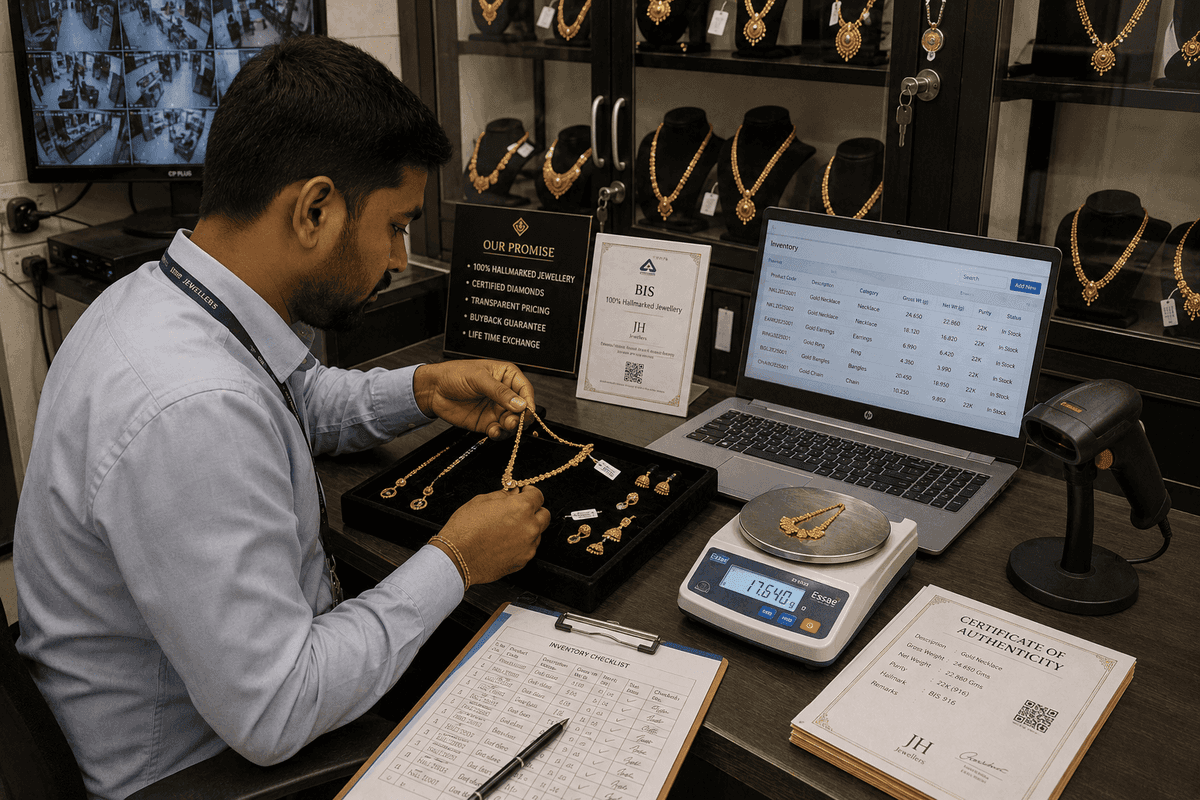
- Tags and SKUs: Each piece tagged with category, metal, purity, weight, stones, making, design ID, and price.
- Weight and purity: Gross weight and fine weight views, hallmarked items, and purity equivalents (22K, 18K, etc.).
- Stone data: Carat, clarity, cut, colour, certification, and status (mounted vs loose).
- Process flows: Receive (weigh, assay, tag, post), transfer (branch/vault), issue to karigar, sell, exchange/melt, reconcile.
Implement:
- Central product and tag catalog.
- Branch and vault stock mapped separately.
- Documented transfer vouchers, not just chat messages.
- Regular stock audits focusing on high-value categories first.
- Secure storage practices (safes, lockable displays, role-based access).
Centralized inventory helps you see:
- Which designs and categories sell best by outlet.
- Where stock is ageing and needs attention.
- Which branch should receive which new collection.
- Which pieces to remake, melt, or push via promotion.
You can start small:
- Tag discipline and POS integration at one location.
- Add branch transfers and vault stock later.
- Bring karigar issue–receipt flows onto the system.
5. Create a Stronger After-Sales and Customization System
Jewellery customers often need:
- Resizing and minor adjustments.
- Polishing and re-plating.
- Repairs (loose stones, broken parts).
- Custom pieces and remakes.
- Old gold exchange and redesign.
At scale, these services become part of your brand promise, not just back-room tasks.
Build a simple service workflow:
- Capture customer and piece details (tag, weight, stones, photographs).
- Record the issue or request clearly.
- Estimate time and cost; explain limitations honestly.
- Assign work to the relevant karigar or service partner.
- Track status and updates.
- Inform the customer when ready, and document the outcome.
Maintain:
- Service history per customer.
- Karigar performance and quality.
- Typical timelines per service type.
This reduces disputes and strengthens trust.
Zopkit CRM can store service and repair history, and Zopkit Project Management can track custom orders and karigar workflows, so after-sales and customization are not just “remembered” work but structured processes.
6. Connect Online and Offline Jewellery Sales
Jewellery customers today often browse online, shortlist designs, and then visit stores to see and feel pieces before buying—or they may order certain categories directly online.
Connect:
- Website or online catalog (with clear photos and basic specs).
- Instagram and other social platforms for showcasing designs.
- WhatsApp Business for enquiries and shortlists.
- Google Business for location, reviews, and directions.
- Physical stores and showrooms.
Keep consistency across channels:
- Design details (metal, purity, stones, weight ranges).
- Certification and hallmark information.
- Price logic and offer structure.
- Availability by store or central stock.
- Appointment and viewing options.
You can introduce:
- Online appointment booking and design shortlist.
- “View in store” or “Reserve and visit” flows.
- WhatsApp catalog sharing for existing customers.
- Certain categories (coins, small gifts) available for direct online purchase with pickup or delivery.
Omni-channel jewellery retail is not just about being online and offline. It is about interconnected touchpoints and unified data.
7. Strengthen Suppliers, Margins, and Cash Flow
Jewellery scaling demands refined control over:
- Metal suppliers and bullion buying.
- Stone and design suppliers.
- Karigar network and manufacturing costs.
- Cash flow, credit, and working capital.
Evaluate partners on:
- Reliability and purity.
- Rate competitiveness and credit terms.
- Design strength and differentiation.
- Speed and consistency of work.
Use:
- Structured purchase planning based on sales, stock age, and design gaps.
- Clear karigar issue–receipt records for metal and stones.
- Visibility into how much working capital is locked in stock, work-in-progress, and receivables.
Jewellery inventory is a real asset, but uncontrolled expansion of stock can strain cash flow. Zopkit Finance can help you track bills, receipts, expenses, and profitability so you scale with unit economics in mind, not just store count.
8. Build a Team-Led Management Structure
Scaling a jewellery business requires moving from purely family-led to professionally managed operations while preserving your design strength and customer intimacy.
Assign ownership for:
- Sales performance and customer experience.
- Visual merchandising and display.
- Stock receiving, tagging, and audits.
- Karigar coordination and WIP control.
- Repairs, remakes, and complaints.
- Marketing and omni-channel content.
Train the team on:
- Transparent explanation of weight, purity, and making charges.
- Ethical selling and realistic expectations for custom work.
- Handling high-value pieces securely.
- Using systems (POS, CRM, ERP) correctly and consistently.
Use weekly or fortnightly reviews to discuss:
- Store-wise and staff-wise sales.
- Category performance and slow stock.
- Service and complaint patterns.
- Operational issues and improvements.
Zopkit HRMS can manage employee records, attendance, shifts, payroll, roles, and onboarding, while Zopkit Academy can host product knowledge, service processes, and brand training content, so the business runs on more than just oral tradition.
9. Use a Jewellery Retail ERP to Manage Scale
As you add stores, categories, and channels, separate tools for billing, tags, karigars, customers, and finance quickly become limiting.
A Jewellery Retail ERP should connect:
- POS and billing.
- Product catalog and tag-level data.
- Metal and stone inventory, with purity and weight.
- Branch and vault stock.
- Karigar issue–receipt and WIP.
- Repairs, remakes, and service cases.
- Customer profiles, visits, and purchase history.
- Multi-store reporting and dashboards.
Zopkit can support the broader business structure through:
- Zopkit CRM: Customers, occasions, purchases, repairs, and campaigns.
- Zopkit Finance: Bills, payments, expenses, cash flow, budgets, and profit visibility.
- Zopkit Project Management: Collection launches, promotions, store setups, karigar workflows, and expansion projects.
- Zopkit HRMS: Employee records, attendance, payroll, roles, and onboarding.
- Zopkit Academy: Design knowledge, sales training, stock procedures, and customer service modules.
The aim is to have one operating view of your jewellery business, from design and stock to sales, service, and brand growth.
10. Plan a Phased Expansion Roadmap
Scaling should follow operational readiness and brand clarity, not just an available showroom.
A simple roadmap:
Phase 1 – Strengthen the first store
Clean up inventory, tags, valuation, customer experience, and cash flow.
Phase 2 – Deepen services and trust
Standardize repairs, remakes, custom orders, and complaint handling.
Phase 3 – Build omni-channel visibility
Launch or refine your website/catalog, social presence, and online enquiries tied to store processes.
Phase 4 – Test new categories and formats
Add lighter designs, silver lines, or specific collections based on data, not just trends.
Phase 5 – Open another outlet
Choose locations based on existing customer clusters, delivery patterns, and competition—not only rent deals.
Phase 6 – Build a recognizable jewellery brand
Standardize store look, collection logic, pricing discipline, training, service standards, and reporting across locations.
Each phase should tighten systems and data rather than simply increase store count.

Conclusion
Scaling a jewellery business in India is not just about opening more outlets or adding more designs. It is about building a complete, repeatable system around each piece and each customer—covering design selection, transparent pricing, secure inventory, careful service, and long-term relationships.
The business becomes easier to scale when metal and stone inventory, tags and valuation, karigar work, customers, services, staff, payments, and campaigns are connected through clear processes and a shared operating backbone.
Zopkit supports this backbone through CRM, Finance, Project Management, HRMS, and Academy, helping jewellery retailers manage customers, payments, projects, staff, and training as the business expands.
Explore how Zopkit can support your jewellery business at zopkit.com.