How to Grow a Food Truck Business in India

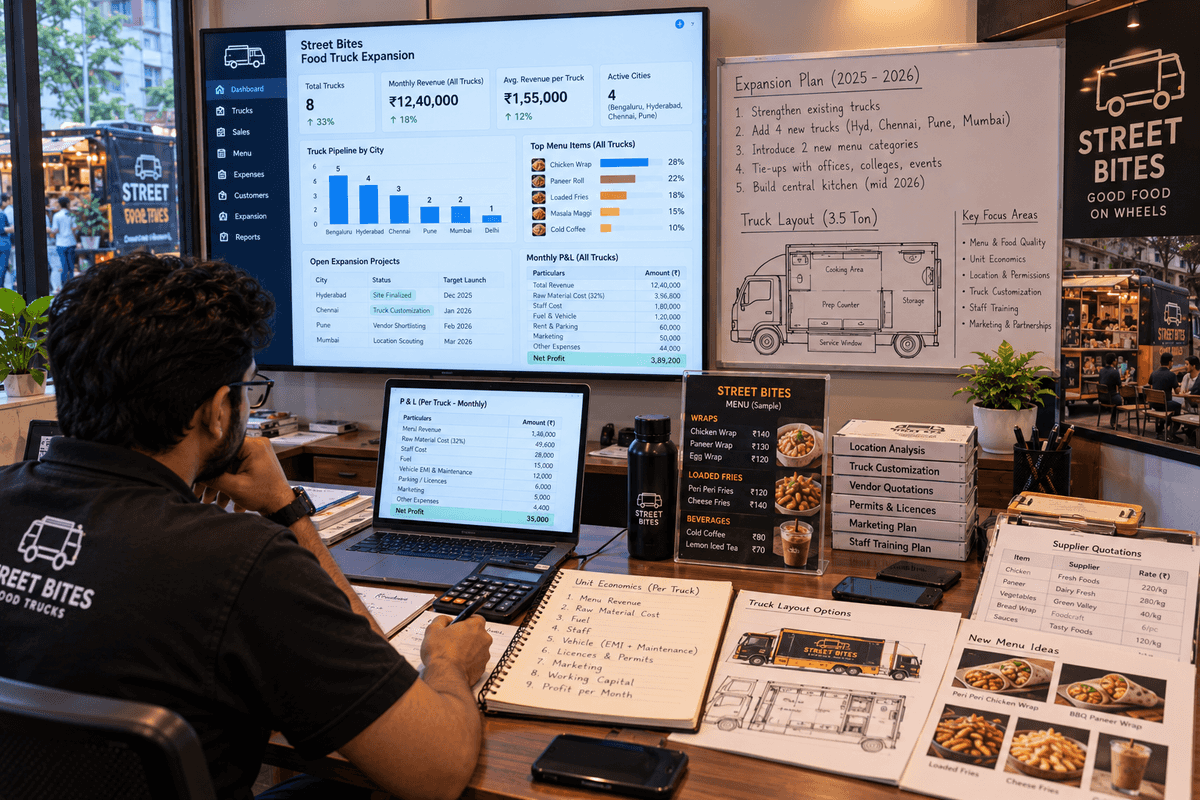
Growing a food truck business in India is not just about adding more locations or running more discounts. It means improving unit economics per truck, optimizing your menu and throughput, building strong repeat customer relationships, using social media and events intelligently, controlling food and logistics cost, and organizing people and processes so each truck can run smoothly without the founder handling every detail.
If you are still choosing your concept, researching your target audience and locations, arranging registrations and licences, planning investment, and setting up your first truck, start with the “How to Start a Food Truck Business in India” guide first.
Related Guide:
How to Start a Food Truck Business in India
Use that guide to understand:
- Business models and formats (single cuisine, multi cuisine, specialty, tiffin, events)
- Market and customer research
- Vehicle and location strategy
- Business registration, licences, and compliance
- Investment and unit economics
- Menu, truck kitchen, and supply basics
- Core team structure and systems
Once the food truck is launched and at least getting some steady orders and footfall, the next challenge is growth. Growing a food truck business is not only about “more customers”. It is about making existing operations healthier and more repeatable, then scaling what works.
This guide explains how to move from a functional food truck to a stronger, more profitable, and more organized business.
Table of Contents
- Understand your current truck performance
- Sharpen your menu and truck throughput
- Increase average order value and truck revenue
- Strengthen customer loyalty and repeat visits
- Build stronger social media, events, and local presence
- Tighten supply, food cost, and logistics
- Improve truck operations and SOPs
- Grow your team and training structure
- Use Zopkit and systems to manage growth
- Prepare for controlled expansion
1. Understand Your Current Truck Performance
Before pushing for growth, you need a clear view of where the truck stands today.
Look at your food truck:
- Sales per day, week, and month
- Average order value, walk-up and delivery
- Orders per day by channel (walk-up, delivery apps, own online)
- Peak hours and day parts (breakfast, lunch, evening, late night)
- Food and packaging cost percentage and gross margin
- Labour, fuel, and location cost as a percentage of sales
- Popular items and slow movers
- Customer reviews, ratings, and complaint patterns
Build a simple dashboard of core metrics:
- Revenue
- Contribution margin (after food and packaging)
- Prime cost (food plus labour plus fuel and location)
- Truck level profitability
- Cancellation, refund, and complaint rates
- Average preparation and service time
Identify:
- Which day parts and categories drive most profit
- Menu items that truly contribute versus those that just add complexity
- Cost leakages, wastage, or process gaps
- Whether growth should focus on more footfall, higher AOV, or better margins
Growth becomes more predictable when you know which levers move your numbers.
2. Sharpen Your Menu and Truck Throughput
Food trucks grow faster when each truck can serve more customers per hour without compromising quality.
Work on your menu:
- Keep it focused around high demand, high contribution items
- Remove or reduce attention on very slow moving or operationally complex items
- Group items into clear categories and combos that are easy to understand
- Allow for some daily specials or limited-time offers without overcomplicating operations
Optimize throughput:
- Simplify preparation steps for core items
- Use pre-prep and mise-en-place for peak hours
- Organize the truck kitchen so each station does specific tasks efficiently
- Limit excessive customization that slows down operations
Aim for:
- Fewer, better SKUs that stay consistent
- A menu structure that supports fast counter service and delivery
- Predictable preparation times so service speed can improve
When each truck can reliably push more orders per hour with a tight, profitable menu, growth becomes much easier.
3. Increase Average Order Value and Truck Revenue
One powerful way to grow revenue without adding new trucks is to increase average order value and daily orders at existing trucks.
Use menu engineering:
- Highlight star items (high demand, high margin) on menus and boards
- Structure combos and meal deals (main plus side plus drink) that feel like good value
- Place strategic “decoy” premium items to make your target items feel reasonably priced
- Offer add-ons (extra toppings, sides, sauces, desserts) in a clear, simple way
At the truck:
- Train staff to suggest logical upsells, like adding a side or beverage to a main
- Keep visible displays of sides, desserts, or small add-ons near the ordering window
- Create time-bound offers around slower day parts, such as mid-afternoon or late evening
For delivery:
- Design special delivery-only combos and family packs
- Use in-app messaging to promote bundles during peak ordering times
- Offer add-ons at the checkout stage (desserts, beverages, extras)
The goal is not to push random items, but to help customers build satisfying, complete meals while increasing revenue per order.
4. Strengthen Customer Loyalty and Repeat Visits
Food trucks that grow sustainably focus on repeat customers, not just new ones.
Build simple loyalty structures:
- Points or stamp-based programs where customers earn rewards on repeat visits or orders
- Occasional free item or upgrade after a certain number of orders
- Special benefits for high frequency customers or members
Make loyalty easy to use:
- Mobile number-based or app-based identification, no complicated cards
- Clear explanation of how to earn and redeem rewards
- Visible progress indicators (how close the customer is to the next reward)
Improve retention:
- Offer consistent quality and service so customers trust the brand
- Collect feedback after visits and act on recurring issues
- Use occasional personalized offers (favourite item discount, birthday month treat)
Use WhatsApp and social media:
- Build a broadcast list of regulars to share daily location and specials
- Send occasional offers and reminders to your loyal customers
- Encourage customers to save your number and follow your social pages
Zopkit CRM can help you:
- Maintain customer profiles across channels
- Segment customers by frequency, spend, and preferences
- Run targeted campaigns without relying only on aggregators or memory
When loyalty and repeat behaviour improve, growth requires less ad spend and fewer discounts.
5. Build Stronger Social Media, Events, and Local Presence
For most food trucks, growth now comes from a mix of daily locations, events, and social media buzz.
Strengthen social media:
- Post daily location updates on Instagram, Facebook, and WhatsApp
- Share short videos of food being prepared and real customers enjoying meals
- Use stories and reels to highlight new items, limited-time offers, and behind-the-scenes
Use events strategically:
- Participate in local food festivals, flea markets, and weekend markets
- Host themed nights or pop-ups at your regular spots
- Partner with local brands, colleges, or communities for joint events
Optimize local presence:
- Keep your Google Business Profile updated with current locations and timings
- Use clear signage and QR codes on the truck that link to your location page or ordering link
- Encourage customers to leave Google reviews after visits
For delivery:
- Ensure menus on aggregators are clean, optimized, and aligned with your in-truck menu
- Use good packaging that keeps food safe, hot, and presentable
- Monitor preparation and dispatch times closely
Customers should feel they are engaging with one brand, whether they visit the truck, order online, or meet you at an event.

6. Tighten Supply, Food Cost, and Logistics
As the business grows, controlling food cost and logistics becomes critical.
Supply and procurement:
- Consolidate purchasing of common ingredients to negotiate better prices
- Maintain approved supplier lists and backup options for critical items
- Align order cycles and minimum stock levels with truck demand patterns
Food cost:
- Track actual versus theoretical food cost per truck
- Monitor wastage, spoilage, and portion control consistently
- Standardize portion sizes and train staff to use weighing or standard scoops where needed
- Review high variance trucks and investigate root causes
Logistics:
- Plan fuel, parking, and location costs carefully for each truck and route
- Ensure timely supply of raw materials to each truck
- Have backup plans for vehicle breakdowns or supply delays
Zopkit Finance and Project Management can support:
- Central tracking of purchase orders, supplier bills, and costs
- Projects for menu cost optimization and wastage reduction
- Truck-wise profitability analyses that highlight where food cost or supply is off track
Strong supply, cost, and logistics discipline keeps the business healthy as volumes increase.
7. Improve Truck Operations and SOPs
Growth is easier when every truck runs on clear, simple standard operating procedures (SOPs).
Core SOP areas:
- Opening and closing routines (kitchen prep, cleaning, cash handling, equipment checks)
- Order taking, preparation, and dispatch flows
- Food safety and hygiene routines (handwashing, temperature logs, storage rules)
- Cleaning schedules for kitchen, serving area, and truck exterior
- Handling complaints, refunds, and special cases
Make SOPs:
- Written and visually supported (charts, checklists, short videos)
- Easy to understand for new staff
- Embedded in daily and weekly routines, not just in a manual
Measure:
- Service times (order to ready, order to delivery)
- Errors (wrong orders, missing items, packaging issues)
- Hygiene scores from internal audits
Use Zopkit Project Management to create:
- Truck-level checklists and recurring tasks
- Audit and improvement projects
- Tracking of issues and resolution status
SOPs are the backbone that allows each truck to operate reliably, even when managers or staff change.
8. Grow Your Team and Training Structure
A growing food truck business must systematically develop its people, not just keep hiring reactively.
Define a people structure:
- Truck managers or shift supervisors
- Kitchen staff: cook, prep staff, helpers
- Front of house: cashiers, servers, runners
- Central roles: operations, supply, quality, HR, and training
Create clear role expectations:
- KPIs for truck managers (sales, food cost, labour cost, hygiene scores, complaints)
- Responsibilities for shift leads and senior kitchen staff
- Promotion paths from crew to supervisor to manager
Invest in training:
- Onboarding programs covering brand values, food safety, service basics, and core SOPs
- Role specific training for kitchen, service, and operations
- Continuous learning on new menu items, tech tools, and campaigns
Zopkit HRMS and Academy can:
- Maintain staff records, roles, and attendance
- Assign and track training modules for different teams
- Record completions and assessment outcomes
The more repeatable your training and people structure, the easier it becomes to grow without hitting a talent wall.
9. Use Zopkit and Systems to Manage Growth
As the business grows, disconnected tools and spreadsheets become a serious risk.
A practical backbone for a growing food truck business should connect:
- Menus, recipes, and product master data
- Truck-wise inventory and procurement
- Sales, bills, and cash/UPI/card settlements
- Customer profiles, feedback, and campaigns
- Projects such as menu changes, truck upgrades, and new launches
- Staff records, roles, attendance, and training
- Financials: P and L, cash flow, and key ratios
Zopkit can support this backbone through:
- Zopkit CRM to organize customer data, feedback, and loyalty campaigns
- Zopkit Finance to track supplier bills, expenses, cash flow, and truck level profitability
- Zopkit Project Management to coordinate menu updates, truck upgrades, and seasonal campaigns
- Zopkit HRMS to manage staff across trucks, including attendance, shifts, and payroll
- Zopkit Academy to host training content and track completion for all roles
Using Zopkit as the operating spine makes growth less about constant firefighting and more about executing a series of well-tracked initiatives.

10 . Prepare for Controlled Expansion
Once unit economics are healthy and systems are in place, you can think about adding more trucks or formats.
Before expanding:
- Ensure your best trucks are consistently profitable
- Confirm that SOPs, menu, and supply systems are documented and working
- Make sure your core team can manage more than the current number of trucks
- Check that your tech and reporting can support additional trucks
Expansion options:
- New trucks in similar micro markets where your model already works
- New formats, such as tiffin service, cloud kitchen tie-ups, or event-only trucks
- Franchise partners in cities or regions where direct management is harder
- New cities once you have a strong base in your initial city or region
Expand in phases:
- Phase 1: Strengthen existing trucks and fix weak ones
- Phase 2: Add a small number of new trucks in known markets
- Phase 3: Explore new cities or formats once your team and systems are ready
- Phase 4: Consider franchise models or strategic partnerships if they fit your brand
Use Zopkit Project Management and Finance to:
- Plan expansion budgets and timelines
- Track new truck opening tasks and dependencies
- Monitor performance of new trucks against targets from day one
Controlled expansion makes it more likely that growth will stick instead of creating fragile, overextended operations.
Conclusion
Growing a food truck business in India is not just about more trucks or more discounts. It is about improving unit economics at existing trucks, sharpening menus and throughput, increasing average order value, building loyalty and repeat visits, balancing daily locations, events, and delivery, tightening supply, food cost, and logistics, strengthening truck operations and SOPs, and building a team and system structure that can handle more trucks with less chaos.
When these pieces are supported by a backbone for customers, finance, projects, people, and training, the business becomes easier to grow and safer to manage.
Zopkit supports this wider operating system through CRM, Finance, Project Management, HRMS, and Academy, helping food truck businesses manage customers, stock, suppliers, payments, staff, and learning as they grow.
Explore how Zopkit can support your food truck business at zopkit.com.