Zopkit Group Operating System: One Data Layer for Sales, Projects, Finance, and HRMS
Ask your VP Sales how many units are available for sale across all projects today. Ask your CFO what the total overdue collections position is across the portfolio. Ask your Head of Projects which construction milestones are due in the next 45 days and how many demand letters those milestones will trigger. Ask your CHRO what the total payroll cost for the sales force was last month including incentives, site allowances, and statutory deductions across all locations.
Each of these answers currently lives in a different system. Some of them live in a spreadsheet. Some of them are correct. Some of them are correct as of last Tuesday when someone last updated the file.
This is not a problem of intent. The people running your systems are capable and diligent. It is a problem of architecture. A large real estate group operating at 200 or more people across 10 to 15 active projects, with 150 to 300 channel partners, 800 to 2000 active buyer payment schedules, and a workforce distributed across corporate offices, city sales offices, and construction sites has outgrown the category of tools it grew up on. The CRM that worked at 80 people does not produce portfolio-level intelligence at 250. The Tally instance that worked for one project's books does not handle 12 project cost centres with milestone-linked demand letter generation. The payroll process that worked when HR was one person does not handle multi-state professional tax, BOCW cess, and incentive computation from live CRM data at 300 employees.
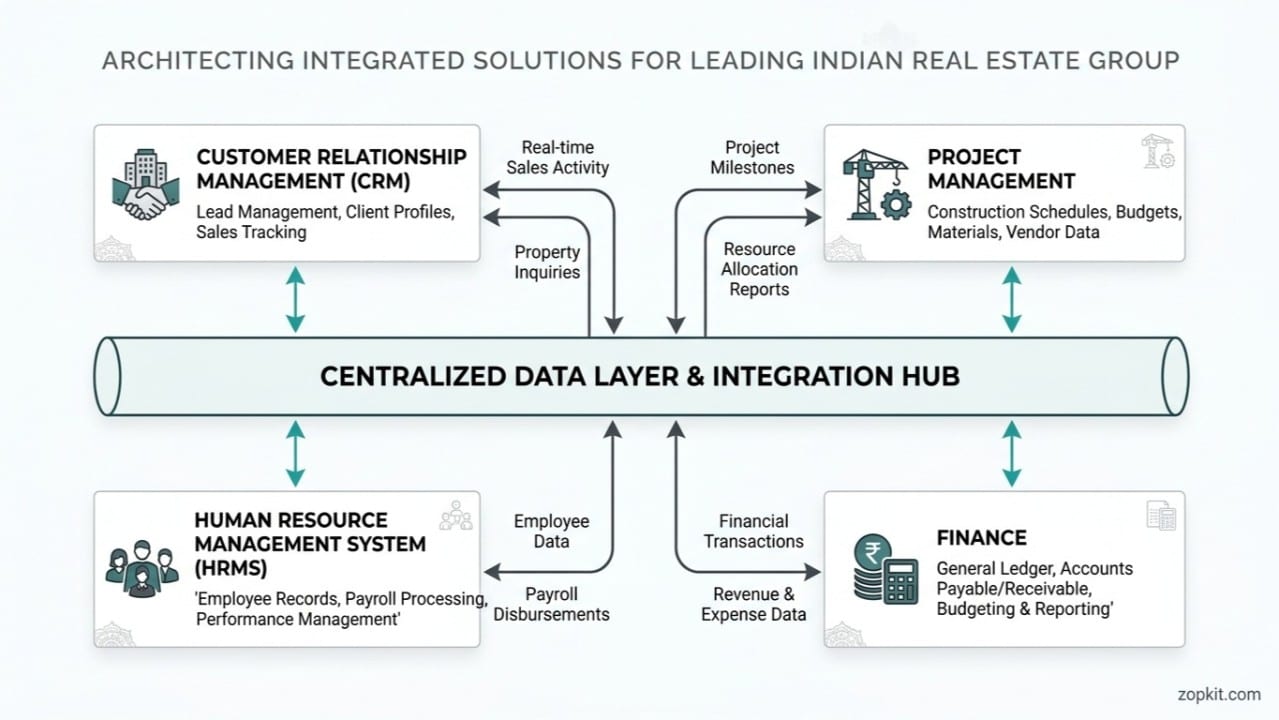
The Zopkit Ecosystem is the connected operating platform built for exactly this scale. Zopkit CRM manages the channel partner network and multi-project sales pipeline at group level. Zopkit Project Management tracks construction milestones and budget position across every active project with Finance integration. Zopkit Financial Accounting handles buyer AR, milestone-triggered demand letters, GST compliance, TDS under 194IA, contractor AP with three-way matching, and group-level P&L. Zopkit HRMS runs payroll for a 250 to 300 person multi-location workforce with every statutory obligation computed natively.
One platform. One data layer. Four functions. Zero manual handoffs between them.
Table of Contents
I. The Scale Problem: Why Tools That Worked at 80 People Break at 250
II. Zopkit CRM: Managing a 200-Partner Channel Ecosystem at Group Scale
III. Zopkit CRM: The Group Sales Intelligence Layer
IV. Zopkit Project Management: 12 Projects, Every Milestone, Every Budget Line
V. Zopkit Finance: 1,000 Buyer Schedules, Milestone-Triggered Demand Letters, Group P&L
VI. Zopkit HRMS: 300 People, Multi-City, Every Statutory Obligation
VII. The Six Connections That Make Zopkit a Group Operating System
VIII. The Group Management Dashboard: What the MD and CFO See Every Morning
IX. The Group-Level Operational Benchmarks
X. The Board-Ready Reporting Stack
I. The Scale Problem: Why Tools That Worked at 80 People Break at 250
Scale Does Not Break Tools Gradually. It Breaks Them Suddenly.
There is a threshold in every real estate group's growth where the tools that served the organisation well become the organisation's biggest operational liability. The threshold is not a headcount number. It is a complexity number: the moment the number of simultaneous projects, the size of the channel partner network, the volume of active buyer collection schedules, and the size of the workforce each exceed the manual coordination capacity of the people managing them.
For most Indian developer groups, that threshold arrives somewhere between the 8th and 12th active project. Before that point, the operations head knows every project's status from direct involvement. The CFO can reconstruct the collections position from two Tally instances and a spreadsheet. The HR head processes payroll for 180 employees across three locations with a combination of a payroll software and a CA's monthly call. The VP Sales tracks channel partner performance from a WhatsApp group and a commission tracker.
After that threshold, all four of these processes require more coordination capacity than the individuals managing them can provide. The operations head cannot hold 12 project milestone schedules in memory. The CFO cannot maintain collection accuracy across 1,200 buyer schedules from two Tally instances. The HR head cannot reliably compute incentives for 60 salespeople without a direct live connection to the booking records. The VP Sales cannot identify which 40 of the 250 channel partners are generating 80% of the group's bookings without structured performance data.
The result is that management reporting lags. Construction-triggered demand letters are delayed. Incentive disputes happen every month. Channel partner relationships that should be formally managed are managed through the VP Sales' relationships and memory. When the VP Sales leaves the organisation, the channel partner network partially leaves with them.
Zopkit solves the post-threshold operational failure at every level simultaneously.
II. Zopkit CRM: Managing a 200-Partner Channel Ecosystem at Group Scale
Your Channel Partners Generate 60 to 70 Percent of Your Bookings. They Are Not Being Managed Like It.
For a large developer group, the channel partner network is the primary sales engine. Direct walk-in buyers and digital leads are important. But for most 200-plus person developer groups, 55 to 70% of bookings are sourced through channel partners: IPC firms, independent brokers, RERA-registered agents, NRI desks at large brokerages, and property portals that operate on a channel model. Managing 200 partners with a WhatsApp group, a commission tracker, and a shared inventory sheet is how groups of this scale routinely lose bookings to competitors who respond faster, track better, and pay commissions cleaner.
The Channel Partner Register at Group Scale:
Every channel partner in Zopkit CRM has a formal Account record containing: RERA registration number and expiry date, GSTIN for commission invoice processing, legal entity name and contact hierarchy, empanelment documentation, which projects they are active on, their commission rate per project type, their bank details for payout, their complete lead attribution history across all projects, and their total booking and commission history for the group's entire relationship with them.
This is not a database of names and phone numbers. It is the full business record of 200 channel partners that replaces the information that currently lives in the VP Sales' memory and the sales coordinator's spreadsheet.
Partner Tier Management and Incentive Structures:
At 200 active channel partners, a group's commercial relationship with its top 10 partners is fundamentally different from its relationship with the bottom 80. Top partners receive priority inventory access, higher commission tiers, co-marketing budgets, and dedicated relationship manager assignments. They are formally recognised at the group's annual broker summits. The middle tier receives a standard commission structure with project-specific bonuses on launch campaigns. The bottom tier is deprioritised for new project launches and receives a re-engagement communication cadence.
All three tiers and their corresponding treatment rules are configured in Zopkit CRM. Partners are automatically tiered based on their rolling 90-day booking performance. A partner who has delivered 8 bookings across three projects in the last quarter moves to the top tier and receives the corresponding access and rate automatically. A partner who has delivered zero bookings in 90 days gets flagged for re-engagement. No sales coordinator maintains this manually. The system maintains it continuously.
Lead Attribution Across Multiple Projects:
A channel partner submits a lead for a buyer who is interested in a 2BHK at the group's Pune residential project. Three months later, the same buyer decides they prefer a 3BHK at a different project in the same city. The channel partner who submitted the original lead should receive attribution for the booking, regardless of which project it eventually closes on.
Zopkit CRM tracks lead attribution by source and partner across the entire portfolio. When the booking closes on a different project, the commission is attributed to the originating partner. The system prevents the common dispute where a buyer is claimed by two channel partners across two projects, and the sales team does not have a structured record to resolve the conflict.
Channel Partner Campaigns and Communications:
New project launch announcements, inventory release notifications, commission scheme updates, quarterly performance recognitions, and annual summit invitations all go to the channel partner network as structured campaigns from Zopkit CRM's multi-step email outreach and SMS communication capability. The top tier receives the launch announcement 48 hours before the open network. The mid tier receives it at launch. The campaign tracks open rates, click-through, and leads submitted within 7 days of the communication, giving the VP Sales a measurable return on every partner communication investment.

III. Zopkit CRM: The Group Sales Intelligence Layer
12 Projects. 60 Salespeople. 900 Active Leads. One Pipeline View.
At group scale, the VP Sales and MD need a portfolio-level view of the sales function that no individual project sales manager can produce. The portfolio view requires: booking velocity per project against target, lead conversion rate by project type and city, channel partner contribution to each project's booking, the group's total booking forecast for the quarter, and the AI-generated alerts that flag risks before they become misses.
Territory-Based Access Controls at Group Scale:
60 salespeople do not all need to see all leads across all projects. Zopkit CRM's territory-based access controls structure the visibility: a salesperson at the Pune Riverfront project sees Pune Riverfront leads and buyers. A city sales manager sees all Pune project pipelines. The VP Sales sees the full group portfolio. The MD sees the same portfolio view plus the executive summary KPIs. Role-based access is configured once and maintained automatically. When a salesperson transfers from one project to another, their access profile updates in one step.
AI Pipeline Intelligence at Group Scale:
With 900 active leads across 12 projects, the AI assistant in Zopkit CRM is the layer that makes the portfolio manageable. It surfaces: stalled deals above a value threshold across the group, leads with no activity in a configurable period by project and salesperson, channel partner leads that have been assigned but not visited, booking forecast variance from monthly target by project, and duplicate buyer records across projects. The MD or VP Sales asks the AI in plain English: "Show me all deals above ₹2 crore in Negotiation across all projects with no activity in the last 10 days." The answer is immediate, from live data, without a sales coordinator assembling a report.
Buyer Records as the Long-Term Relationship Infrastructure:
A buyer who books a unit today will have a relationship with the group for 3 to 5 years through construction updates, instalment collections, possession coordination, and potentially a second purchase or referral. Zopkit CRM's Account record carries the buyer relationship forward: every communication, every collection event, every service request, every construction update. When the salesperson who handled the original booking leaves the group, the buyer's relationship does not leave with them. The new relationship owner opens the CRM record and sees the complete 4-year history.
Post-Sale Communication at Group Scale:
800 active buyers receiving quarterly construction updates, annual project review communications, and milestone notifications is not a manual communication exercise at this scale. Zopkit CRM's multi-step email and SMS outreach handles the buyer communication calendar: milestone completion updates, possession timeline updates, registration date reminders, and the group's referral program communications. Each project's buyers receive communications tailored to their project's status. The marketing team configures the sequences once. The platform executes them per project on schedule.
IV. Zopkit Project Management: 12 Projects, Every Milestone, Every Budget Line
Construction at 12 Projects Simultaneously Is Not a Projects Problem. It Is an Information Problem.
The construction function at a large developer group produces information that four other functions in the business depend on simultaneously: Finance needs milestone certifications to trigger demand letters, the CFO needs budget vs. actual to make project financing decisions, the sales team needs delivery timeline updates to communicate to buyers, and the MD needs portfolio health to present to the board. When that information lives in 12 separate site WhatsApp groups and monthly progress meetings, all four downstream functions operate on lagged, incomplete data.
Portfolio-Level Construction Health:
Every active project in Zopkit Project Management has a project record with: total project budget, committed costs, actual costs incurred, percentage of completion, current construction phase, upcoming milestones with planned and actual dates, and an AI-generated health score. The group Head of Projects views all 12 projects on one dashboard with traffic-light health scoring. Projects that are on track are green. Projects where a milestone is more than 14 days behind the plan are amber. Projects with cost overruns above a configured threshold are red. The portfolio view replaces the weekly Head of Projects meeting where 12 status updates are delivered verbally and nothing is documented.
AI-Generated Delivery Insights:
Zopkit Project Management's AI delivery insights layer surfaces: budget overrun alerts at the project level when committed costs exceed the approved budget by a threshold percentage, overdue project flags when milestones pass their planned date without certification, and low utilisation warnings when billable time on a project drops below a threshold indicating a resource gap. At group scale with 12 simultaneous projects, the Head of Projects cannot watch all 12 for exception conditions simultaneously. The AI watches all 12 continuously and alerts only when action is needed.
Construction Milestone Linking to Finance:
Each construction milestone configured in Zopkit Project Management is linked to the corresponding instalment trigger in Zopkit Finance. When the site engineer certifies Slab Level 6 for the Prestige Riverfront project, the Finance module automatically identifies all buyers for that project at the Slab Level 6 instalment stage, computes each demand amount with GST at the project-specific rate, and generates the demand letter batch for finance team review and dispatch. For a project with 200 active buyers, the certification of one milestone generates 200 demand letters in one platform action. Without this connection, the Finance team waits for a call from the site, manually identifies the buyer list, computes 200 demand amounts individually, and dispatches over 2 to 4 working days.
Contractor Budget Control at Portfolio Scale:
A large developer group runs 80 to 150 active contractor relationships across 12 projects: civil contractors, MEP contractors, landscape firms, lift vendors, façade consultants, and specialised fit-out agencies. Each contractor engagement has an approved budget per project. Every running bill submitted by a contractor is processed against the project's approved contractor budget in Zopkit Project Management. When a civil contractor's running bills for a project exceed 85% of the approved contract value, a budget alert is generated before the overrun occurs. The Head of Projects, CFO, and project director see the alert. The decision about a budget revision or contract renegotiation is made with data before the liability crystalises.
Milestone Calendar for Demand Forecasting:
The Finance team and CFO need to forecast demand letter outflows 60 to 90 days ahead to manage treasury. Zopkit Project Management's milestone calendar shows every planned milestone across all 12 projects for the next 90 days, with the estimated demand letter value for each milestone from the linked Finance module. The treasury team can see that three milestones across three projects are expected in July, and the combined demand outflow for those milestones is ₹48 crore across 340 buyers. That forecast drives the cash flow model.

V. Zopkit Finance: 1,000 Buyer Schedules, Milestone-Triggered Demand Letters, Group P&L
₹2,800 Crore of Buyer AR Across 12 Projects. Every Rupee Tracked. Every Deadline Met.
The finance function of a large developer group is one of the most operationally intense in any industry. Collections management for 800 to 1,200 active buyer payment schedules across 12 projects, each with different instalment structures, different GST treatment conditions, and different project-specific rules. Contractor AP across 100 active contractor relationships. Multi-entity consolidation for a group with project-level SPVs. GST compliance across every project with GSTR-1 data available at the project level and the group level. TDS under 194IA per buyer per instalment. Monthly close that produces board-level group financial reporting within 3 days. Cash flow forecasting across the group's treasury position.
Group-Level AR With Project-Level Drill-Down:
The CFO views the group AR position: total outstanding across all projects, total overdue by project, the group's collection efficiency ratio, and the aging analysis. The finance controller for each project sees their project's AR: buyer-by-buyer, instalment-by-instalment, demand letter dates, payment received dates, and overdue positions with the last contact date from the CRM. The two views are the same data at different levels of aggregation. No export and no reconciliation required between them.
Milestone-Triggered Demand Letter Generation at Scale:
When a construction milestone is certified in Zopkit Project Management, the Finance module generates demand letters for all buyers at that instalment stage simultaneously. For a project with 200 active buyers and a Slab Level completion milestone linked to a 10% instalment, the certification event generates 200 demand letter documents, each with the correct buyer name, unit number, instalment amount, GST amount, total demand, and due date. The finance team reviews the batch, makes any necessary corrections, and dispatches. The entire process from certification to dispatch takes one working day. Without this system, it takes 4 to 7 working days across multiple manual steps, and the collection cycle for that milestone starts a week late.
India GST Compliance Across Project Types and Categories:
A large developer group operates across residential, commercial, and plotted development, each with different GST treatment positions. Under-construction residential properties above and below the affordable housing threshold have different applicable rates. Commercial under-construction projects have their own rate with full ITC credit availability. Plotted development has no GST applicability on land component. Each project's GST configuration in Zopkit Finance reflects the correct treatment. Every demand letter computes the correct GST amount per project type automatically. GSTR-1 outward supply data across all 12 projects is available from live transaction data at any time during the compliance period.
TDS 194IA Registry Across 600 Buyers:
For all unit values above ₹50 lakhs, buyers deduct TDS at 1% per instalment under Section 194IA and are required to file Form 26QB. For a group with 600 buyers in this category across 12 projects, the TDS register is a significant compliance document. Zopkit Finance maintains the TDS 194IA register per buyer: every demand raised, the TDS deduction per instalment, the net receipt, the Form 26QB acknowledgment reference per buyer, and the quarterly reconciliation between demand records and TDS credit visible in the group's Form 26AS. The quarterly TDS reconciliation that currently takes the finance team a week to produce manually is available from the platform continuously.
Multi-Entity Consolidation for Group SPVs:
Large developer groups typically operate with project-level SPVs: Prestige Riverfront Pvt. Ltd., Prestige Grand Realty Pvt. Ltd., each a separate legal entity. Zopkit Finance handles multi-entity support, where each SPV has its own books of record and the group's consolidated financials aggregate across all entities. The Group CFO sees the consolidated P&L, consolidated balance sheet, and consolidated cash flow statement. Each project director sees their entity's financials. The statutory accounts for each SPV are generated from the entity's data. The group management accounts are generated from the consolidated view.
Contractor AP With Three-Way Matching Across 100 Contractors:
With 100 active contractor relationships raising running bills monthly, the AP function for a group of this size requires control architecture to prevent duplicate payments, unauthorised payments, and bill padding. Zopkit Finance's three-way matching validates every contractor bill against the approved purchase order for that work package and the site-certified work completion document before payment approval. A contractor bill that lacks a valid PO reference or an approved work completion certificate from the projects team is flagged before it reaches the payment stage. The control operates automatically on every bill.
Group Cash Flow Forecasting for Treasury Management:
A 30-day rolling cash flow forecast for a group with 12 projects aggregates: expected instalment receipts from the AR module by project (based on demand letters dispatched and historical collection rates), scheduled contractor payment outflows from approved POs, upcoming statutory payment deadlines from the compliance calendar, payroll from HRMS, and project finance loan servicing from the loan schedule. The Group CFO and treasury team use this forecast to manage inter-entity fund transfers, short-term borrowings, and construction finance drawdown timing.

VI. Zopkit HRMS: 300 People, Multi-City, Every Statutory Obligation
250 to 300 People Across Pune, Mumbai, Nashik, Bangalore, Hyderabad. One Payroll Run. Every Obligation Met.
A large real estate group's workforce is genuinely complex to manage. Corporate leadership and finance teams in the registered office city. Project directors and site teams at 12 construction sites, many of which are in locations far from the city centre. City sales offices in 4 to 5 cities with local sales teams, each with a base-plus-incentive structure. Security and facility management staff at completed projects under possession coordination. And senior leadership with ESOP participation as part of their retention package.
Multi-Location Attendance for Site and City Office Staff:
12 construction sites, 5 city sales offices, and 1 corporate office all have different shift structures, overtime policies, and attendance tracking requirements. Construction site engineers work fixed shifts with overtime provisions governed by BOCW regulations. City sales executives work variable schedules tied to site visit hours. Corporate staff work standard office hours with remote work provisions. Zopkit HRMS configures attendance policies per location, handles shift assignment and overtime approvals, and processes regularisation requests from field staff who cannot swipe at a fixed terminal. Month-end payroll input for 300 people across 18 locations is clean because attendance is captured in the system, not compiled from phone calls and WhatsApp screenshots.
Sales Incentive Computation at Group Scale:
The monthly incentive payout for 60 salespeople across 12 projects is one of the most contested processes in a large developer group's HR function. The contention happens because the sales team and the finance team often have different booking counts for the same period, and the HR team has no independent record to arbitrate between them.
In Zopkit, the incentive formula in HRMS references the CRM booking count directly. The booking records in Zopkit CRM are the authoritative source. For each salesperson, the formula computes: base incentive from bookings at the applicable tier rate, project-level bonus if the project hit the monthly target, city-level bonus for city managers whose team hit the city target, and seniority-based accelerators for long-tenure performers. The computation is transparent, traceable to individual deal records, and produces the same number every time for the same input data. Incentive disputes from this system are eliminated because the record is objective and visible to all parties.
Multi-State Statutory Payroll Across 5 States:
With staff in Maharashtra, Karnataka, Telangana, Karnataka, and Rajasthan (if the group is active there), the statutory payroll computation spans different professional tax schedules per state, ESI applicability for the relevant salary band in each state, PF contribution for all eligible employees, TDS on salary for each employee at their applicable rate with their investment declarations factored in, and Form 16 generation for all eligible employees at year-end. Every statutory deduction for every employee in every state is computed natively in Zopkit HRMS. No CA runs the group's payroll externally. No external payroll tool bridges the gap.
BOCW Compliance for Construction Site Staff:
Under the Building and Other Construction Workers Act, developers with construction activity are required to register under the relevant state BOCW board, pay cess based on the cost of construction, and maintain welfare fund contributions for eligible workers. For a group with 12 active construction sites across multiple states, the BOCW compliance obligation is significant and multi-dimensional. Zopkit HRMS handles the BOCW compliance calendar, cess computation per project based on approved construction cost, quarterly return preparation, and worker register maintenance per site.
ESOP Administration for Leadership Retention:
For a developer group that has offered equity participation to project directors, the CFO, the VP Sales, and the Group MD's key reports, Zopkit HRMS includes full ESOP administration: cap table management with each grantee's allocation, vesting schedule per grantee with cliff and monthly vesting configurations, exercise workflow with board approval routing, valuation records per exercise window, and the regulatory compliance calendar for ESOP reporting obligations under the Companies Act and FEMA for any NRI participants. The ESOP ledger sits alongside the compensation record of each participant in the same HRMS.
Recruitment for a Group That Hires Continuously:
A 250-person developer group with 12 active projects is continuously recruiting: site engineers for new project phases, sales executives for new project launches, project managers for expansion, and corporate function hires for a growing organisation. Zopkit HRMS's recruitment module includes a public-facing careers portal, structured interview workflows with stage-by-stage candidate progression, offer management, and candidate pipeline reporting. The Head of Projects can see how many site engineer positions are open across all projects and what stage each candidate is at. The CHRO sees the full recruitment pipeline across all functions and all cities.

VII. The Six Connections That Make Zopkit a Group Operating System
Six Automatic Events. Six Manual Processes Eliminated. Every Month. Across 12 Projects.
The structural advantage of running CRM, Project Management, Finance, and HRMS on the Zopkit Ecosystem is not the feature depth of any individual module. It is the six automatic data connections that eliminate the six most expensive manual handoffs in a large developer group's monthly operations.
Connection 1: Booking confirmed in CRM creates buyer AR record in Finance.
When a deal is marked Won in Zopkit CRM, the buyer's AR collection record is created in Zopkit Finance automatically: buyer details, unit number, project, booking value, and the full instalment schedule pre-populated. The collections team does not re-enter buyer data. The collection cycle starts the moment the booking is confirmed, not 3 days later when the sales coordinator sends the booking form to Finance.
Connection 2: Construction milestone certified in Project Management triggers demand letters in Finance.
When the site team certifies a milestone in Zopkit Project Management, the Finance module generates demand letters for all buyers at that instalment stage automatically. For a 200-unit project, 200 demand letters are generated in one platform action. The 5-day lag between site certification and demand dispatch is eliminated.
Connection 3: CRM booking count drives salesperson incentive in HRMS.
Deal records marked Won in Zopkit CRM for the payroll period are the direct input to each salesperson's incentive formula in Zopkit HRMS. The computation is automatic. The incentive dispute, a monthly event for most developer groups at this scale, disappears when both the sales team and the HR team are looking at the same CRM record as the authoritative source.
Connection 4: HRMS payroll journals post automatically to Finance.
When the monthly payroll is approved in Zopkit HRMS, salary disbursement journals post to Zopkit Finance automatically. PF, ESI, PT, TDS, and BOCW statutory liabilities appear in the correct payable accounts. The Finance team does not re-enter payroll data.
Connection 5: Contractor payment in Finance updates project budget in Project Management.
When a contractor payment is approved in Zopkit Finance with the project cost centre, the committed cost for that project updates in Zopkit Project Management immediately. The Head of Projects sees the remaining budget per contractor package without querying Finance.
Connection 6: Milestone calendar in Project Management feeds cash flow forecast in Finance.
Planned milestones in Zopkit Project Management with their expected demand values inform the AR receipts forecast in Zopkit Finance. The CFO's 30-day and 90-day cash flow forecasts incorporate construction progress assumptions automatically, not from a manually updated treasury spreadsheet.

VIII. The Group Management Dashboard: What the MD and CFO See Every Morning
The Board Should Never See a Number the MD Has Not Already Seen Three Days Before.
The most senior users of a group-level operating platform are the MD and CFO. They do not operate any single function daily. They need a group-level view that flags exceptions, tracks portfolio performance against targets, and provides the information required to make capital allocation and strategic decisions without a 2-day reporting cycle.
The MD's Morning View:
- Total bookings across all projects yesterday, this week, and month to date against monthly target
- Project-wise booking performance: which projects are ahead of target, which are behind, and what the AI-flagged reasons are
- Channel partner network health: top 10 partner performance, new partner activations, commission payouts due
- Construction portfolio: which projects have AI-generated health alerts (budget overrun, milestone delay, or cost escalation) requiring MD attention
- Recruitment pipeline: open positions across all functions and the stage of key leadership hires
- Any AI CRM alert for deals above a threshold value that have been stalled beyond the configured period
The CFO's Morning View:
- Group AR position: total outstanding, overdue by project, and collection efficiency ratio against the same period last year
- Demand letter calendar: which milestones are due in the next 30 days and the aggregate demand value they represent
- Group cash position: bank balances across all entity accounts, 7-day and 30-day forecast, and any treasury alerts
- Contractor AP: total AP outstanding, payments due in the next 14 days, and any bills flagged by three-way matching for review
- Statutory compliance calendar: upcoming filing deadlines in the next 30 days across all obligations for all entities
- Payroll status: payroll run completion status and any flagged exceptions in the current month's incentive computation
Both views are generated from live transaction data in Zopkit. No report is prepared by the Finance team or the sales operations team before the MD and CFO access them. The data is current to the previous evening's transactions. The board pack for the quarterly review is produced directly from the same platform data, formatted for board presentation without a parallel manual compilation exercise.
IX. The Group-Level Operational Benchmarks
What to Measure at 30, 60, and 90 Days Post Full Go-Live
Demand letter generation time per milestone:
Target at 30 days: same day to next morning from milestone certification. Baseline for a group of this scale without system integration is 4 to 8 working days from site certification to buyer receipt.
Monthly incentive dispute rate:
Target at 60 days: zero disputes per month. Baseline for a 60-salesperson group without CRM-to-HRMS integration is 4 to 12 disputes per payroll cycle.
Group management report compilation time:
Target at 60 days: 4 to 6 hours from platform data. Baseline is 3 to 5 working days of combined Finance and Sales Operations time.
Overdue AR as percentage of total group outstanding:
Target at 90 days: below 6%. Baseline for a group of this scale without structured collection escalation automation is typically 10 to 18%.
Channel partner commission payout cycle:
Target at 90 days: all commissions paid within 21 days of booking confirmation with GSTIN-linked invoice matching. Baseline is 30 to 60 days with frequent disputes from unmatched invoices and booking confirmation delays.
Project budget overrun detection lag:
Target at 90 days: overruns visible in Project Management the day the contractor payment is approved, before the monthly review meeting. Baseline is discovery at the next monthly project review, 2 to 4 weeks after the overrun begins.
X. The Board-Ready Reporting Stack
Quarterly Board Reports Should Not Take Three Days to Compile.
A large developer group's board requires quarterly financial and operational reporting across all entities. The reporting stack from Zopkit is available from live platform data and does not require Finance team manual compilation.
Financial reports available from Zopkit Finance:
- Group consolidated P&L with entity-level breakdowns
- Group consolidated balance sheet
- Group consolidated cash flow statement
- Project-level P&L for all 12 active projects
- Group AR aging report with project-level drill-down
- Collection efficiency report: demand raised vs. collected by project and period
- GST compliance status: GSTR-1 data per entity and consolidated
- TDS 194IA register and reconciliation summary
Operational reports available from Zopkit CRM and Project Management:
- Group booking performance vs. target by project and month
- Channel partner contribution report: bookings and booking value by partner by project
- Lead source and conversion funnel by project type
- Construction health report: all 12 projects, milestone status, budget position
- Milestone calendar with demand forecast for next 90 days
HR reports available from Zopkit HRMS:
- Group headcount report by entity, location, and function
- Payroll cost by entity and location, quarter vs. budget
- Statutory compliance calendar: all filings completed and upcoming
- Sales incentive report: total payout, average per salesperson, cost as percentage of booking value
The full board pack is produced from these platform reports in a single working day. The CFO reviews, formats, and delivers. The board sees accurate, current, platform-sourced data rather than a manually compiled document that the finance team spent three days producing and that is already slightly outdated by the time the board reads it.
Conclusion
At 12 Projects and 1,000 Buyers, the Question Is No Longer Which Tool. It Is Which Platform Runs the Group.
A large real estate group operating at 200 to 300 people across 10 to 15 active projects has not had a tool problem for a long time. It has had a platform problem. Individual tools for sales, projects, finance, and HR that were each adequate at a smaller scale have collectively created an organisation where the most important information, the number that tells you whether this month's collection is on track, whether the demand letter went out the day after the milestone was certified, whether the channel partner who generated 22 bookings this quarter is being paid correctly and on time, is always slightly wrong, always slightly late, or always in someone's head rather than in a system.
Zopkit CRM manages 218 channel partners as a formal revenue function with tier management, attribution tracking, and performance analytics. Zopkit Project Management tracks 12 construction projects with AI-generated health scoring
visite zopkit.com