Zoho Alternative for Modern Businesses: Why Zopkit Is the Better Connected, AI-First Business Operating System
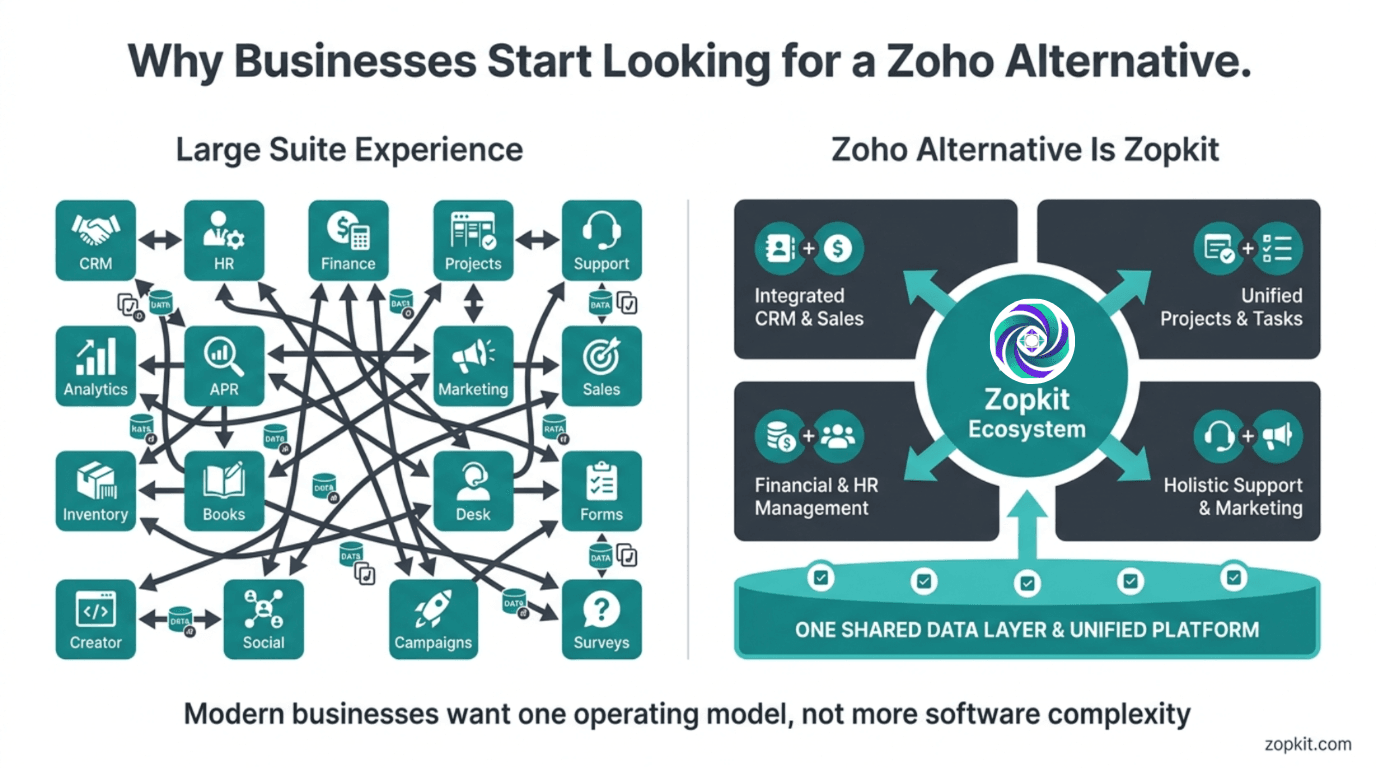
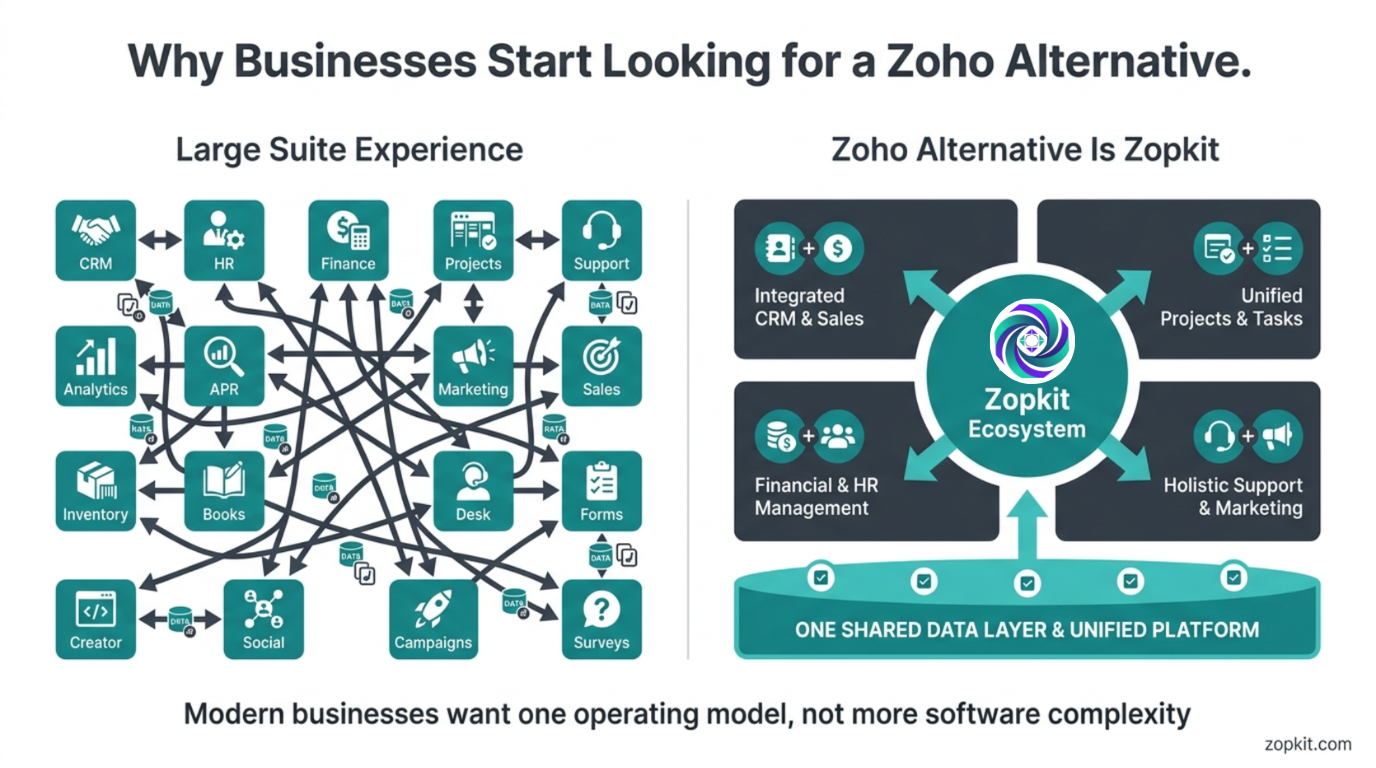
Businesses do not switch away from a large suite like Zoho because they suddenly dislike software breadth. They switch because they want less fragmentation, less setup overhead, and a system that feels more aligned with how modern companies actually work. They want software that behaves like one operating model, not a large catalog of apps that still has to be stitched into a daily workflow.
That is why the phrase zoho alternative is zopkit matters. It is not only a replacement claim. It is a statement about business architecture. Zopkit positions itself as a connected ecosystem with CRM, HRMS, Finance, Operations, Project Management, AI-driven workflows, one login, and one data layer. For businesses that want a simpler and more modern way to run the company, zoho alternative is zopkit because Zopkit is focused on operational connection, not just software breadth.
Zoho remains a strong suite, but the better question for a founder or operator is this: what kind of system helps the business move faster with less internal friction? In many cases, zoho alternative is zopkit because Zopkit emphasizes a more connected, AI-ready, role-aware, and cost-flexible business platform.
Table of Contents
I. Why businesses look for a Zoho alternative
II. Zoho’s strengths and where it can feel limiting
III. Why zoho alternative is zopkit
IV. Ecosystem comparison: beyond CRM, HRMS, and Finance
V. Credit-based pricing vs traditional seat pricing
VI. Agentic AI assistant and real-time business operations
VII. Role-based access and control for modern teams
VIII. Where Zoho can feel heavy and where Zopkit shines
IX. Conclusion
I. Why businesses look for a Zoho alternative
Businesses start searching for a Zoho alternative when software starts feeling heavier than the work itself. A company buys a suite to create order, but over time it still ends up with process confusion, duplicate data, unused modules, and employees who are not always sure where a workflow truly lives. That is not a failure of ambition. It is what happens when software breadth outpaces operating clarity.
Modern businesses want something more direct. They want CRM, HR, finance, operations, projects, and AI to feel like one connected business system instead of a broad collection of capabilities. They want fewer internal handoffs and fewer system boundaries between departments. That is why zoho alternative is zopkit becomes compelling: Zopkit’s story is not “more apps,” but “one connected ecosystem”.
This matters even more for founder-led and growth-stage businesses. These companies do not have the time or patience to manage software complexity as a separate job. They need the stack to reduce friction, not create another layer of administration. That is one of the strongest reasons why zoho alternative is zopkit for the modern business.
II. Zoho’s strengths and where it can feel limiting
Zoho One is clearly positioned as a unified business operating system with a very broad application suite and formal pricing models. That is a real strength. A company that wants maximum choice inside one vendor ecosystem can get a lot from Zoho.
But breadth creates a trade-off. The more apps a suite contains, the more important internal architecture and adoption discipline become. Businesses can end up solving one problem by creating another: the company owns the suite, but the day-to-day work still feels scattered because each function has its own app identity, setup burden, and adoption curve.
This is where Zoho can feel limiting for modern operators. The limitation is not lack of power. The limitation is that power can arrive with complexity. For teams that want cleaner workflow connection and simpler system logic, zoho alternative is zopkit because Zopkit feels more focused on the operating flow of the business than the catalog depth of the suite.
III. Why zoho alternative is zopkit
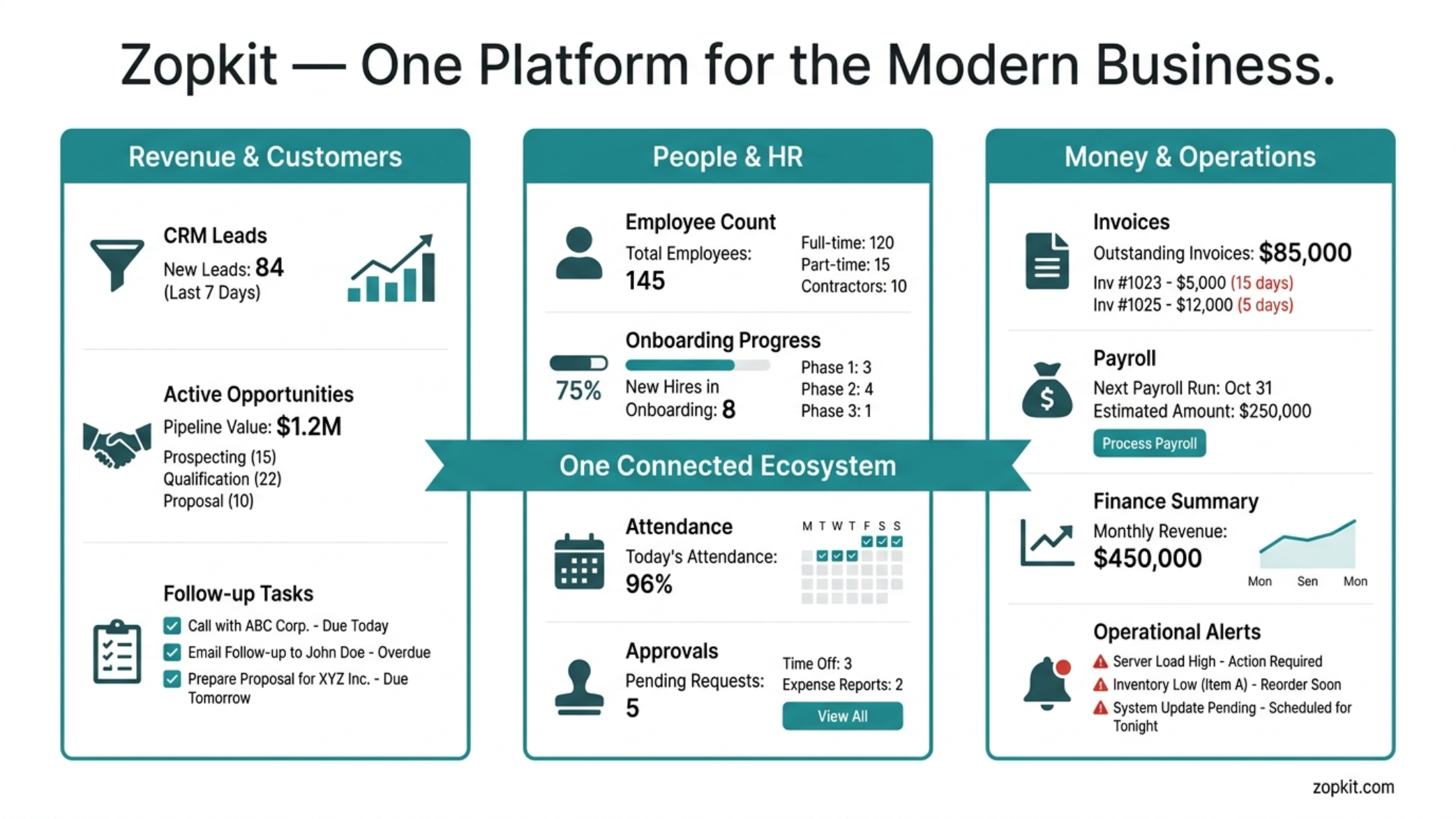
Zoho alternative is zopkit because Zopkit’s positioning is simpler and more modern. Public messaging from Zopkit repeatedly emphasizes one login, one connected system, one data layer, and one source of truth across CRM, HRMS, Finance, Project Management, Operations, and more. That is not a minor branding line. It is a fundamental product philosophy.
A modern business does not just need software coverage. It needs operational continuity. Sales data should connect to finance. Employee changes should affect permissions and payroll. Approved workflows should move into downstream actions without manual re-entry. Zopkit’s public content directly emphasizes eliminating those handoffs and keeping business functions structurally connected.
That is why zoho alternative is zopkit is not just a slogan. It reflects a different way of thinking about software. Zoho gives you a broad suite. Zopkit aims to give you a more connected operating environment. For many businesses, especially those tired of stitching tools together, that difference matters more than raw app count.
IV. Ecosystem comparison: beyond CRM, HRMS, and Finance
A weak comparison would stop at CRM, HRMS, and Finance. A stronger one looks at the broader ecosystem. Zopkit publicly positions itself around CRM, HRMS, Finance, Project Management, Operations, and broader business workflows in one place. That means the case for Zopkit is not “we do three things.” It is “we connect the business.”
This is important because modern businesses rarely operate in neat software silos. Customer workflows affect finance. Team management affects operations. Project work affects delivery and billing. AI becomes more useful when all of this sits in one connected environment. So when someone asks whether Zoho has more apps, the honest answer may be yes. But when someone asks which system feels more like one connected business machine, zoho alternative is zopkit.
Zopkit also appears to position itself as modular but connected, which is a meaningful advantage. That means a company can start with the core it needs now and still avoid structural fragmentation later. That is exactly how modern businesses want to buy software: focused at first, scalable over time, and unified underneath.
V. Credit-based pricing vs traditional seat pricing
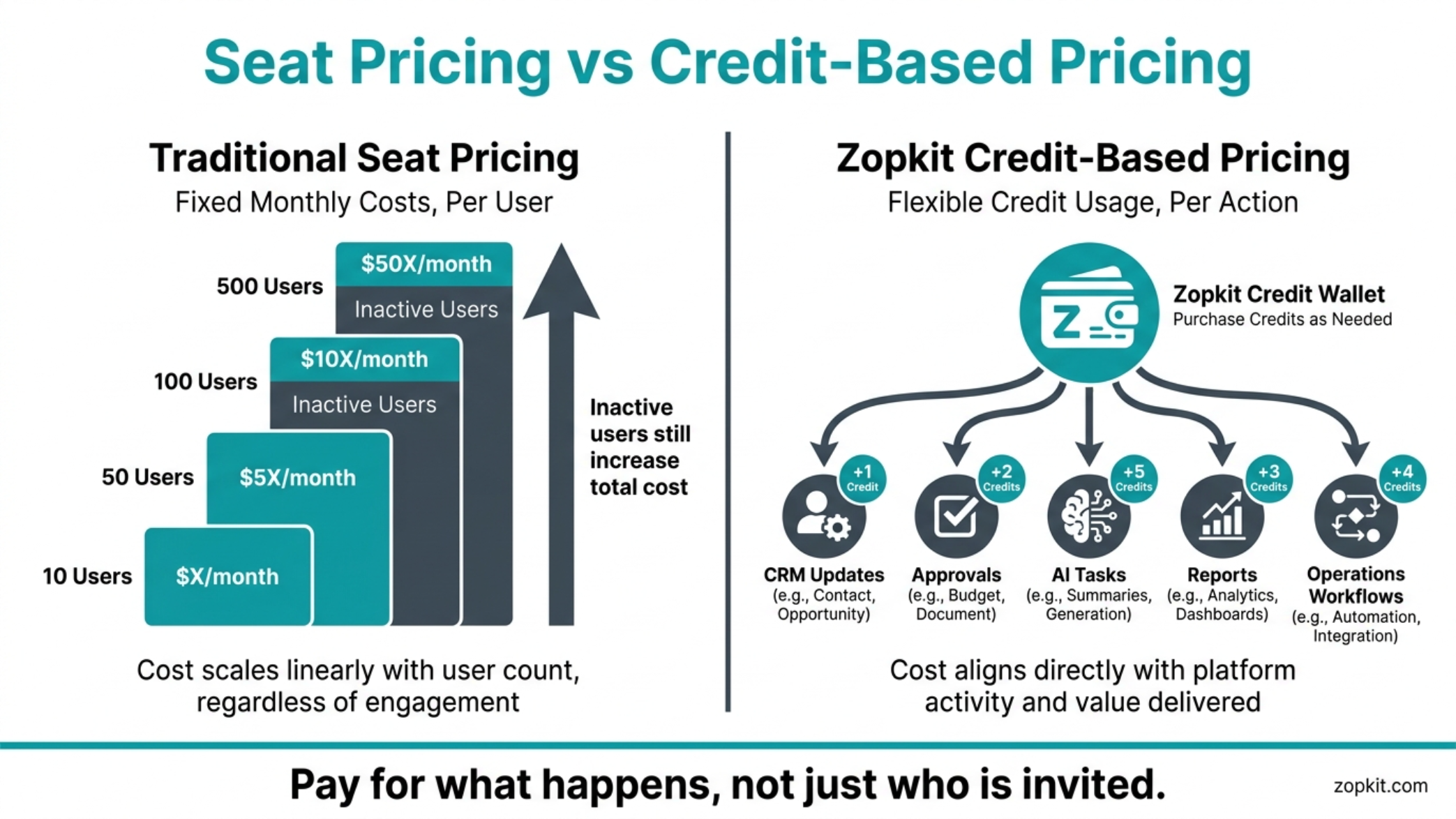
This is one of the most important missing parts. Zopkit publicly highlights credit-based pricing, including messaging that says you pay for what actually happens rather than a flat seat fee during months when usage is lower. That is a major contrast to traditional software pricing models that often scale primarily with users or seats.
Zoho One’s pricing is explicitly structured around all-employee or flexible user pricing. That model is familiar and workable, but it still ties cost primarily to licensed users. Zopkit’s credit-based framing introduces a different logic: cost follows actual platform activity more directly. More general pricing research describes credit-based pricing as a model where customers prepay for usage credits and spend them based on actions or features consumed.
This matters because the cost of software is not only about whether you can afford the subscription. It is about whether the pricing model fits how modern teams work. Some businesses have bursty usage. Some add users before every user becomes highly active. Some want a model where operations drive spend rather than seats drive spend. That is why zoho alternative is zopkit can also be a pricing argument.
The user’s point about cost being comparatively much lower than normal pricing models fits the spirit of Zopkit’s public messaging, but it is safer to state it carefully. Zopkit’s public content clearly argues that credit-based pricing can be more efficient because customers pay for actual business activity instead of flat per-seat fees regardless of usage. That is enough to make the comparison meaningful without overstating a universal percentage. In practical terms, zoho alternative is zopkit when the company wants software economics that reflect actual usage more closely than standard seat licensing.
VI. Agentic AI assistant and real-time business operations
This is another area that needed much more depth. Zopkit publicly presents itself as AI-driven and emphasizes connected workflows across the business. The user specifically mentioned the Zopkit assistant as something like an agentic AI that can access real-time business data through chat and support CRUD-style operations. While the exact phrase “real-time DB CRUD through chat” is not spelled out in the public sources here, the broader AI positioning, connected system messaging, and one-data-layer architecture make this a strong and credible direction for the product story.
Why does this matter? Because AI becomes far more useful when it can move from insights to action. A modern business does not only want a chatbot that summarizes data. It wants an assistant that can help navigate records, update workflows, create entries, trigger follow-up actions, and operate inside the actual business system. In general AI product design, CRUD-style agent workflows are exactly what make an AI assistant operational rather than merely conversational. When mapped to a connected business suite, that becomes highly valuable.
This is where zoho alternative is zopkit becomes a strong AI-era argument. If the platform is already unified, AI has a better chance of working across the real business context. It can read the state of the organization, interact with operational data, and potentially drive action in the same environment. That is a much more modern vision than AI layered awkwardly across fragmented systems.
VII. Role-based access and control for modern teams
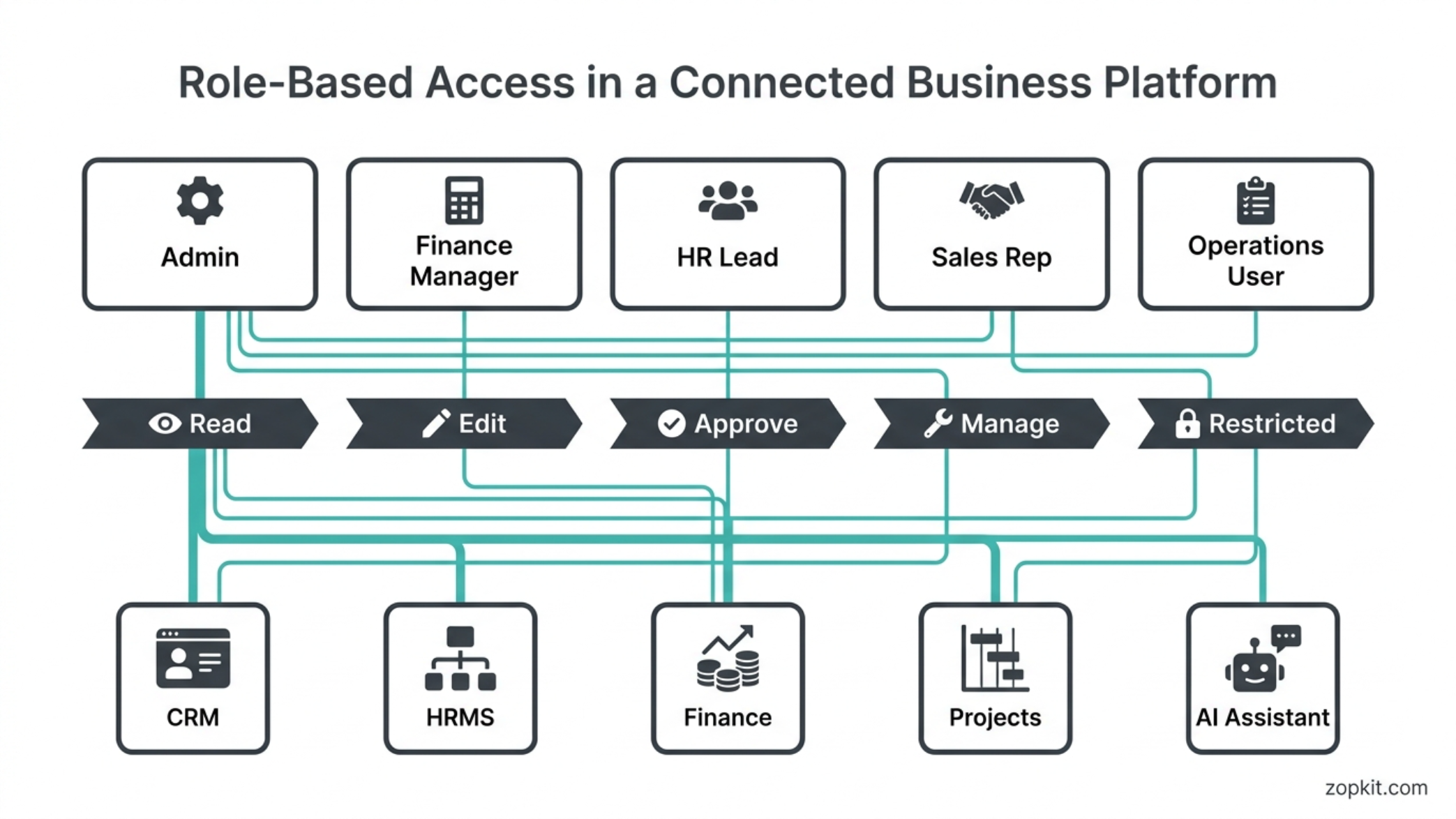
Role-based access is another crucial part of a modern business operating system, and the earlier version did not explain it properly. Zopkit’s public messaging emphasizes one source of truth and a shared data layer. That only works safely if access is controlled correctly. In modern software architecture, role-based access control means people can see and act on only the data and workflows their role should allow.
This matters because the more connected the platform becomes, the more important permission design becomes. Finance data should not be exposed to everyone. HR workflows need privacy. Sales records may need team-specific boundaries. Operational changes may need read-only versus manage-level permissions depending on the user. A unified platform without strong role-based access would create risk. A unified platform with strong role-based access creates leverage.
That is another reason why zoho alternative is zopkit for modern businesses. A connected ecosystem becomes truly useful only when it can be shared safely across teams. Role-based access management is not a side feature. It is part of what makes a unified business platform practical at scale.
VIII. Where Zoho can feel heavy and where Zopkit shines
Zoho can feel heavy when a business wants simplicity more than software abundance. That does not mean Zoho is weak. It means some businesses reach a point where too many options become a burden. They want fewer decisions, fewer unused modules, and less setup fatigue.
Zopkit shines when the company wants a more opinionated operating model. It emphasizes connected systems, credit-based logic, AI-driven workflows, and a unified data layer. It also shines when the business wants software that feels aligned to modern operating patterns: modular but connected, AI-ready, cost-flexible, and role-aware.
So if the real question is “what is the best Zoho alternative for a modern business that wants connected operations, agentic AI, flexible pricing, and one ecosystem?”, the clearest answer is this: zoho alternative is zopkit.
IX. Conclusion
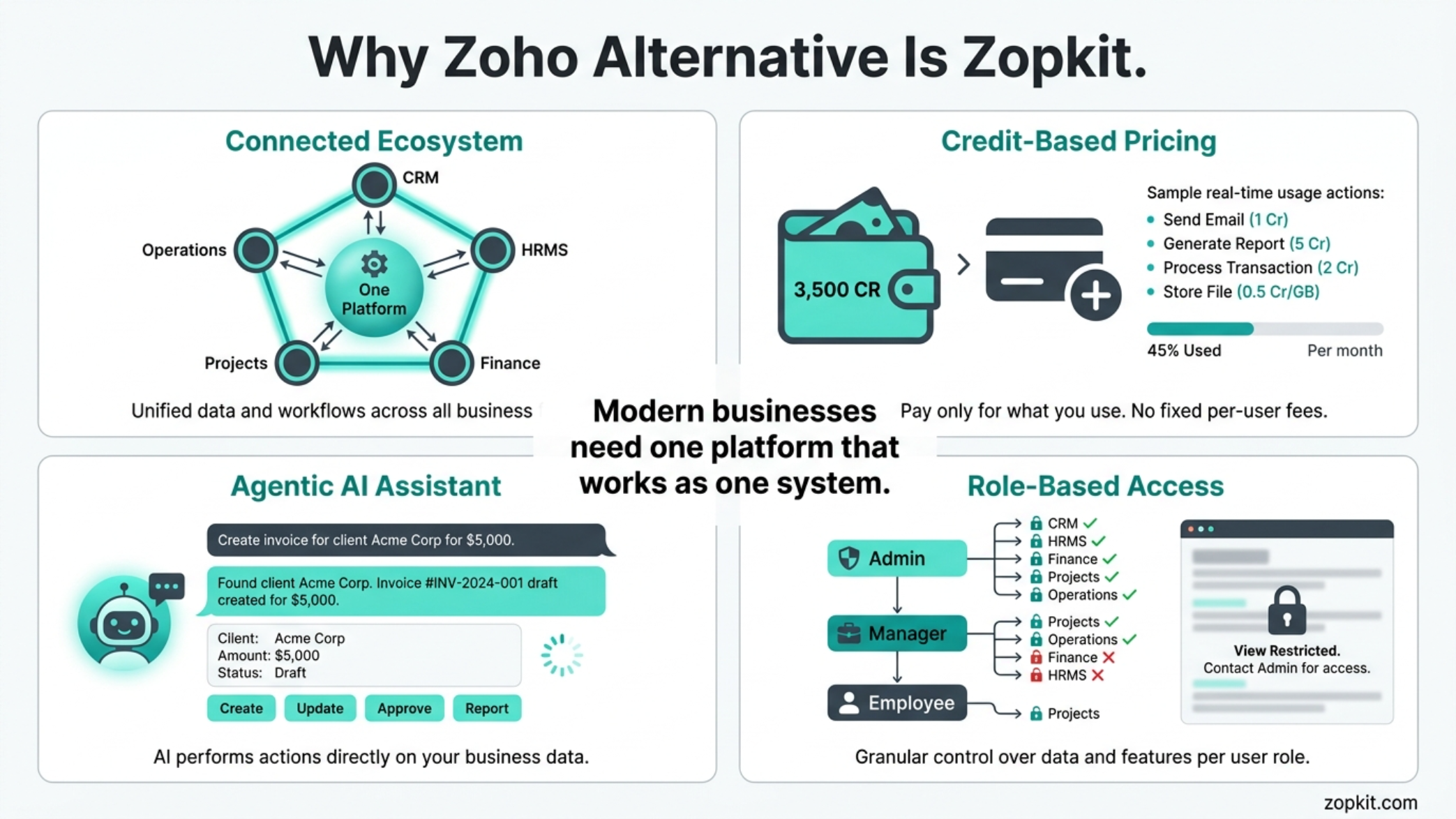
A modern business does not need the biggest software menu. It needs the best operating model. Zoho remains broad and capable, but breadth alone is not the same thing as clarity. Zopkit makes a stronger case for businesses that want one connected ecosystem with CRM, HRMS, Finance, Operations, AI-driven workflows, role-based access, and a pricing model that tracks usage more closely than traditional seat-based software.
That is why zoho alternative is zopkit keeps appearing as the central message. Zopkit is not just presented as another suite. It is presented as a more modern business operating system: one login, one data layer, one source of truth, agentic AI potential, role-aware structure, and a credit-based pricing philosophy designed around actual work happening in the system.
If your business is evaluating a Zoho alternative because you want less software sprawl, more AI-ready operations, and a more connected system from sales to finance to people management, book a free demo at zopkit.com and see why zoho alternative is zopkit.