What Measures Has Zopkit Taken to Become DPDP Compliant?
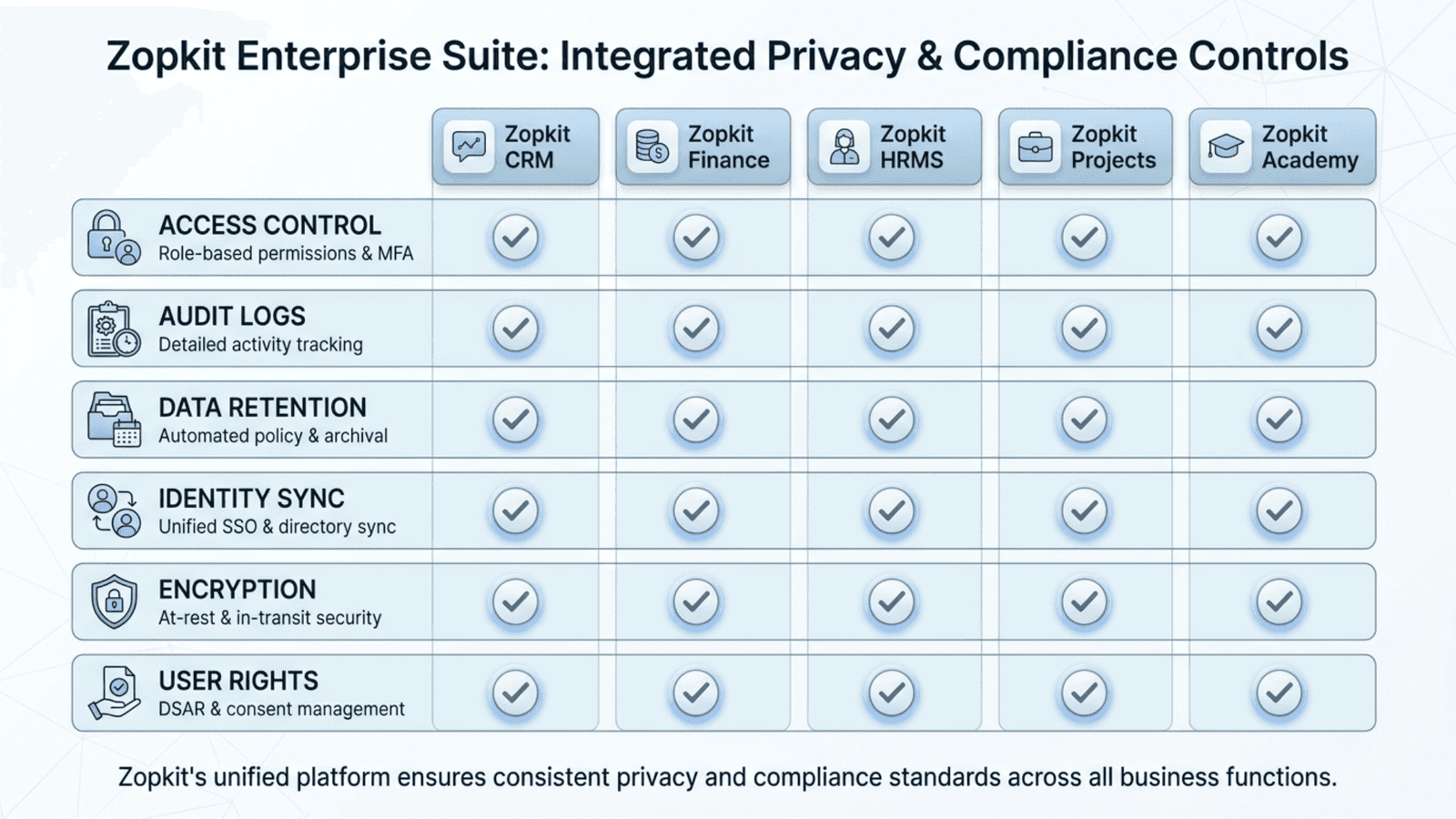
Zopkit’s DPDP readiness is not built as a single checkbox feature. It comes from the platform’s architecture: multi-tenant isolation, role-based permissions, audit logs, retention controls, secure integrations, identity centralization, and workflow governance across CRM, Finance, HRMS, Projects, and Academy.
That said, it is best to frame this as DPDP-aligned measures already present in the platform rather than a legal certification. The product features show that Zopkit has implemented many of the operational controls businesses need for privacy, access, retention, and accountability.
Table of Contents
- Why DPDP compliance matters for Zopkit
- Zopkit’s core privacy measures
- Product-by-product compliance controls
- What these measures mean for customers
- Gaps to keep in mind
- Conclusion
1) Why DPDP compliance matters for Zopkit
Zopkit operates across multiple business applications, so it processes customer, employee, financial, project, and learning data inside a shared ecosystem. That means privacy control cannot live in one module only; it has to be built into the platform structure itself.
The DPDP Act emphasizes purpose limitation, access control, retention discipline, breach readiness, and accountability. Zopkit’s architecture shows measures that support those expectations, especially through tenant-scoped data, role-based access, audit trails, and secure integrations.
2) Zopkit’s core privacy measures
Zopkit has several platform-level measures that support DPDP-style compliance.
Measure | What Zopkit does | Why it matters for DPDP |
|---|---|---|
Multi-tenant isolation | Records are scoped to a tenant and access is enforced before handlers run | Prevents cross-customer data exposure |
Role-based access control | Permissions are module-based and UI hides what users cannot access | Supports least privilege |
Wrapper-synced identity | Users, roles, org structure, and billing sync through Wrapper | Centralizes control and reduces identity drift |
Audit logs | Sensitive changes and activities are tracked in logs | Creates accountability and evidence |
Retention support | Some products include retention and archive controls | Helps data lifecycle management |
Secure integrations | APIs, webhooks, OAuth, and encrypted secrets are used | Reduces risk from third parties |
Public compliance surfaces | Unsubscribe, preference pages, verification links, and public flows exist in some apps | Helps user rights and transparency |
Permission-aware mobile/web access | Mobile and web respect the same capability model | Avoids “mobile lite” security gaps |

3) Product-by-product compliance controls
A. CRM
Zopkit CRM includes multi-tenant isolation, row-level security hooks, role-based access, wrapper-synced users and roles, audit-friendly activity logs, and tenant branding/settings controls. It also supports email suppression lists, public unsubscribe preference pages, and logged email events, which are important for handling communication preferences and accountability.
Key measures in CRM:
- Tenant-scoped records and middleware-enforced access.
- Role-based permissions for users, admins, and super admins.
- Audit logs and activity history on records.
- Unsubscribe, bounce, and complaint handling for emails.
- Public preference and compliance pages.
B. Finance
Finance is built with multi-tenant and multi-entity context, RBAC, audit logs, activity logs, credit ledger visibility, and internal cache invalidation for sync events. It also supports entity-level reporting, permissions sync, and operational logs that help show who did what and when.
Key measures in Finance:
- Entity-scoped accounting and reporting.
- Role-based access per module and operation.
- Activity logs and audit logs.
- Real-time permission sync from Wrapper.
- Credit ledger transparency.
C. HRMS
HRMS has strong privacy-relevant controls because it handles employee records, payroll, leave, performance, documents, compliance, and ESOP data. It uses RBAC, tenant-scoped records, audit trails, document retention policies, workflow approvals, and mobile permission parity.
Key measures in HRMS:
- Multi-tenant data model.
- Role-based access with fine-grained permission codes.
- Batched, partitioned activity logs with retention and archive.
- Document retention, e-signatures, workflows, and full-text search.
- Same permission model across web and mobile.
D. Projects
Project Management includes tenant isolation, role-based access, audit logs, data retention policies, encrypted integration secrets, and security events. It also includes integration governance, webhook controls, and permission middleware that restricts access to project, task, time, and reporting data.
Key measures in Projects:
- Multi-tenant isolation.
- Permission middleware and 100+ granular permissions.
- Audit logs and security events.
- Data retention policies per workspace.
- Encrypted integration secrets.
E. Academy
Academy is a multi-tenant learning platform with role-aware dashboards, certificate verification, public certificate views, mobile permission gating, and secure auth flows. It also uses shared contracts for validation, which helps maintain consistent behavior across web and mobile.
Key measures in Academy:
- Role-based dashboards for platform admin, tenant admin, and student.
- Certificate verification and public certificate views.
- JWT-based authentication and Google OAuth.
- Mobile access limited to learner capabilities.
- Shared schemas for validation consistency.
4) What these measures mean for customers
For customers, these platform controls reduce the amount of privacy work they need to build from scratch. Instead of depending on manual spreadsheets and disconnected tools, they get systems that already support tenant segregation, permission controls, logging, and controlled workflows.
That helps in a few practical ways:
- Less risk of unauthorized access across teams or business units.
- Better audit evidence for internal review and investigations.
- More manageable retention and deletion processes.
- Better control of customer and employee communication preferences.
- More consistent compliance behavior across web and mobile.
In simple terms, Zopkit’s compliance measures are embedded in the product architecture rather than bolted on later.
5) Gaps to keep in mind
It is important to be precise. The source material shows strong operational controls, but it does not claim that Zopkit has received a formal DPDP certification or legal attestation. So the right language is that Zopkit has taken measures that support DPDP compliance.
There are also feature-level differences across products:
- Some flows are fully built; others are partially scaffolded or depend on deployment configuration.
- Some compliance surfaces are strong in CRM and HRMS, while others rely on implementation choices such as tenant settings, vendor integrations, or environment variables.
- Some public compliance features exist, but broader process compliance still depends on how each customer configures the platform.
So, the platform provides the right building blocks, but each deployment still needs proper governance, policy setup, and operational discipline.

6) Conclusion
Zopkit’s DPDP readiness comes from the way the platform is built: multi-tenant isolation, strong RBAC, audit logs, identity sync, retention-aware modules, and secure integration patterns across CRM, Finance, HRMS, Projects, and Academy.
Those are meaningful measures because they support the core DPDP themes of privacy by design, accountability, access limitation, and lifecycle control. The important distinction is that these are DPDP-supporting product measures, not a formal legal certification.
visit zopkit.com