Vendor Sprawl & DPDP Compliance Pain vs. How Zopkit Ecosystem Solves It.
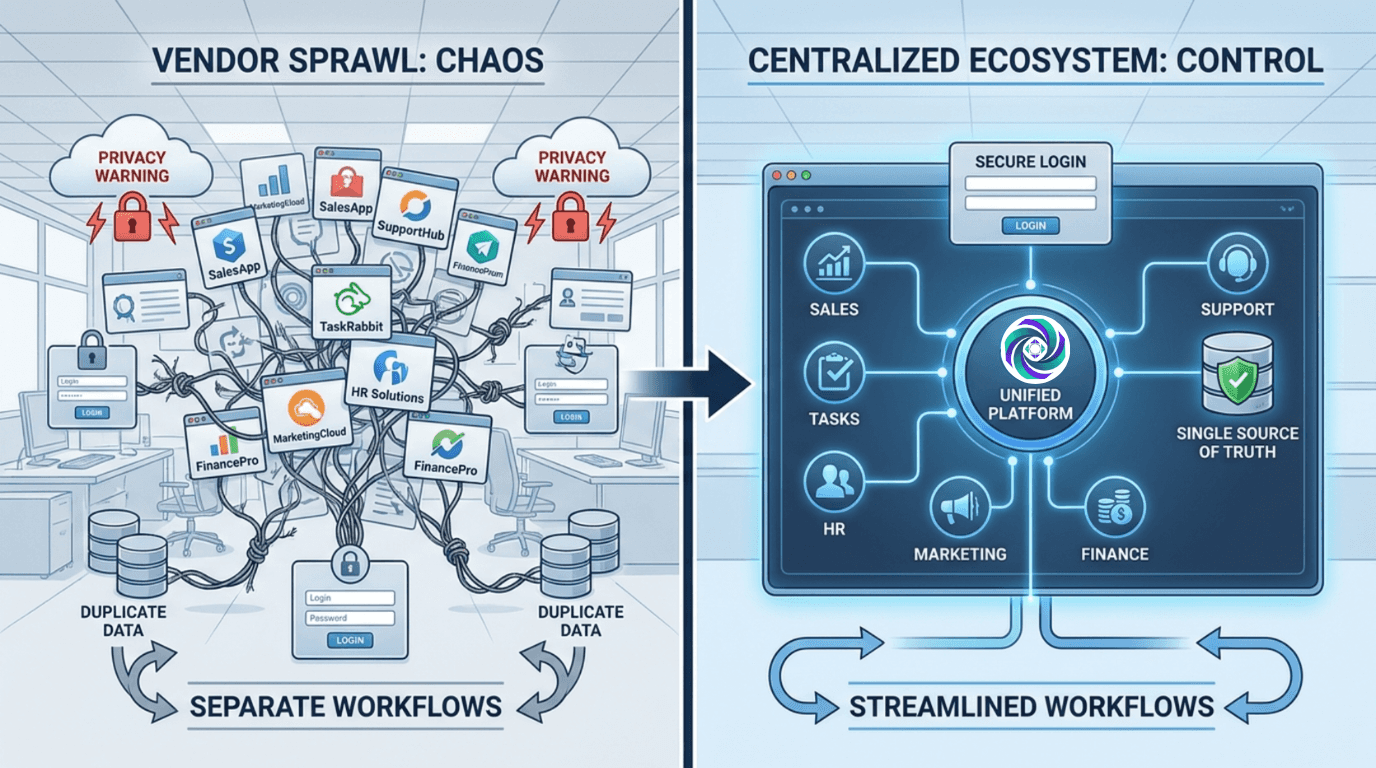
Vendor sprawl is one of the biggest hidden reasons DPDP compliance becomes expensive, confusing, and slow. When customer data, employee data, finance records, learning data, and operational workflows are spread across too many tools, organizations lose visibility, control, and accountability.
Under DPDP, that problem becomes even more serious because the organization remains responsible for how personal data is collected, used, stored, shared, and deleted — even when vendors are involved. Zopkit’s ecosystem approach addresses this by bringing CRM, Finance, HRMS, Projects, and Academy into one connected platform with shared identity, permissions, logs, retention-aware features, and secure integrations.
Table of Contents
- What vendor sprawl means in a DPDP context
- Why vendor sprawl creates compliance pain
- How Zopkit ecosystem solves the problem
- Module-by-module impact
- Comparison table: sprawl vs Zopkit
- Business benefits of consolidation
- Conclusion with CTA
I .What vendor sprawl means
Vendor sprawl happens when an organization uses too many overlapping applications that do not integrate cleanly or are hard to govern centrally. It usually starts when each department buys its own solution for CRM, HR, finance, support, communications, analytics, or training, and each tool develops its own rules and data storage behavior.
That creates a compliance headache because data is no longer easy to track end to end. The business must still explain what data it has, why it collects it, where it sends it, how long it keeps it, and which third parties can see it. If the stack is fragmented, those answers are harder to prove and harder to audit.
II . Why vendor sprawl hurts DPDP
The DPDP pain starts with visibility. When data lives across too many vendors, teams lose the ability to trace records clearly, and that makes privacy operations and audits much slower. Even basic questions — such as who accessed a record, which vendor stored it, or whether it was deleted — become cross-system investigations instead of simple queries.
The second pain point is control inconsistency. One vendor may have strong retention rules while another depends on manual clean-up. One system may have rich logs while another barely stores event history. One tool may support opt-out or consent changes while another only stores a checkbox.
The third pain point is risk multiplication. Vendor-risk guidance makes it clear that organizations cannot transfer compliance responsibility just by outsourcing processing. A single weak processor can expose the entire chain, especially if data sharing, retention, or incident handling is not consistent across the stack.
Common pain points include:
- Too many logins and admin consoles.
- Duplicate tools for similar workflows.
- Manual exports and re-entry between systems.
- Inconsistent retention and deletion practices.
- Scattered logs and audit evidence.
- Hidden processors and sub-processors.
III . How Zopkit solves it
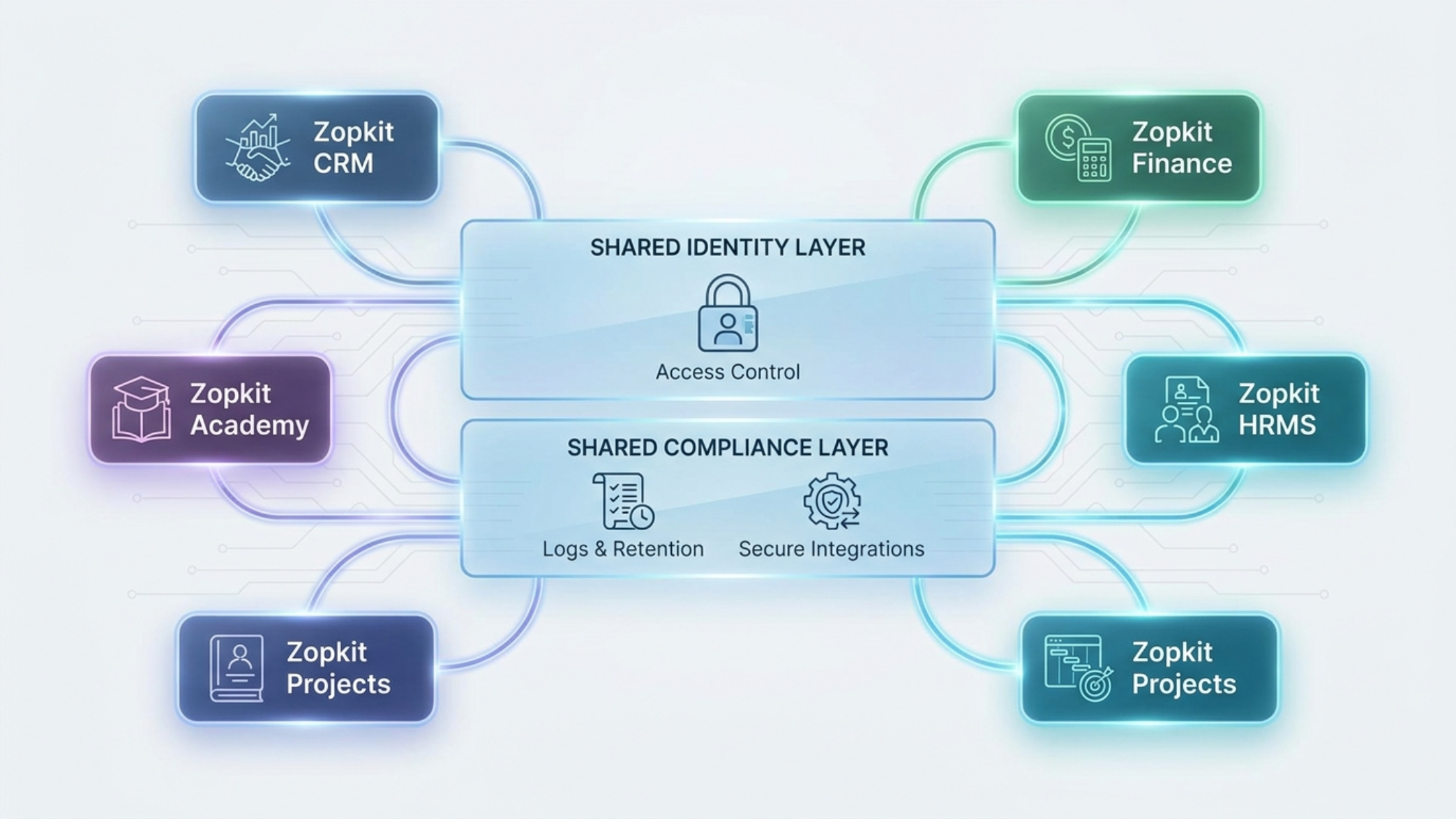
Zopkit reduces sprawl by acting as a unified ecosystem rather than a bundle of unrelated tools. CRM, Finance, HRMS, Projects, and Academy are designed within one product family, so they can share tenant boundaries, roles, identity, logs, and integration patterns.
That is important because consolidation is not only about saving software cost. It is also about reducing the number of places where personal data is stored, accessed, copied, and governed. Zopkit’s ecosystem design supports that goal by keeping more operational data inside one consistent architecture.
Shared identity
Zopkit uses shared identity and synced roles through Wrapper and Kinde in CRM, Finance, and HRMS, while Projects and Academy also use role-aware access and permission-gated navigation. This reduces duplicate user management across vendors and makes revocation, onboarding, and access review much easier.
Tenant isolation
CRM uses tenant-scoped records and row-level security hooks, Projects uses multi-tenant isolation with access checks before handlers, and HRMS and Finance also scope data by tenant or entity. This gives Zopkit a privacy boundary that is much stronger than the average sprawl-heavy stack.
Audit trail
CRM, Finance, HRMS, and Projects all include activity logs, audit logs, or security events. HRMS adds batched, partitioned activity logs with retention and archive support, which is especially valuable for compliance and investigation readiness. Instead of logging across many vendors, the organization can keep evidence inside a smaller number of systems.
Retention support
HRMS includes document retention policies, and Projects includes data retention policies per workspace. CRM also includes soft-delete and suppression behaviors that help manage customer communications and record lifecycle. These controls help organizations avoid keeping data indefinitely, which is a major DPDP risk.
Secure integrations
Zopkit uses APIs, OAuth, webhooks, and encrypted secrets across modules. That matters because integrations are often where vendor sprawl creates leaks and governance blind spots. By keeping those flows inside one ecosystem, Zopkit reduces the number of external processors and data handoffs.
IV . Module-by-module impact
CRM
Zopkit CRM unifies leads, accounts, pipeline, tickets, campaigns, email sync, and compliance-related communication features in one workspace. It also includes unsubscribe lists, suppression handling, and public preference surfaces, which means customer communication controls are built into the same product rather than delegated to another email vendor.
Finance
Finance combines entity-scoped accounting, RBAC, audit logs, credit visibility, and permission sync. That removes the need for separate finance tools for different parts of the control chain, reducing reconciliation problems and compliance drift.
HRMS
HRMS centralizes recruitment, employee records, time, leave, payroll, compliance, documents, performance, benefits, and ESOP. This is a major anti-sprawl advantage because HR data is typically the most fragmented across ATS, payroll, document storage, performance tools, and internal policy systems.
Projects
Projects consolidates task management, time tracking, analytics, workflows, documents, integrations, and webhooks. That means work execution, accountability, and audit evidence are closer together, which simplifies governance.
Academy
Academy brings courses, assessments, certificates, roadmaps, progress, and student administration into one environment. That avoids the common problem of learning data being split across one system for content, another for testing, and another for certificates.
V . Comparison table
Area | Vendor Sprawl | Zopkit Ecosystem |
|---|---|---|
Identity | Separate logins and admin systems | Shared identity through Wrapper and Kinde |
Access | Different permissions everywhere | Consistent RBAC across modules |
Data visibility | Hard to trace data across vendors | Tenant-scoped data in one ecosystem |
Auditability | Logs are fragmented or missing | Logs and activity trails across products |
Retention | Different tools, different rules | Retention support in HRMS and Projects |
Integrations | Many external processors | Fewer handoffs and secure integration patterns |
User controls | Opt-out and preference handling is inconsistent | Unsubscribe and preference surfaces are built in |
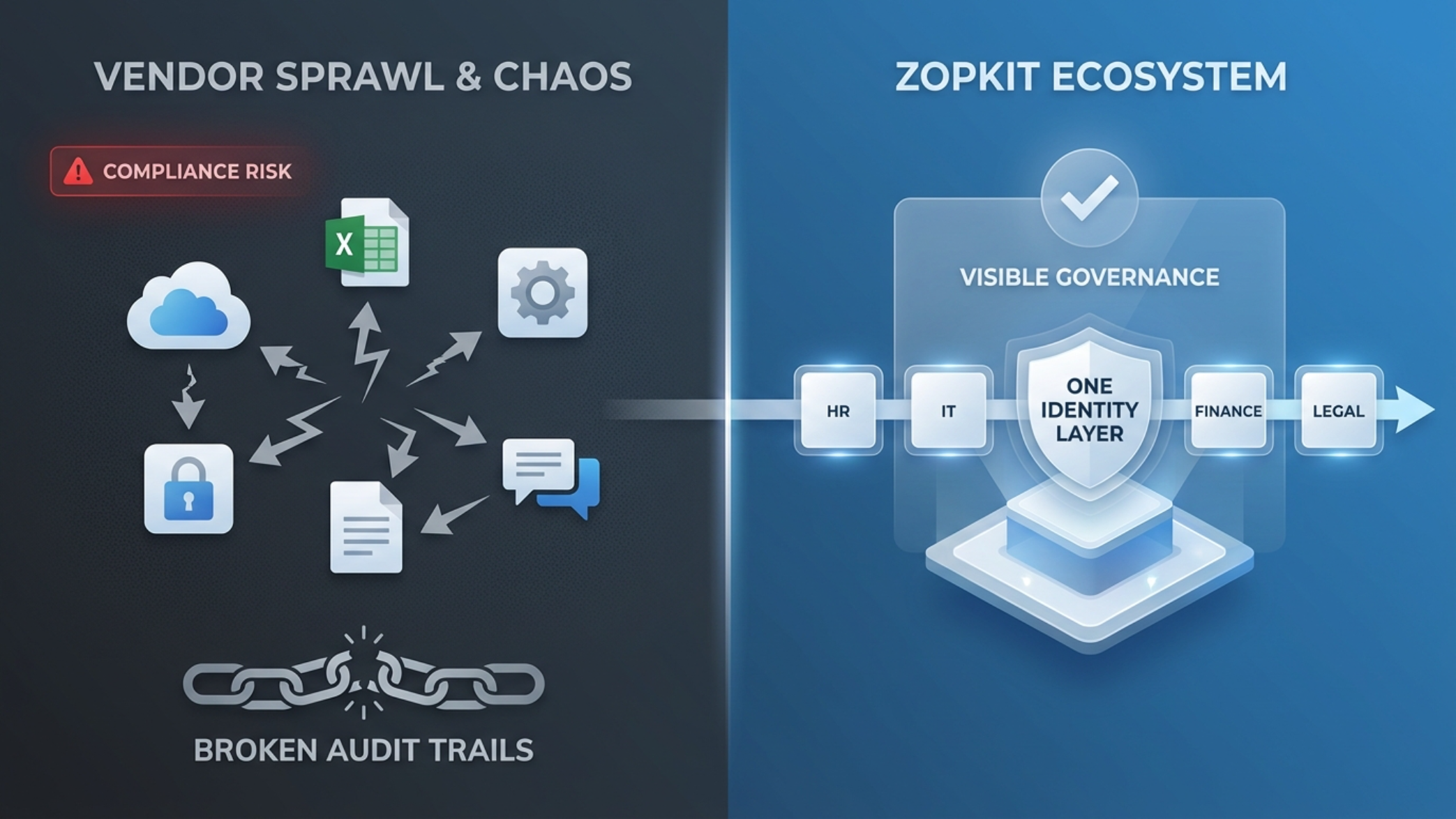
Compliance ownership | Hard to prove accountability | One ecosystem with clearer governance |
VI . Business benefits
The business case for reducing vendor sprawl is strong. Fewer tools mean fewer contracts, fewer renewals, fewer training paths, and less time spent reconciling data between systems. It also means fewer places for compliance gaps to hide, which makes audits, access reviews, and incident response much easier.
Zopkit turns that into a practical operating advantage by letting teams work in one ecosystem instead of juggling five or six disconnected products. That can lower cost, reduce friction, and improve privacy readiness at the same time.
Key benefits include:
- Lower software and integration overhead.
- Easier access reviews and offboarding.
- Better retention and deletion discipline.
- More reliable audit evidence.
- Stronger privacy-by-design posture.
VII .Conclusion
Vendor sprawl is not just a technology problem. Under DPDP, it becomes a compliance risk because it fragments data, permissions, logs, retention, and accountability across too many systems. A business may still be compliant in a sprawl-heavy environment, but it will need much more effort, discipline, and tooling to get there.
Zopkit solves this by bringing major business functions into one ecosystem with a common identity layer, tenant isolation, role-based access, audit logs, retention-aware features, and secure integrations. That gives organizations a much cleaner foundation for DPDP readiness because governance is embedded in the platform rather than bolted on after the fact.
If your organization is struggling with too many tools, too many vendors, and too many privacy gaps, Zopkit gives you a simpler path forward. Explore how CRM, Finance, HRMS, Projects, and Academy can run inside one connected ecosystem so your team can reduce vendor sprawl, improve control, and build a stronger DPDP-ready operating model.
visit : zopkit.com