The Multi-Centre Diagnostic Chain Is Running Its HR on Excel, Its Finance on Branch-Level Tally, and Its NABL Training on a Physical Register.
The NABL Assessor Wants All Three Next Thursday.
A diagnostic chain with 4 centres and 80 staff is not a large business by any conventional measure. But it is complex in ways that its tools were never designed to handle.
The complexity is not in any single centre. Each centre, viewed alone, is a manageable operation — 15 to 25 staff, a daily sample volume of 30 to 80, a billing counter, and a lab section with 2 to 4 technicians running analysers. The owner who started with one centre managed it comfortably with a basic billing software, a Tally installation, and a salary Excel.
The complexity appears at the chain level — the moment there are 4 centres, 80 staff across different locations, technicians who need to be shifted between centres when one is short-staffed, P&L visibility that the owner needs per centre (not just group-level), and a NABL accreditation requirement that mandates documented quality training for every technician, at every centre, with records that an external assessor can examine.
At this scale, the Excel that worked for one centre becomes 4 separate Excels that are never synchronised. The Tally installation that worked for one centre becomes 4 separate Tally databases that the CA has to consolidate manually before every quarterly review. The physical training register that was fine for 20 staff becomes a stack of folders across 4 locations, none of which the chain owner has seen in the last 3 months.
The NABL assessor who visits next Thursday does not accept "we'll compile and send you the records." They review what exists. And what exists, at a chain running disconnected tools, is always partially missing — spread across 4 locations, 4 admin managers, and 4 formats.
Zopkit covers HRMS, Finance, and Academy for the 50 to 100 staff diagnostic chain — multi-centre architecture built in, so the chain owner sees consolidated group data and individual centre data from one platform, without an integration project or a second set of tools.
Table of Contents
- The Multi-Centre Management Problem
- Zopkit HRMS: Technician Management Across All Centres
- Zopkit Finance: Centre-Level P&L and Group Consolidation
- Zopkit Academy: NABL Compliance Training Across All Centres
- The NABL Audit Readiness Scenario
- Centre-Level vs. Group-Level Visibility: How the Architecture Works
- Migration: From Disconnected Tools to Zopkit
- The Business Case
I. The Multi-Centre Management Problem
Three Layers of Complexity That Appear When a Diagnostic Chain Crosses Two Centres
Layer 1 — Staff management across locations:
The technician who works at Centre 1 but needs to cover Centre 3 for 2 weeks while a colleague is on leave creates a payroll attribution question (whose payroll budget?), an attendance question (who tracks his attendance at Centre 3?), and a compliance question (is his NABL training record accessible at Centre 3 if the assessor asks?). None of these questions have easy answers when each centre runs its own separate tools.
Layer 2 — Financial visibility without consolidation:
The chain owner who wants to know which centre is the most profitable — revenue per sample, revenue per staff member, operating cost as a percentage of revenue — cannot get this from 4 separate Tally databases without the CA's monthly consolidation exercise. The decision about where to invest (which centre to expand, which to investigate for cost overruns) is being made from data that is always 3 to 4 weeks old.
Layer 3 — Compliance training without a central record:
NABL accreditation under ISO 15189:2022 requires documented competency assessment and quality training for all technical staff. The chain that has 4 centres with 20 technical staff per centre — 80 technicians total — has 80 individual training records to maintain, update, and produce on demand for the assessor. Physical registers at 4 locations, maintained by 4 different lab managers, in 4 different formats, is not a compliance posture. It is a liability.
II. Zopkit HRMS: Technician Management Across All Centres
The Multi-Centre Staff Roster
Diagnostic chain technicians are not interchangeable — an MLT qualified to run haematology and biochemistry analysers is not automatically deployable on the microbiology section at another centre. But within their competency category, technicians do move between centres, cover leave, and operate in rotations. Managing this movement without a shared HRMS creates persistent confusion about who is where, whose attendance is being tracked, and whose payroll is being computed by which centre's admin manager.
In Zopkit HRMS, every technician has a single profile — not a profile per centre. The profile records their home centre (their primary posting), their competency category (haematology/biochemistry, microbiology, histopathology, phlebotomy, radiology support), their salary structure, and their accumulated leave balance. When a technician is temporarily deployed to another centre, the deployment is recorded in HRMS with a start and end date and a payroll attribution rule (salary charged to the receiving centre or split). The technician's attendance is tracked at the receiving centre. Their leave balance is maintained centrally. Their payroll is computed correctly regardless of which centre they were at on which day.
Shift Scheduling for a Multi-Centre Chain
A diagnostic chain that operates morning and afternoon shifts at all 4 centres is managing 8 shift slots per day. Minimum staffing requirements per shift per centre: at least 1 qualified MLT on the analyser section, 1 phlebotomist, and 1 receptionist for billing. When a technician calls in sick at Centre 2 on a Wednesday morning, the Centre 2 manager needs to know immediately whether there is a qualified technician at any nearby centre who can cover.
In Zopkit HRMS's multi-centre roster view, the chain owner or operations manager sees all 4 centres' shift coverage in one screen. The Wednesday morning gap at Centre 2 is flagged — and the operations manager can see that Centre 1 has a surplus technician on that shift who can cover. The inter-centre deployment is recorded as a temporary shift assignment, not an informal arrangement that creates payroll confusion at month-end.
The Group Payroll Run
For a 50 to 100 staff chain, the choice is between running 4 separate payroll processes (one per centre, managed by each centre's admin manager) or a centralised payroll run (group HR processes all 4 centres' payroll together from one Zopkit screen). Zopkit HRMS supports both:
Federated payroll: Each centre's admin manager processes their own centre's payroll in Zopkit. The chain owner sees a consolidated payroll cost dashboard after each centre completes its run. Payroll for temporary deployments (technicians who spent part of the month at a different centre) is attributed correctly based on the deployment records in HRMS.
Centralised payroll: The chain owner or group HR manager processes payroll for all 4 centres in one Zopkit payroll run. All staff appear in a single payroll screen, segmented by centre. One PF ECR, one ESI challan, one professional tax remittance — covering all staff across all centres. The CA receives one structured payroll output, not 4 separate centre-level summaries.

III. Zopkit Finance: Centre-Level P&L and Group Consolidation
The Financial Visibility a Diagnostic Chain Owner Needs
The chain owner who does not know which of their 4 centres is profitable and which is subsidised by the others cannot make a sound expansion or contraction decision. The question "which centre should I open a 5th branch near?" requires knowing the revenue per sample, revenue per square foot, and operating cost structure of each existing centre — information that lives in 4 separate Tally databases and requires 2 to 3 days of the CA's time to consolidate.
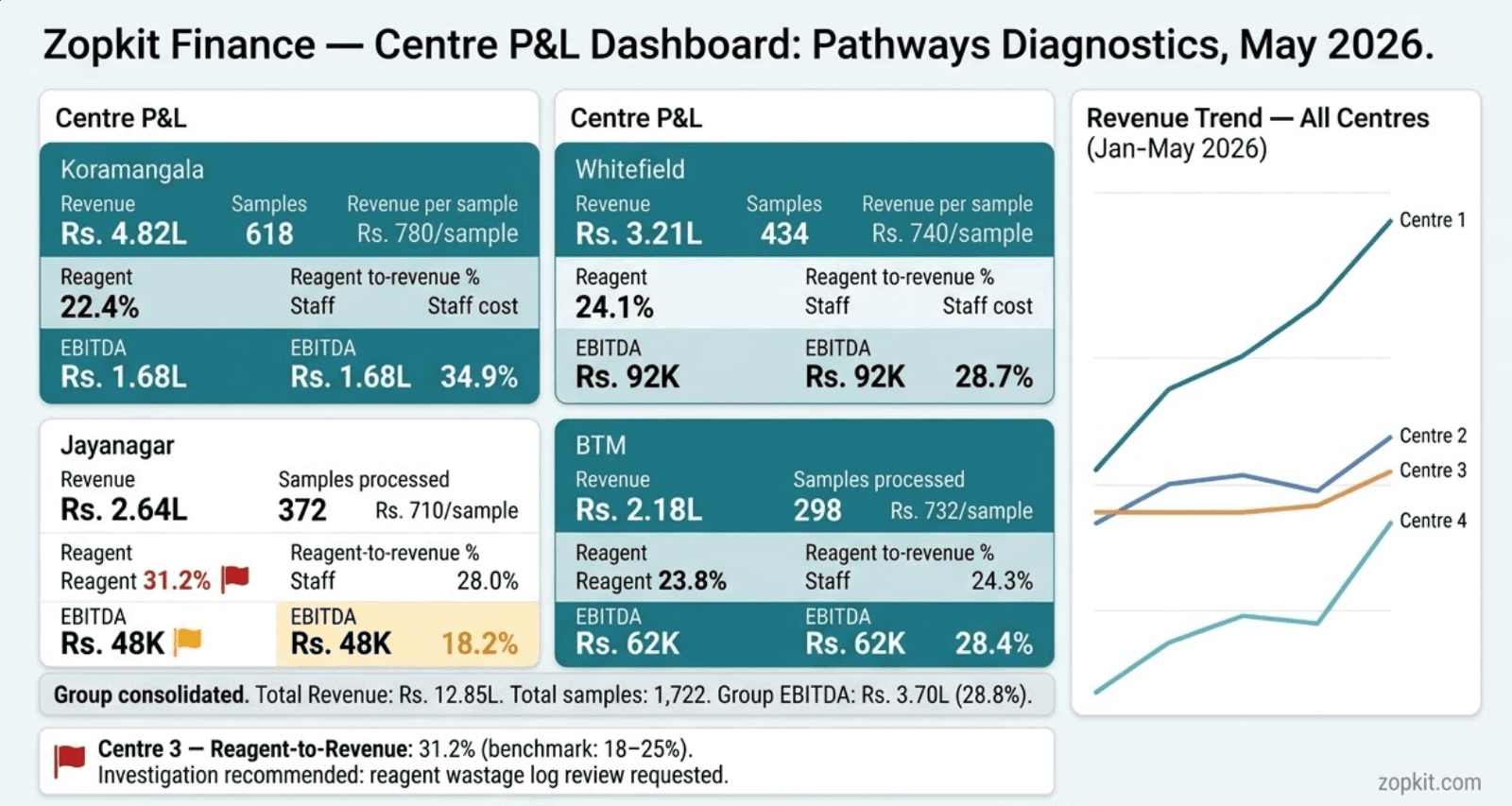
In Zopkit Finance for a multi-centre chain, the financial architecture mirrors the operational structure from day one. Every billing transaction is tagged to a centre. Every cost entry (reagents, staff salary, rent, consumables) is tagged to a centre. The centre-level P&L is a live computation — not a month-end consolidation exercise.
The Centre-Level P&L in Zopkit Finance
Revenue line:
All billing categories tracked by centre — walk-in, doctor-referred, corporate, home collection — with daily, weekly, and monthly totals. Revenue per sample (total revenue divided by total samples processed) as a daily-updated metric. Revenue trend vs. prior month and prior year for each centre.
Cost of services:
Reagent and consumable costs entered by each centre's lab manager (or imported from the chain's central procurement system). Reference lab charges (tests outsourced to a reference lab, billed to the patient but costing the chain the reference lab's rate) tracked as a cost line. Direct labour cost (technical staff payroll for each centre, pulled from HRMS) as a second cost line.
Operating expenses:
Centre rent, utility costs, equipment AMC charges, and administrative costs — entered monthly, tagged to each centre. The chain that allocates a portion of central overhead (group BD executive salary, group management costs) across centres can configure the allocation rules in Zopkit Finance.
Centre-level EBITDA:
Revenue minus cost of services minus operating expenses, computed continuously. The chain owner sees each centre's EBITDA margin — and the chain's combined EBITDA — without waiting for the CA's monthly summary.
The Reagent-to-Revenue Ratio: The Diagnostic Chain's Key Efficiency Metric
The most important operational efficiency metric for a diagnostic chain is the reagent-to-revenue ratio: reagent and consumable cost as a percentage of total revenue. Industry benchmark for a well-run diagnostic chain: 18 to 25%. A centre with a ratio above 28% is either pricing its tests too low, experiencing reagent wastage (calibrators and controls run more frequently than necessary, expired reagent written off), or running an analyser that has poor reagent efficiency at low volumes.
In Zopkit Finance, the reagent-to-revenue ratio is a configured metric on the centre-level P&L dashboard. The chain owner who sees Centre 3 running at a 31% ratio flags it for investigation — and the centre manager's reagent usage log (entered in Zopkit) provides the data for diagnosis.

Group-Level Financial Consolidation
The chain's CA who previously received 4 Tally exports on different days and spent half a day consolidating them for the quarterly review now receives one structured export from Zopkit Finance. The export includes:
- Group consolidated P&L (all 4 centres combined)
- Centre-level P&L (each centre's standalone financials)
- Intercompany entries (if the chain has a central purchasing entity that supplies reagents to centres at a transfer price)
- GST summary per GSTIN (each centre may have its own GSTIN, or the chain may operate under a single GSTIN depending on its legal structure)
- TDS summary for vendor payments across all centres
The CA's consolidation work is eliminated. The chain owner's quarterly review is a 30-minute Zopkit Finance review, not a 3-day wait for the CA's consolidated spreadsheet.
IV. Zopkit Academy: NABL Compliance Training Across All Centres
What NABL ISO 15189:2022 Requires in Terms of Staff Training Documentation
ISO 15189:2022 — the international standard for medical laboratory quality and competence, under which NABL accredits diagnostic labs in India — has specific requirements for staff training and competency documentation under Clause 6.2 (Personnel). The requirements relevant to a diagnostic chain's training management:
Clause 6.2.2 — Competence requirements: The lab must define competence requirements for each role that affects examination results. For MLTs and phlebotomists, this means documented competency in the specific examinations they perform.
Clause 6.2.3 — Authorization: Staff must be authorised to perform specific examination functions only after documented competency assessment. New joiners must complete competency assessment before performing examinations independently.
Clause 6.2.4 — Continuing education and professional development: The lab must have a programme for continuing education and document staff participation.
Clause 6.2.5 — Competency assessment: Staff competency must be reassessed periodically (typically annually for ongoing staff, immediately after any significant process change or equipment upgrade).
The diagnostic chain with 80 technical staff across 4 centres has 80 competency records to maintain — each with initial assessment documentation, periodic reassessment records, and continuing education logs. Physical registers maintained by individual lab managers cannot produce this documentation reliably on demand. Zopkit Academy can.
The NABL Training Matrix in Zopkit Academy
In Zopkit Academy for a diagnostic chain, the training matrix is configured around the NABL ISO 15189 personnel requirements:
Programme 1 — Pre-examination procedures:
Collection procedures, sample acceptance criteria, sample labelling, chain of custody. Mandatory for all phlebotomists and MLTs. Annual recertification.
Programme 2 — Examination procedures by department:
Department-specific: haematology (cell counter operation, manual differential, QC procedures), biochemistry (analyser operation, reagent handling, calibration), microbiology (culture media preparation, identification procedures, biosafety), histopathology (tissue processing, staining, safety). Role-specific — only staff performing these examinations are enrolled.
Programme 3 — Quality control and internal QC procedures:
QC rule interpretation (Westgard rules), internal QC documentation, corrective action for out-of-control situations. Mandatory for all technical staff performing quantitative examinations.
Programme 4 — Biosafety and infection control:
Personal protective equipment, sharps disposal, spillage management, biological waste segregation. Mandatory for all laboratory staff including support staff.
Programme 5 — Equipment maintenance logs:
Basic equipment maintenance procedures, malfunction reporting, and calibration record interpretation. Role-specific for staff assigned to equipment maintenance responsibilities.
Programme 6 — New joiner competency assessment:
Structured 30-day competency assessment programme for all new technical joiners, documented in Zopkit Academy. Assessment milestones tracked. The new MLT does not perform independent examinations until the Zopkit competency record shows all assessment milestones cleared.

V. The NABL Audit Readiness Scenario
Centre 3: NABL Assessment in 66 Days, Compliance at 64%
The assessor from NABL visiting Centre 3 on August 14 will request documentation for the following personnel-related items under ISO 15189:2022 Clause 6.2:
- Competency records for all technical staff performing examinations — initial assessment and most recent annual reassessment
- Continuing education log for all staff — programmes completed in the last 12 months, with attendance records
- Authorization records — which staff are authorized to perform which examinations independently
- Training records for any new joiners in the last 12 months — 30-day competency assessment milestones
On disconnected tools (physical registers, individual lab manager folders), assembling this documentation on August 13 for 20 technical staff requires 2 to 3 days of the lab manager's time, produces documentation that is partially missing, and reveals gaps that there is no longer time to remedy.
In Zopkit Academy, the Centre 3 lab manager opens the NABL documentation export on August 13 and generates:
- A competency record PDF for each of the 20 technical staff — initial assessment date, assessment scope, authorized examinations, annual reassessment date
- A continuing education log for each staff member — all programmes completed in Zopkit Academy in the last 12 months, with completion date and assessment score
- A group authorization matrix — which staff is authorized for which examination category
The export is ready in 15 minutes. The documentation is complete because the training was recorded in Zopkit as it happened — not reconstructed the day before the assessment.
The 66-day remediation plan (for the 26% non-compliant staff):

All 4 remediation actions are tracked in Zopkit Academy as scheduled sessions. As each completion is recorded, the compliance matrix updates. The chain owner sees the percentage moving from 64% toward 100% in real time — not through email updates from the Centre 3 lab manager.
VI. Centre-Level vs. Group-Level Visibility: How the Architecture Works
The Three Access Layers in Zopkit for a Multi-Centre Chain
Centre-level access (lab manager or centre admin):
Each centre's lab manager sees their centre's staff, roster, payroll inputs, Finance transactions, and Academy compliance status. They can record attendance, log training completions, enter billing transactions, and flag deployment needs. They cannot see other centres' data.
Group-level access (chain owner or operations manager):
The chain owner sees consolidated data across all centres — group HRMS, group Finance P&L, group Academy compliance matrix. They can drill into any centre's data. They see every inter-centre deployment, every centre's payroll cost, and every centre's NABL compliance status from one dashboard. They can assign group-level training programmes to all centres simultaneously.
Specialist access (CA, NABL consultant, auditor):
External users can be given read-only access to specific modules — the CA sees Finance data only, the NABL consultant sees Academy compliance data only. They do not see HR salary data or billing details unless explicitly granted.
This three-layer architecture means the chain owner has full visibility without every centre admin manager needing to send weekly summaries. The chain's information flows up automatically as centre-level transactions are recorded.

VII. Migration: From Disconnected Tools to Zopkit
The 8-Week Setup for a 4-Centre Chain
The multi-centre diagnostic chain that moves from 4 separate tools to Zopkit follows a structured 8-week onboarding:
Weeks 1 to 2 — Foundation setup:
Group account structure configured. 4 centres created as sub-accounts. Staff profiles created for all 83 staff (data imported from existing HR Excel or entered from employment contracts). Salary structures configured per staff category. Centre-level access assigned to each centre's admin manager.
Weeks 3 to 4 — Payroll parallel run:
The June payroll is run in both the old method and Zopkit simultaneously. Any discrepancies are identified and resolved. The July payroll is the first live payroll in Zopkit. Old payroll Excel retired.
Weeks 5 to 6 — Finance live:
All 4 centres begin recording billing transactions in Zopkit Finance. Existing open corporate account balances entered as opening balances. Historical billing data for the current financial year entered as a summary (not transaction-by-transaction) for YTD comparisons.
Weeks 7 to 8 — Academy live:
NABL training matrix configured. All 6 mandatory programmes created in Zopkit Academy. Existing training records (from physical registers) entered for all 83 staff — a one-time data entry effort that the lab managers at each centre complete over 2 to 3 days. From week 8, all new training completions are recorded in Zopkit Academy.
By the end of week 8: all 4 centres are live on HRMS, Finance, and Academy. The chain owner sees the group dashboard with real data for the first time.
VIII. The Business Case
Three Quantifiable Value Drivers
Value Driver 1 — CA consolidation time eliminated:
A 4-centre chain's CA currently spends 1 to 1.5 days per month consolidating 4 Tally databases into a group P&L. At Rs. 6,000 to Rs. 8,000 per day (billed consulting rate or opportunity cost), this is Rs. 72,000 to Rs. 1.44 lakh per year in consolidation effort — eliminated when Zopkit Finance provides live consolidated data.
Value Driver 2 — NABL non-compliance risk mitigated:
A NABL accreditation suspension for one centre in a 4-centre chain has downstream consequences across the entire chain's reputation and CGHS/TPA empanelment. The cost of a suspension — remediation, re-assessment fees, revenue loss during suspension, corporate account cancellations — ranges from Rs. 8 to 20 lakh for a medium-sized centre. A compliance dashboard that identifies a centre at 64% compliance 66 days before its assessment converts a potential suspension into a managed 8-week remediation.
Value Driver 3 — Technician deployment efficiency:
A chain that can identify in real time that Centre 3 has a surplus technician on the morning shift and Centre 2 has a gap reduces its reliance on contract or temporary technician hiring. One avoided temp technician placement per month (Rs. 600 to Rs. 1,200 per day for a temp MLT, for an average of 5 to 7 days per requirement) saves Rs. 3,000 to Rs. 8,400 per month — Rs. 36,000 to Rs. 1 lakh per year.
Combined value from these three drivers alone: Rs. 1.5 to Rs. 3 lakh per year for a 4-centre, 80-staff chain — before accounting for the strategic value of real-time P&L visibility enabling better expansion decisions.

Conclusion
The Chain That Sees All Four Centres Clearly Makes Better Decisions Than the Chain That Sees One at a Time
The diagnostic chain that has grown to 4 centres and 80 staff has already demonstrated the most difficult thing in the Indian diagnostics market: it built a quality-driven, relationship-dependent business from a standing start, without the procurement scale or marketing budget of the national chains.
What it has not yet built is the operational infrastructure that matches its current size. Four Excels, four Tallys, and four physical NABL registers is the infrastructure of four separate single-centre labs — not a chain. The chain owner who manages all four from these disconnected tools is spending 30 to 40% of their management time on information assembly — consolidating, chasing, and reconciling data that should be available instantly.
Zopkit gives the 50 to 100 staff diagnostic chain the one thing the large chains have that you do not: a single operational platform where every centre's HR, Finance, and compliance data flows into one view, automatically, in real time. Not because you have an IT team. Because the architecture is built for multi-centre operations from the start.
The NABL assessor who arrives at Centre 3 in 66 days sees complete, current, well-organised documentation. The chain owner who opens their dashboard on a Monday morning sees all 4 centres' P&L, staffing gaps, and compliance status before the first coffee. The CA who arrives for the quarterly review receives one structured export, not four.
Four centres. One platform. Start at zopkit.com. Full setup in 8 weeks.