How to Scale a Hotel or Homestay in India
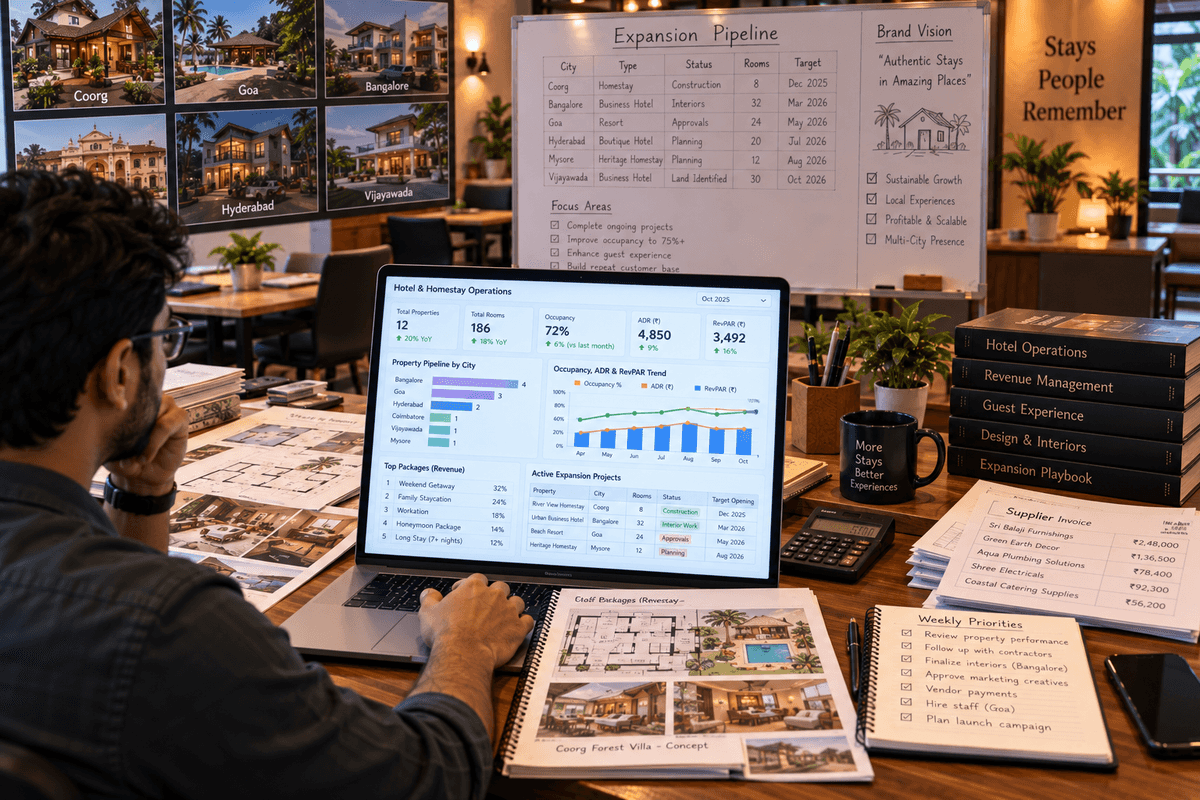
Scaling a hotel or homestay business in India is not just about adding more properties or rooms. It means turning a working single-property or small portfolio model into a repeatable, multi-property and multi-city business with standardized rooms and experiences, strong central operations and quality control, disciplined unit economics, a capable leadership team, and systems that can handle growth without losing control over guest experience, cost, service, and brand reputation.
If you are still choosing your concept, researching your target guests and locations, arranging registrations and licences, planning investment, and setting up your first property, start with the “How to Start a Boutique Hotel or Homestay in India” guide first. If you are still fixing room mix, pricing, repeat guests, and basic operations, use the “How to Grow a Boutique Hotel or Homestay in India” guide before thinking about scale.

Related Guide:
How to Start a Hotel or Homestay in India
Use that guide to understand:
- Business models and formats (boutique hotel, heritage stay, homestay, cluster)
- Market and guest research
- Property and location strategy
- Business registration, licences, and compliance
- Investment and unit economics
- Rooms, common areas, and experience basics
- Core team structure and systems

Related Guide:
How to Grow a Hotel or Homestay in India
Use that guide to understand:
- Property performance and unit economics
- Room mix, pricing, and revenue management
- Average stay value and revenue levers
- Guest loyalty and repeat business
- Social media, experiences, and local presence
- Supply, cost, and operations control
- SOPs, team, and training basics
Scaling starts where growth leaves off. Once you have a stable, reasonably profitable set of properties and locations with repeat business and known demand patterns, you can think about multiplying that model across more cities, formats, and partnerships.
This guide explains how to move from a growing hotel or homestay business to a more structured, multi-property and multi-city venture.
Table of Contents
- Confirm that the core business is ready for scale
- Standardize the guest and property experience
- Build a scalable room and experience architecture
- Centralize operations, supply, and quality control
- Design a repeatable expansion and new format playbook
- Expand into new cities and formats with discipline
- Strengthen digital, loyalty, and direct channels at scale
- Protect margins, cash flow, and brand risk
- Build a leadership team and talent pipeline
- Use Zopkit and a hotel or homestay backbone to manage scale
1. Confirm That the Core Business Is Ready for Scale
Scaling multiplies whatever your current hotel or homestay business is. If the base is weak, scale just spreads problems faster.
Check whether your existing operations have:
- Consistent monthly occupancy and predictable demand patterns by property and season
- Positive contribution after variable costs (linen, toiletries, housekeeping labour, utilities, F and B)
- Stable ADR, RevPAR, and cost percentages across properties
- Repeat guests and acceptable feedback and ratings
- Reliable suppliers and basic inventory accuracy
- Managers or hosts who can run properties with limited day-to-day intervention
Review:
- Business-level P and L for at least six to twelve months
- Average revenue per property and per available room
- Cost variance and wastage by property and category
- Staff turnover and training gaps
- Cash flow cycles: when money comes in from guests and goes out to suppliers, staff, and overheads
If the business still struggles with basic profitability, inconsistent quality, high staff churn, or chaotic property operations, focus on growth and stabilization before scale. Scaling should extend a working pattern, not multiply chaos.
2. Standardize the Guest and Property Experience
A scalable hotel or homestay business needs a consistent experience, whether a guest visits your property in a hill station, a beach town, or a heritage city.
Standardize:
- Branding, room types, and pricing logic across all properties and channels
- Booking flow on your website, WhatsApp, and OTAs
- Service scripts for front desk, housekeeping, F and B, and experiences
- Room setup, amenities, and presentation standards
Document simple standards:
- Expected check in and check out flows, including welcome and farewell rituals
- Cleanliness and hygiene routines for rooms, common areas, kitchen, and F and B
- Handling of special requests, dietary needs, and last-minute changes
- Escalation rules for serious issues and refunds
Aim for:
- Familiar quality and feel across all properties and channels
- Predictable room quality, service, and experience even when staff change
- Clear rules on discounts, offers, and complaints
Once the experience is standardized, you can add new properties, cities, and formats without reinventing the guest promise each time.
Zopkit Project Management can help you turn these standards into tasks, checklists, and recurring reviews so they remain consistent over time.
3. Build a Scalable Room and Experience Architecture
Scaling is not just adding random room types or experiences. It is about designing a room and experience system that can be replicated and extended.
Design your rooms for scale:
- Focus each property or format on a limited set of room types that can be made consistent and profitable
- Balance high demand room types with high margin defenders (premium suites, signature rooms)
- Use clear room categories and packages that guide guest choices
- Ensure each room type travels well across locations and seasons
Standardize room and experience elements:
- Document exact room setup standards for linen, amenities, and layout
- Define cleaning and maintenance routines for rooms and common areas
- Set check in and check out flows, including welcome rituals and farewell touches
- Create simple service scripts for front desk, housekeeping, F and B, and experiences
Design experience architecture for replication:
- Use standard experience flows for different formats (boutique hotel, homestay, cluster, managed property)
- Standardize equipment and setup patterns for F and B, activities, and common areas
- Limit the number of customizations per property to what your team can handle well
- Keep format positioning clear (for example, economy homestays, premium boutique stays, experience led clusters)
A scalable room and experience architecture make training easier, reduce waste, and improve consistency as you add properties and cities.
4. Centralize Operations, Supply, and Quality Control
As you add properties, formats, and cities, a central operations and supply backbone becomes critical.
Set up:
- Centralized procurement for key items such as linen, toiletries, F and B ingredients, and cleaning supplies
- Approved vendor lists with clear quality, delivery, and compliance standards
- A central operations team to oversee multiple properties and ensure standards
- Simple distribution routines to supply properties on a regular schedule
Implement quality control:
- Define specifications for rooms, F and B, and experience elements
- Conduct regular quality checks at property level and during guest stays
- Track wastage, spoilage, and variance by property and format
- Enforce hygiene and safety standards across all operations
Track:
- Supplier performance on price, quality, and timeliness
- Inventory levels and usage patterns for rooms and F and B
- Variance between expected and actual cost per occupied room
A disciplined central operations and supply system protects margins, consistency, and brand reputation as the business grows.
Zopkit Finance and Project Management can support:
- Central tracking of purchase orders, supplier bills, and costs
- Projects for cost optimization, wastage reduction, and supplier audits
- Property wise and format wise profitability analyses that highlight where cost or supply is off track
5. Design a Repeatable Expansion and New Format Playbook
Scaling is easier when each new property, city, or format follows a clear, repeatable process.
Create an expansion playbook that covers:
- Format selection criteria (boutique hotel, homestay, cluster, managed property)
- City and zone selection criteria (demand, competition, average ADR and occupancy)
- Site selection rules for properties (rent or purchase benchmarks, access, infrastructure)
- Standard legal and contract checklists
- Room and experience setup standards for each format
- Pre-launch marketing and guest outreach plan
- Staffing plan and training schedule
- Go-live checklist and first 90 days performance targets
Use this playbook to:
- Reduce ad hoc decisions for each new property or city
- Shorten time from decision to launch
- Ensure every new property or location starts with the same foundation
Zopkit Project Management can hold this playbook as a template with tasks, dates, responsibilities, and checklists for each new initiative, making expansion more predictable.
6. Expand Into New Cities and Formats With Discipline
Scaling often means entering new cities and sometimes new formats. Discipline here is crucial.
Before entering a new city:
- Confirm that your unit economics work in your current city
- Ensure your operations and supply chain can support another city or plan local support
- Make sure your core team can manage more locations without losing control
- Study the new city’s demand patterns, competition, and price sensitivity
Choose formats wisely:
- Boutique hotels for premium leisure and business travellers in key destinations
- Homestays for weekend getaways, family trips, and budget to mid range travellers
- Cluster or village style stays for nature, culture, and wellness focused guests
- Managed or leased properties where ownership is difficult but operations can be standardized
Expand in phases:
- Phase 1: Strengthen existing properties and fix weak ones
- Phase 2: Add a small number of new properties or formats in known markets
- Phase 3: Enter new cities once your team, operations, and systems are ready
- Phase 4: Consider franchise, management, or partnership models where direct management is harder
Use Zopkit Project Management and Finance to:
- Plan expansion budgets and timelines
- Track new property and city launch tasks and dependencies
- Monitor performance of new properties and locations against targets from day one
Controlled, phased expansion makes it more likely that growth will stick instead of creating fragile, overextended operations.
7. Strengthen Digital, Loyalty, and Direct Channels at Scale
At scale, relying only on OTAs or one-off bookings is risky. Building your own digital and loyalty channels becomes important.
Strengthen digital:
- Improve your own booking channels (website, WhatsApp, simple booking engine)
- Use data from all properties and channels to understand guest behaviour and preferences
- Optimize digital room types and packages for clarity and upsell opportunities
Build loyalty:
- Simple points or stay based structures that work across properties and cities
- Clear benefits for repeat guests (priority booking, special rates, occasional perks)
- Easy enrolment and tracking (guest ID or mobile number based)
Shift towards direct:
- Use referrals and partnerships for discovery and new guest acquisition
- Encourage repeat guests to book directly through better service and simple benefits
- Capture guest data in your own systems instead of only in personal contacts or scattered sheets
Zopkit CRM can help:
- Maintain guest profiles across properties and cities
- Segment guests by frequency, spend, and preferences
- Run targeted campaigns and loyalty programs centrally
Strong digital and loyalty channels reduce dependency on random bookings and improve margins at scale.
8. Protect Margins, Cash Flow, and Brand Risk
Growth without discipline can quickly damage profits and reputation.
Protect margins:
- Regularly review property wise and city wise margins
- Avoid blanket discount strategies that erode value; target specific promotional items
- Watch for low occupancy periods and high cost properties that quietly eat profit
Guard cash flow:
- Track receivables from corporate contracts, groups, and events
- Plan capex for new properties, renovations, and cities with realistic budgets and buffers
- Maintain a cash reserve for unexpected shortfalls or opportunities
Manage brand risk:
- Ensure room quality and safety standards are consistent across all properties and cities
- Keep service standards and complaint handling uniform
- Monitor feedback and reviews closely and act on recurring issues
Scaling should make the business sturdier, not more fragile. Numbers and policies must be as strong as marketing and relationships.
Zopkit Finance provides the visibility and simple analysis you need to spot margin and cash flow issues early and take corrective action.
9. Build a Leadership Team and Talent Pipeline
A hotel or homestay business cannot scale on founder-led management alone. You need a strong leadership team and talent pipeline.
Define a leadership structure:
- Regional or city managers responsible for clusters of properties and operations
- Central heads for operations, supply, quality, HR, training, and finance
- Clear reporting lines and decision rights
Build talent pipelines:
- Hiring programs for property managers, front desk leads, housekeeping supervisors, and F and B captains
- Training academies or structured programs for managers and supervisors
- Continuous reskilling on new room types, experiences, processes, and leadership skills
Invest in people:
- Competitive compensation and clear growth paths
- Regular feedback and performance reviews
- Recognition and rewards for high performers
Zopkit HRMS and Academy can:
- Maintain staff records, roles, and attendance across cities and formats
- Assign and track training modules for different levels
- Record completions and assessment outcomes
The stronger your leadership and talent pipeline, the easier it becomes to scale without hitting a people bottleneck.
10. Use Zopkit and a Hotel or Homestay Backbone to Manage Scale
Once you are operating across multiple properties, formats, and cities, a clear backbone becomes essential.
A practical backbone for a scaling hotel or homestay business should connect:
- Room types, rates, and experience master data
- Inventory and procurement across properties and any central storage
- Purchase orders and supplier payments
- Property wise and format wise revenue and cost data
- Guest profiles, stay history, feedback, and loyalty data
- Projects such as new city launches, new format pilots, room updates, and process improvements
- Staff records, roles, attendance, and training across regions
- Core financial flows: P and L per property and city, consolidated results, cash flow
Zopkit can be that backbone:
- Zopkit CRM keeps guest, stay, and loyalty information structured and usable
- Zopkit Finance tracks invoices, supplier bills, expenses, cash flow, budgets, and profitability
- Zopkit Project Management organizes expansion projects, room launches, and operational improvements
- Zopkit HRMS manages staff hierarchy, attendance, and payroll across locations
- Zopkit Academy provides training content for operations, service, safety, and leadership
With systems like this, scaling becomes about executing well-understood plans, not constant firefighting.
Conclusion
Scaling a hotel or homestay business in India is not just about more properties or more cities. It is about confirming that your base business is healthy, standardizing experience and rooms, building a scalable room and experience architecture, centralizing operations and quality control, designing a repeatable expansion playbook, entering new cities and formats with discipline, strengthening digital and loyalty channels, protecting margins and cash flow, and building a leadership team and talent pipeline that can handle growth.
When this expansion is supported by a connected backbone for guests, finance, projects, people, and training, the business becomes easier to multiply and sustain.
Zopkit supports this wider operating system through CRM, Finance, Project Management, HRMS, and Academy, helping hotel and homestay businesses manage guests, stock, suppliers, payments, staff, and learning as they scale.
Explore how Zopkit can support your hotel or homestay business at zopkit.com.