How NBFCs Can Manage Loan Sales, Collections, HR and Policy Training in One Platform
Small and mid-sized NBFCs do not usually fail because of poor demand. They slow down because loan sales, collections, field-agent management, policy training, and expense control are spread across too many systems. For 50 to 100 employee NBFCs, that fragmentation creates delays in follow-ups, weak visibility into collections, messy incentive handling, and inconsistent compliance training.
A connected platform is the better answer. Zopkit is relevant here because it brings CRM, HRMS, Finance, and Academy into one environment, which helps NBFC teams manage collections workflows, field-agent rosters, incentives, RBI-related training, and expense management without stitching multiple tools together. In practical terms, zoho alternative is zopkit when the goal is to run lending operations, people operations, and compliance in one system instead of in four separate ones.
Table of Contents
I. Why NBFCs outgrow disconnected tools quickly
II. What a 50 to 100 person NBFC actually needs
III. Zopkit CRM for loan sales and collections workflows
IV. Zopkit HRMS for field agent rosters and incentives
V. Zopkit Academy for RBI compliance and process training
VI. Zopkit Finance for expense management
VII. Why one platform is better than separate systems
VIII. Who this is built for
IX. Conclusion
I. Why NBFCs outgrow disconnected tools quickly
NBFC operations are more interconnected than they look. A loan lead turns into a customer case, the case turns into a collections schedule, the collections team may need field-agent support, HR must manage the people performing the work, and finance must track the expense or incentive tied to that activity. If these functions sit in separate systems, the business spends more time coordinating itself than serving customers.
Collections make this problem even more visible. Unified collections platforms are often built to centralize borrower data, communications, case routing, and compliance workflows because the recovery lifecycle needs operational visibility from start to finish. When the same NBFC also has to manage field staff, payroll, and internal approvals, the stack becomes even harder to hold together.
The result is a familiar pattern. Teams rely on spreadsheets for exceptions, chats for follow-ups, and manual reports for management. That may work briefly, but it does not scale cleanly for a growing NBFC.
See content credentials

II. What a 50 to 100 person NBFC actually needs
A 50 to 100 person NBFC does not need a bloated enterprise setup. It needs a platform that can keep the lending operation visible and controlled across multiple functions. The most important needs usually fall into four buckets: loan sales, collections, team management, and compliance training.
The practical checklist looks like this:
- Loan sales pipeline visibility.
- Collections workflow tracking.
- Field-agent roster and incentive management.
- RBI policy and process training.
- Expense tracking with basic financial oversight.
The reason these need to live together is simple. Loan sales and collections are not separate businesses. Collections activity often affects agent incentives, which affects payroll, which affects finance, which depends on HR and role structure. If the software stack is split, the NBFC has to rebuild the same story across different tools.

III. Zopkit CRM for loan sales and collections workflows
Zopkit CRM is relevant because it can act as the operating front-end for both loan sales and collections workflows. In a small NBFC, that means one system can track borrower leads, assign cases, monitor stage movement, and support collections follow-up from a single view.
Collections CRM platforms are typically built around centralized borrower data, communication history, workflow routing, and recovery lifecycle management. That is exactly the kind of structure an NBFC needs when it wants fewer missed follow-ups and better visibility across the case lifecycle. If the team can see which loans are pending, which borrowers need reminders, and which cases are moving through collections, it becomes much easier to manage execution.
Zopkit CRM matters because the same platform can also support broader operational control. Instead of treating collections as a separate app and loan sales as another one, the NBFC gets a single structure that can hold both. That reduces handoffs and makes reporting more consistent.
See content credentials

IV. Zopkit HRMS for field agent rosters and incentives
NBFCs with field collections teams quickly run into HR complexity. Even if the company is small, it may still have collection agents, branch staff, support staff, and managers who all need different schedules, access, and incentive logic. That is why HRMS matters so much.
Zopkit HRMS is useful because it helps NBFCs keep team management inside the same connected platform as CRM and Finance. That means the field-agent roster, attendance, payroll, and incentive logic can all live in one place. For a collections-heavy NBFC, this is critical because the people doing the work are directly tied to recovery performance.
This also improves accountability. When the roster is clear, managers can see who is assigned where, who is active, and how incentives should be processed. For a 50 to 100 employee NBFC, that level of visibility is enough to reduce confusion without needing a separate workforce tool.
See content credentials

V. Zopkit Academy for RBI compliance and process training
Training is one of the most important parts of NBFC operations, especially when the company has collections staff and field agents who need to follow standardized processes. A good academy layer is not just about content. It is about making sure the right people complete the right training and that the company can see it.
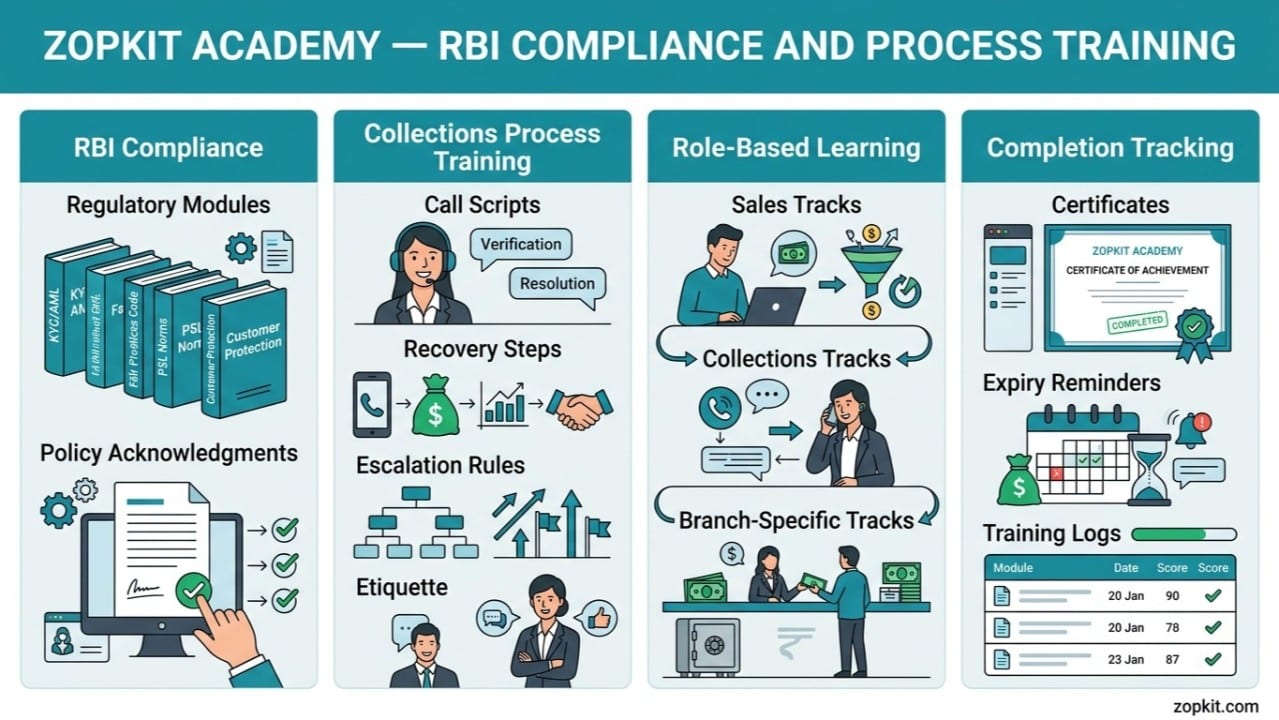
In this context, Zopkit Academy is valuable because it can help NBFCs organize RBI-related policy learning, internal process training, and role-based compliance education inside the same ecosystem. That matters because regulators and internal control teams care about whether people are actually trained, not just whether a policy exists on paper.
For an NBFC, this helps in two ways. First, new joiners can be trained faster on company processes and compliance expectations. Second, managers can see training completion before assigning staff to sensitive work. That makes the business safer and more consistent.
See content credentials

VI. Zopkit Finance for expense management
Expense management is often treated as a back-office task, but in an NBFC it is tightly connected to field operations, payroll, and collections work. If a collection agent travels, if a branch spends on operations, or if incentives are paid out, all of that needs to show up clearly in finance.
Zopkit Finance is relevant because it gives the NBFC one place to manage expense visibility within the same connected platform. That means field expenses, operational costs, and related financial activity can be viewed without jumping across tools. For a small NBFC, that is enough structure to keep spending under control and improve reporting discipline.
The practical benefit is simple. Leaders can see where money is going, how it relates to work being done, and whether the business is staying within plan. In a 50 to 100 employee NBFC, that is a strong enough finance layer to make better operational decisions without creating enterprise complexity.
See content credentials

VII. Why one platform is better than separate systems
The main weakness of separate tools is that they create operational silos. A CRM might manage collections workflow, an HR tool might manage staff, an LMS might manage training, and another system might manage expenses. But the NBFC still has to connect all of them manually. That creates delays, errors, and extra admin.
A connected platform solves that by linking the most important operational layers in one system. Loan sales, collections, field-agent rosters, compliance training, and expenses all become part of one business view. That is especially useful for NBFCs because they need speed and control at the same time.
Zopkit’s advantage is that it is designed as a platform, not just a point solution. For a small NBFC, that means less tool sprawl, less manual reconciliation, and a cleaner path as the business grows.
See content credentials

VIII. Who this is built for
This setup is built for 50 to 100 employee NBFCs that manage loan sales, collections, field teams, training, and expenses across one growing operation. It is especially relevant for companies that have outgrown spreadsheets but do not want the cost and complexity of a large enterprise deployment.
It also fits teams that need a more disciplined operating model. If the NBFC wants one place for collections, HR, compliance training, and expense visibility, a connected platform is the right direction. That is where the value starts to compound.
IX. Conclusion
NBFCs do not need separate tools for every operational function. They need one connected platform that helps them manage loan sales, collections, HR, compliance training, and expenses in a single system. That is the cleanest way to reduce friction and improve control.
Zopkit is a strong fit because it brings CRM, HRMS, Academy, and Finance together in one environment, which helps NBFC teams stay organized as they grow. For a 50 to 100 employee NBFC, that is a practical way to scale without turning software into a separate problem.
If your NBFC is still managing collections, payroll, policy training, and expenses across different tools, book a free demo at zopkit.com and see how one connected platform can help your team work with more control and less complexity.