How Large Pharma Distributors With 200+ Employees Are Replacing Five Disconnected Tools With One Connected Operating Platform
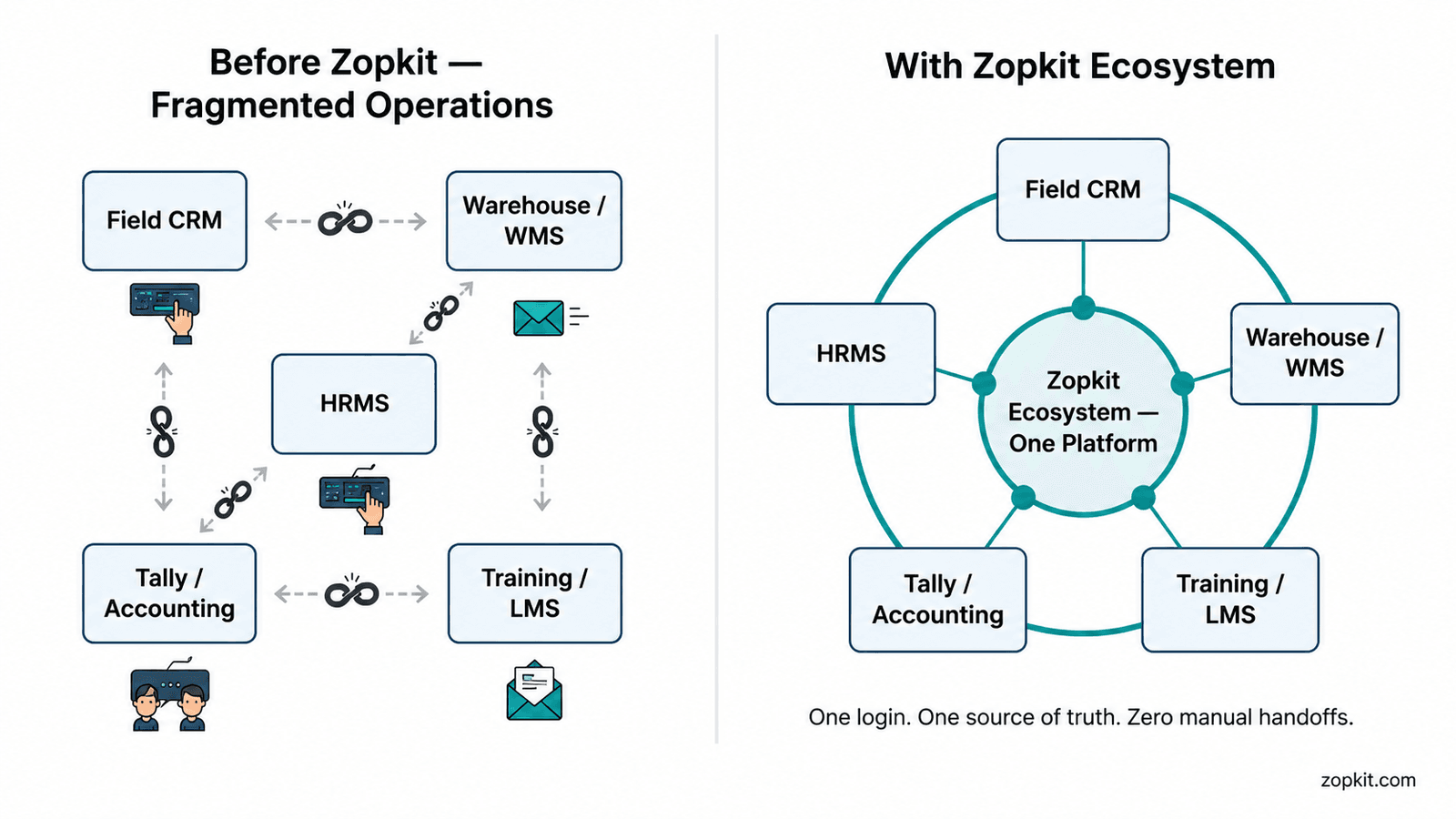
You did not build a 200-person pharma distribution company to spend every Monday morning reconciling a sales report from your CRM, a stock position from your WMS, an attendance sheet from your HRMS, a GST summary from Tally, and a training tracker that lives in a shared folder nobody remembers to update.
Yet here you are.
Not because you made bad decisions. Because nobody built the right system for companies at your stage until now.
This is what the Zopkit Ecosystem is, what each module does for large pharma distributors specifically, and why it is the most complete connected operating platform for Indian pharma distribution businesses that have outgrown tool sprawl.
Table of Contents
I. The Real Problem: Why Five Tools Fail at the 200-Employee Stage
II. What Large Pharma Distributors Actually Need From an Operating Platform
III. How the Zopkit Ecosystem Replaces Tool Sprawl
IV. Core Capabilities That Drive Field, Finance, People, and Learning
V. Why This Fits Indian Pharma Distribution Specifically
VI. The Credit-Based Model: A Fairer Way to Pay
VII. Who This Is Built For
I. The Real Problem: Why Five Tools Fail at the 200-Employee Stage
Most large pharma distributors do not have a shortage of software. They have a shortage of connection between their software.
Your CRM tracks field rep visits and customer accounts. Your WMS tracks inventory, batches, and dispatches. Your HRMS manages payroll, attendance, and leave. Tally handles your GST invoices and books of record. And somewhere on a shared drive, a training tracker tells you which rep completed which product course — or does not, because nobody updates it consistently.
Every time data needs to cross a system boundary, a human being moves it manually. That human makes errors. Those errors cost money. And nobody notices until month-end, or until a principal company auditor asks for a UCPMP compliance report and you cannot produce one cleanly.
The impact of vendor sprawl at the 200-employee stage looks like this:
- Your sales manager closes a deal in the CRM. Your warehouse team does not know until someone emails them. Your Finance team generates the GST invoice separately.
- Your field rep creates a stockist order but cannot see the customer's live credit limit because the CRM and Tally do not talk in real time.
- Your HR team runs payroll on one tool and tracks leave on Excel. PF and ESI numbers are reconciled manually every quarter.
- Your training admin updates the LMS user list by exporting a CSV from HRMS every time a new rep joins. The two systems do not know they are looking at the same person.
- Your Finance Head cannot produce a P&L by territory without pulling data from three systems and stitching it together in Excel.
The answer to vendor sprawl is not adding more tools. It is replacing fragmented tools with one connected operating platform where every part of your business shares the same data, the same user identity, and the same source of truth.
That is exactly what Zopkit is.

II. What Large Pharma Distributors Actually Need From an Operating Platform
At 200+ employees, a pharma distributor's operating model is genuinely complex. You have field reps managing hundreds of chemist, stockist, and hospital accounts across multiple territories. You have a warehouse managing batch-tracked, expiry-sensitive inventory under GDP guidelines. You have a Finance team responsible for GST compliance, vendor payments, and customer collections. You have an HR team managing payroll for 150 to 300 people spread across offices, territories, and warehouse floors. And you have a training requirement that covers both regulatory compliance and continuous product education.
What this business actually needs is not more tools. It needs:

The last row is where most distributor stacks fail. Each individual tool gives data about one function. Nobody can answer: which of my field reps have overdue customer outstanding balances AND have not completed the new product training AND are in territories below 75% of monthly target? Answering that question in a fragmented stack takes two to three hours of manual cross-referencing. It should take fifteen seconds.
III. How the Zopkit Ecosystem Replaces Tool Sprawl
Zopkit is an AI-driven B2B SaaS company that provides a complete ecosystem of business operating tools. The goal is to give every business — regardless of size or stage — access to the full suite of software it needs to run every function from one platform.
The Zopkit Ecosystem is not a collection of tools that happen to sit on the same website. It is a platform designed from the ground up so that every product shares three things:
One Identity. Every person in your organization has one login that works across every Zopkit tool they are permitted to use. When you add a new field rep, you do not create accounts in a CRM, an LMS, and an HRMS separately. You add them once. When they resign, one offboarding action removes their access everywhere.
One Central Hub. All users, roles, permissions, and billing flow through a central management layer. Changes made here reflect everywhere, immediately. The territory manager who is promoted to Area Manager gets updated access in CRM, HRMS, and Academy at the same time — not in three separate admin panels.
One Credit System. Instead of paying per seat for each product separately, you operate on a credit-based model. Credits are consumed based on actual usage. You are not paying for 200 seats on a tool that 40 people use daily and 160 people access once a month.
The result is that data moves between tools automatically:
- A field rep added to the HRMS is available in CRM and Academy immediately
- A sales order created in the field flows into warehouse pick-and-pack without a manual handoff
- An inventory dispatch generates a GST-compliant invoice and posts to the accounting books without Tally export
- Payroll runs from HRMS data and posts journal entries to Finance without a CA's monthly intervention
- A product certification passed in Academy unlocks the product for field promotion in the CRM — no API configuration required
This is one platform. Not one more tool.
IV. Core Capabilities That Drive Field, Finance, People, and Learning
Zopkit B2B CRM — Built for Pharma Field Force Management
Zopkit CRM gives large pharma distributors a structured system to manage the entire customer relationship and field execution lifecycle.
What it covers for pharma distributors:
- Territory and account management — assign doctors, chemists, stockists, and hospital accounts to territories with geographic or logical boundaries. Reps see only their accounts. Area managers see their area. Regional managers see their zone. The hierarchy is role-enforced.
- Beat planning and visit scheduling — each rep's working week is structured around a beat plan. Overdue visits (A-class accounts not visited in the target cycle) are flagged prominently. Visit records require mandatory fields before submission — the account visited, products detailed, samples issued, next visit commitment.
- Order capture with real-time credit check — field orders created on mobile trigger a live inventory check against Zopkit Operations and a live credit status query against Zopkit Finance. The rep who creates a ₹45,000 order sees: "Stock available. Credit limit: ₹60,000. Outstanding: ₹38,000. Available credit: ₹22,000." The order is approved within credit or routed to Finance for approval if the limit is exceeded — automatically.
- Quote-to-cash for institutional accounts — for hospital procurement and pharmacy chain accounts, the full pipeline runs inside the CRM: quotation, approval workflow, sales order, invoice linked to Finance, payment receipt.
- Account 360 view — every communication, visit log, order, invoice, support ticket, and training status tied to one customer record.
- Email sync — Gmail and Outlook integration so every customer conversation appears on the account record without manual logging.
- Ask Zop AI assistant — the CRM has a built-in AI assistant that can read pipeline data, answer cross-module questions, and take actions in plain English. "Which of my reps' territories are underperforming vs. target this quarter, and what are the top three factors?" — answered in 15 seconds.
Zopkit Operations Management — Full Supply Chain for Pharma Distribution
For businesses managing batch-tracked pharma inventory across multiple warehouses, the Operations module covers the entire supply chain from principal company procurement to customer delivery.
What it covers:
- Multi-location real-time inventory — stock is tracked across every warehouse and stocking point, updated instantly with every inbound GRN, outbound shipment, return, and inter-location transfer
- FEFO batch tracking — First Expired First Out logic enforced at the warehouse task level, not just as a report. The picker's mobile screen shows the specific batch to pick. This is directly useful for pharma, FMCG, and food businesses handling expiry-sensitive inventory.
- Procurement management — the full cycle from Purchase Requisition to RFQ to Purchase Order to GRN to Finance AP runs inside Zopkit Operations. Supplier performance — on-time delivery rate, quality rejection rate, price variance — is tracked automatically.
- E-way bill generation — directly from shipment data, for all inter-state movements above the ₹50,000 threshold. No re-entry into the government portal. No separate e-way bill tool.
- Customer self-service portal — large stockist and hospital accounts can log in to place orders directly, view order history, track shipments, and pay outstanding invoices.
- GST compliance built in — every product carries its HSN code. Tax determination, GST-compliant invoice generation, and GSTR-aligned reports are native to every transaction.
Zopkit Financial Accounting — Full Books-of-Record for Pharma Distributors
Full-stack accounting for businesses that need more than invoicing. This is a complete, GST-native books-of-record platform built for the Indian compliance environment.
What it covers:

The critical point for pharma distributors: the Finance module is not separate from Operations and CRM. When a field order is dispatched from the warehouse, the GST invoice posts to AR in Finance automatically. When the customer pays, the outstanding balance drops in real time and updates the credit check the field rep sees at the next order. When payroll runs from HRMS, the journal entry posts to the GL without a CA's monthly CSV export.
Zopkit HRMS — Full Employee Lifecycle for Pharma Distribution Teams
Built for the full employee lifecycle from the first job application to the last day of employment — with all India statutory compliance handled natively.
What it covers:
- Recruitment — public-facing careers portal, structured interview workflows, offer management, and candidate pipelines
- Core HR — employee records, org chart, department structure, position catalog, and document management
- Leave management — configurable policies, accrual schedules, half-day and emergency leave options, and manager approval workflows
- Attendance — timesheet submission, overtime approvals, and regularization policies
- Payroll for India — every statutory requirement handled natively: Provident Fund, ESI, Professional Tax, TDS calculation, Form 16 generation, Form 12BA, investment declarations
- Performance management — goal setting, continuous feedback, 360-degree reviews, calibration sessions, and development plans
- Benefits, assets, and expense management — expense claims, asset allocation, and employee helpdesk
For pharma distributors specifically: the shared identity architecture means the field rep who is employee E-0047 in HRMS is the same person as Territory Manager T-014 in the CRM and Learner L-0312 in Academy. When the rep is onboarded in HRMS, their CRM access and Academy enrollment are provisioned simultaneously. When they resign, one offboarding action removes access everywhere.
Zopkit Academy — Product and Compliance Training With a Training Gate Into CRM
A learning management platform for pharma distributors running product launches, UCPMP compliance training, GDP warehouse training, and continuous field education programs.
What it covers:
- Course delivery — video, article, and mixed content types, lesson-level progress tracking, content gating, and enrollment management
- Assessment engine — timed sections, question navigation, mark-for-review, anti-cheating controls, and auto-save
- UCPMP and regulatory compliance training — annual mandatory training for all field-facing employees with QR-verifiable certificates producible for principal company quality audits
- Training gate into CRM — when a rep passes the product certification in Academy, the training status updates in their CRM profile. The CRM's product deployment blueprint checks training status before enabling the product for field promotion. This is native to the platform — not an API integration to configure.
- Post-assessment analysis — across 11 dimensions including score, topic performance, difficulty breakdown, time per question, error tracking, and leaderboard rankings
- Gamification — experience points, badges, challenges, and streaks to maintain engagement between formal learning sessions
- Verifiable certificates — unique codes and a public verification page. Anyone can confirm a credential without logging in.

V. Why This Fits Indian Pharma Distribution Specifically
Indian pharma distributors operate in a compliance-heavy, margin-sensitive, field-execution-driven environment. The software they use must handle GST, FEFO, statutory payroll, and UCPMP compliance as baseline requirements — not as expensive add-ons or third-party integrations.
Here is what makes the Zopkit Ecosystem a specific fit for Indian pharma distribution:
GST is built in, not bolted on. Most international business software requires workarounds or third-party tools to handle Indian GST requirements. Zopkit was designed with GST — HSN codes, e-way bills, GSTR-1, GSTR-3B, credit notes, and tax determination — as a first-class feature built into every transaction by default. When your warehouse dispatches an inter-state order above ₹50,000, the e-way bill generates from the same screen. No re-keying into the government portal.
Payroll compliance is automatic. Provident Fund, ESI, Professional Tax, TDS calculation, Form 16, Form 12BA, and payroll statutory compliance are handled natively inside the same system where you manage your entire workforce. The monthly CA call for payroll reconciliation is no longer necessary.
FEFO enforcement is at the task level. For pharma, food, and regulated inventory, First Expired First Out is not a reporting concept. It needs to be enforced at the moment of picking. Zopkit Operations enforces FEFO at the warehouse task level — the picker's mobile screen shows the specific batch to pull. A batch-level NCR and CAPA workflow handles quality exceptions without a separate QMS tool.
The field rep's operating context is fully connected. The rep who opens a chemist account on their mobile CRM sees: live inventory, live credit limit, outstanding invoices, last visit date, last order, and product training completion status — all from one screen, on one platform, without any integrations to maintain.


VI. The Credit-Based Model: A Fairer Way to Pay for Software
Traditional SaaS pricing charges by the seat. You have 200 employees, you pay for 200 seats on every tool you use. It does not matter if 60 of those employees log in once a month. You pay the full seat price, every month, for every tool.
For large pharma distributors, this model has a specific problem. Indian distribution businesses frequently have high headcount relative to revenue — warehouse staff, field reps, back-office teams, and support functions all need access to different modules at very different frequencies. A per-seat model makes software costs grow in direct proportion to team size, regardless of the value each person extracts from the tool.
Zopkit uses a credit-based consumption model:
- You buy credits
- Usage across all tools in the Zopkit Ecosystem consumes credits based on actual activity
- You pay for what you use — not for seats that sit idle
- When business is slow, you use fewer credits; when activity is high, you consume more
This is especially relevant for pharma distributors because:
- Field rep teams have high seasonal activity variation — peak months around product launches and year-end push are 3 to 5 times higher activity than off-peak months
- Warehouse staff need mobile access to Operations during shifts but are not constant platform users
- Finance team usage spikes around GST filing deadlines and payroll cycles, not evenly distributed
- New reps joining mid-year should not require renegotiating a seat-based contract
Your credit balance, usage history, and subscription status are visible inside the platform at all times. There are no hidden consumption events. You always know what you have used and what it cost.

VII. Who This Is Built For
The Zopkit Ecosystem is relevant across different stages of pharma distributor growth. The earlier sections of this article focused on the 200+ employee segment specifically — but the platform is designed to grow with the business from the first hire to a 500-person operation.
For the 200+ employee pharma distributor specifically:
You are already using multiple tools from different vendors. The integration cost is high — in both money and management bandwidth. Data is always slightly out of sync between your pharma CRM, your WMS, and your Tally installation. Your team wastes hours every week moving information between systems manually. Your Finance Head cannot see a clean P&L by territory without a manual exercise. Your Sales Director cannot answer a cross-function question about reps without three separate data pulls.
Consolidating your operating stack into the Zopkit Ecosystem removes the integration overhead and gives every function a shared source of truth.
How to start:
You do not have to implement everything on day one. Most large distributors start with the module that is costing the most time or money right now and add connected modules as the team migrates.
- Most common starting point: CRM + Operations, because field order management and inventory visibility are daily pain points
- Connect Finance early: every other module touches money, so Finance integration unlocks the credit check, the AR collections flow, and the territory P&L
- Add HRMS and Academy: once CRM and Operations are running, HRMS onboarding automation and the Academy training gate complete the connected operating model
Because everything shares one identity layer and one data system, adding a new module is not a new implementation project. It is activating a new part of a system your team already knows.

Conclusion
Large pharma distributors at the 200-employee stage have already proven the business. The field force is working. The warehouse is moving product. The Finance team is managing GST and compliance. The HR team is keeping the workforce running.
What is missing is connection between all of these. Data that moves automatically without a human carrying it. A Finance module that knows what the field rep just ordered. An HRMS that provisions CRM access the moment a new rep is hired. An Academy that locks a product in the CRM until the rep has passed the training assessment.
That is the Zopkit Ecosystem. Not one more tool. A complete connected operating platform built for the way Indian pharma distribution businesses actually work.
Book a free demo at zopkit.com and see every part of your distribution operation running on one platform.