Every Indian Business Is Running on Broken Tools. Here Is the System That Fixes It.
You did not build your business to spend Monday mornings reconciling spreadsheets, chasing your accountant for GST numbers, and wondering why HR still tracks leaves on Excel. Yet here you are. Not because you made bad decisions. Because nobody built the right tools for Indian businesses until now.
This is what the Zopkit Ecosystem is, what it does, and why it is the most complete operating platform built for the way Indian businesses actually grow.
Table of Contents
- The Real Problem: It Is Not the Tools, It Is the Gaps Between Them
- What the Zopkit Ecosystem Actually Is
- Every Tool in the Ecosystem and What It Solves
- What Makes Zopkit Different From Anything Else Available
- The Credit-Based Model: A Fairer Way to Pay for Software
- Who This Is Built For
- Where to Start
I . The Real Problem Is Not the Tools. It Is the Gaps Between Them.
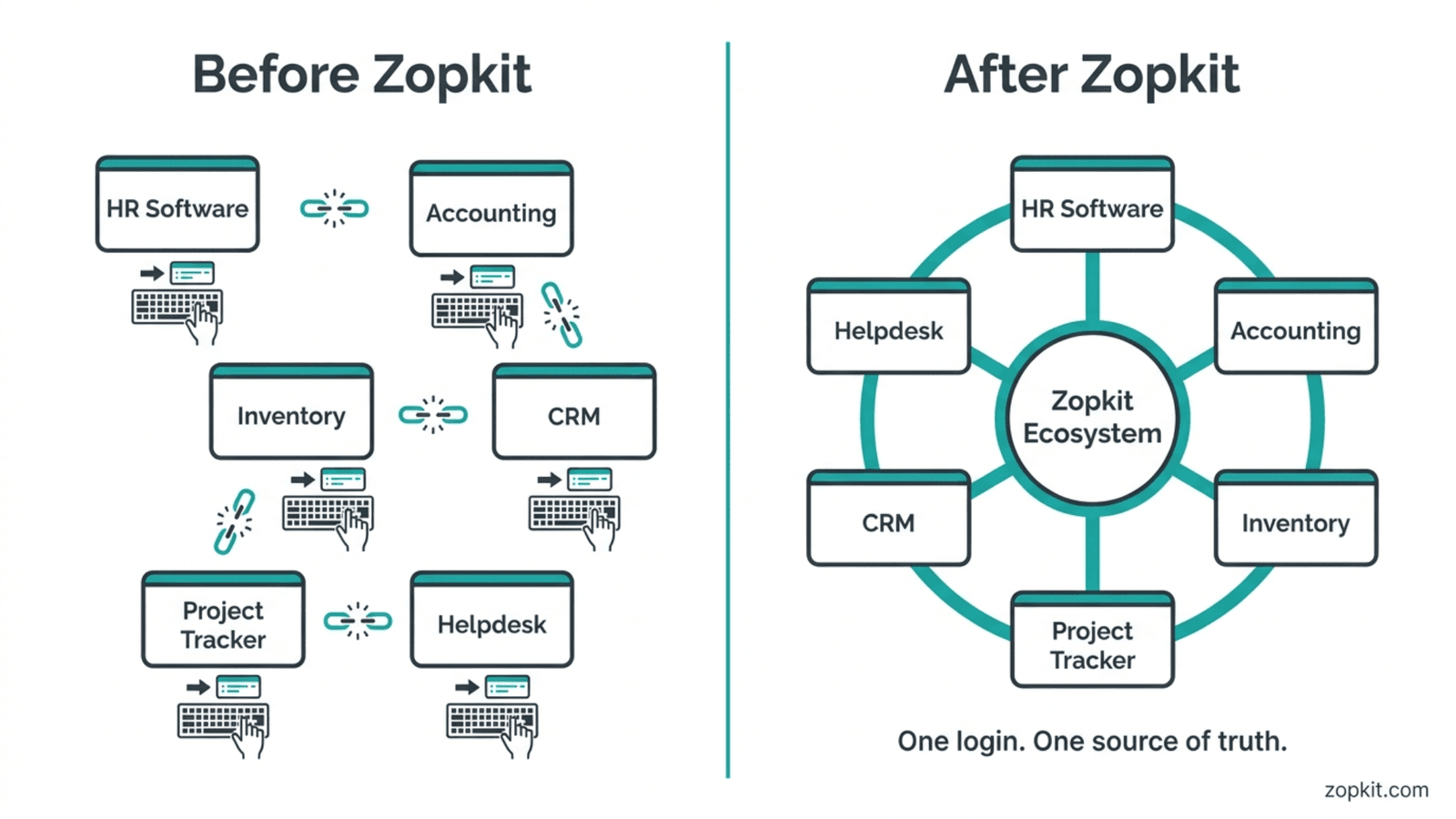
Most businesses do not have a shortage of software. They have a shortage of connection between their software.
Your payroll is in one place. Your inventory is in another. Customer records live in a CRM that does not know anything about your invoices. Your project delivery team tracks work in a tool your finance team has never opened. When something needs to cross a system boundary, a human being moves it manually. That human makes errors. Those errors cost money. And nobody notices until month-end, or until a customer calls to complain.
This is vendor sprawl. It is the condition every growing business eventually reaches when they keep adding tools to solve new problems without ever connecting the ones they already have.
The impact of vendor sprawl in Indian businesses specifically looks like this:
- A 50-person company managing HR, payroll, and compliance across three separate tools, with a CA reconciling the numbers every quarter
- A manufacturer tracking inventory in one system, raising purchase orders in another, and recording payments in Tally while their bank statements live in a third place
- A startup where the sales team uses a CRM the finance team has never seen, so every invoice requires a separate email thread to confirm the deal terms
- A services business where project delivery is tracked in a shared spreadsheet because no one wanted to pay for "one more tool"
The answer to vendor sprawl is not adding more tools. It is replacing fragmented tools with one connected ecosystem where every part of your business shares the same data, the same identity, and the same source of truth.
That is exactly what Zopkit is.
II . What the Zopkit Ecosystem Actually Is
Zopkit is an AI-driven B2B SaaS company that provides a complete ecosystem of business operating tools. The goal is to give every business, regardless of size or stage, access to the full suite of software it needs to run every function from one platform.
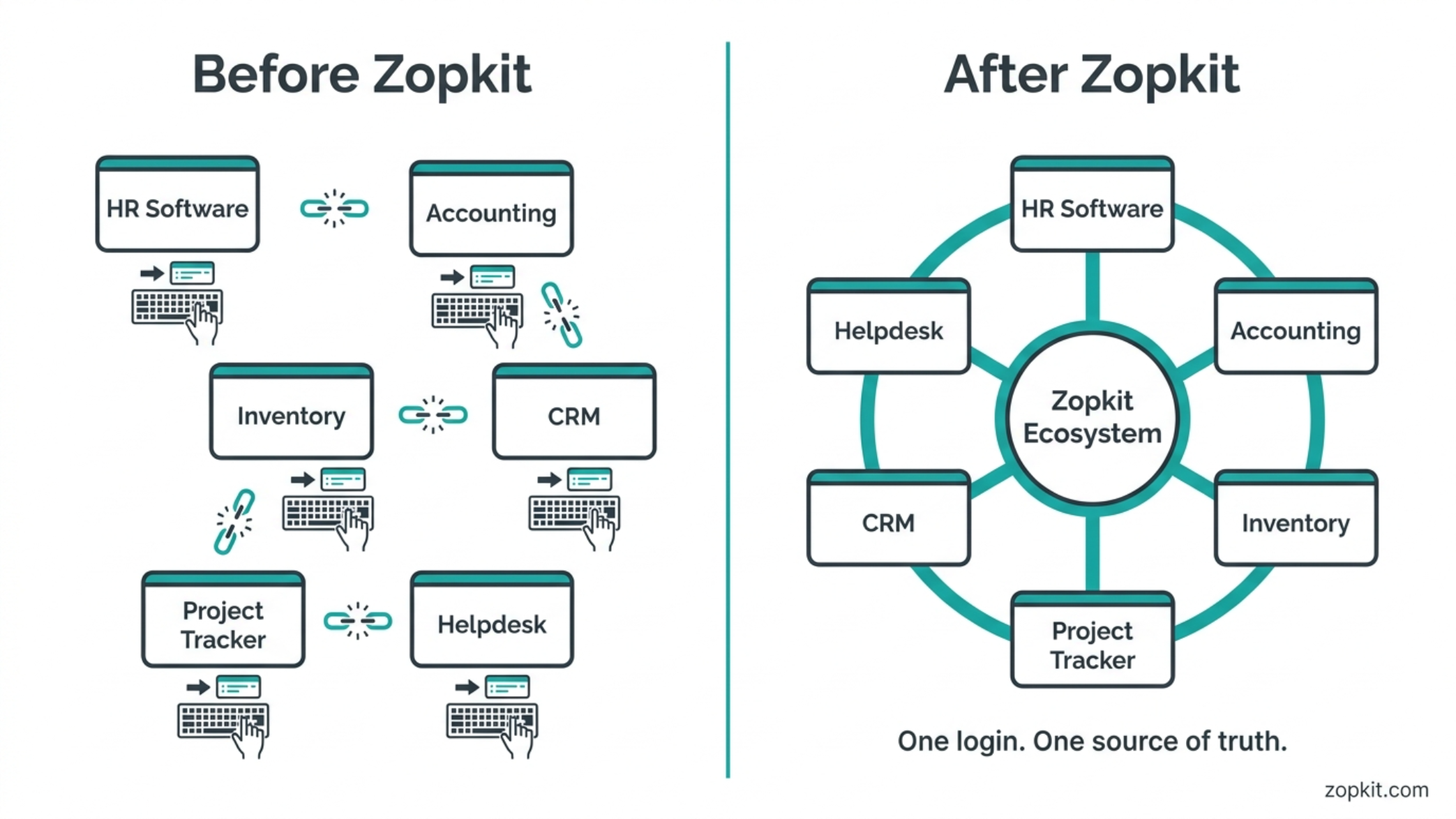
The Zopkit Ecosystem is not a collection of tools that happen to sit on the same website. It is a platform designed from the ground up so that every product shares three things:
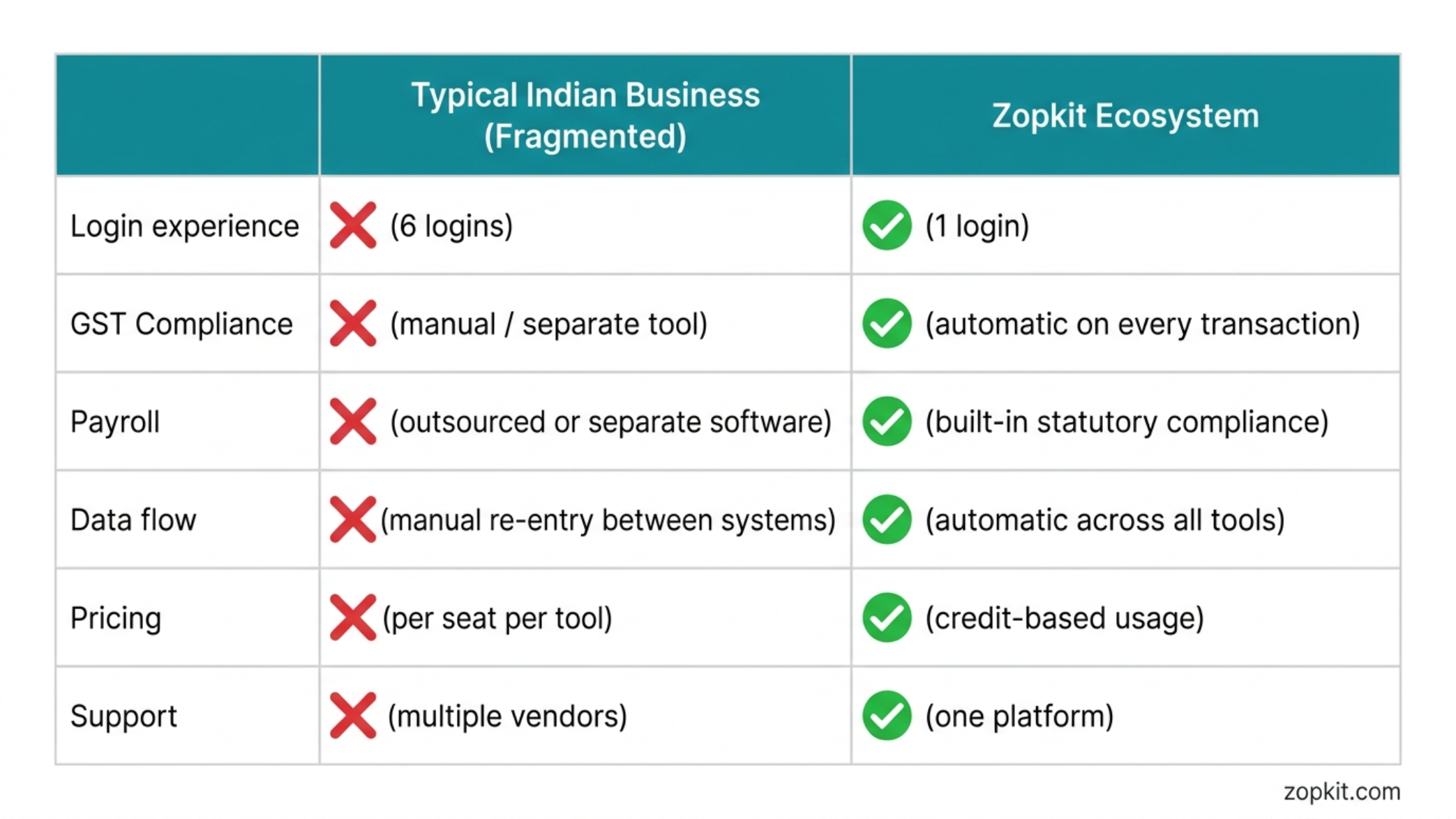
One Identity. Every person in your organization has one login that works across every Zopkit tool they are permitted to use. When you add a new employee, you do not create accounts in six separate systems. You add them once.
One Central Hub. All users, roles, permissions, and billing flow through a central management layer. Changes made here reflect everywhere, immediately.
One Credit System. Instead of paying per seat for each product separately, you operate on a credit-based model. Credits are consumed based on actual usage. You are not paying for seats that sit idle.
The result is that data moves between tools automatically. An employee added to the HRMS is available in every other product their role permits. A sales deal closed in the CRM can flow directly into delivery and billing without re-entry. An inventory movement in Operations updates the financial books without a manual journal entry.
This is one platform. Not one more tool.
III . Every Tool in the Zopkit Ecosystem and What It Solves
Zopkit HRMS
Zopkit HRMS is built for the full employee lifecycle, from the first job application to the last day of employment.
What it covers:
- Recruitment with a public-facing careers portal, structured interview workflows, offer management, and candidate pipelines
- Core HR with employee records, org chart, department structure, position catalog, and document management
- Leave management with configurable policies, accrual schedules, half-day and emergency leave options, and manager approval workflows
- Attendance with timesheet submission, overtime approvals, and regularization policies
- Payroll for India with every statutory requirement handled natively: Provident Fund, ESI, Professional Tax, TDS calculation, Form 16 generation, Form 12BA, investment declarations, and a salary and tax calculator for employees and HR teams alike
- Performance management with goal setting, continuous feedback, 360-degree reviews, calibration sessions, and development plans
- ESOP administration including cap table management, vesting schedules, exercise workflows, valuations, and regulatory compliance calendars
- Benefits, assets, expenses, employee helpdesk, and training management
For Indian companies, the payroll module alone replaces the dependency on a separate payroll tool or the monthly CA call. Every statutory deduction, every compliance report, every payslip is handled inside the same system where you manage your entire workforce.
Zopkit Financial Accounting
Full-stack accounting for businesses that need more than invoicing. This is a complete books-of-record platform.
What it covers:
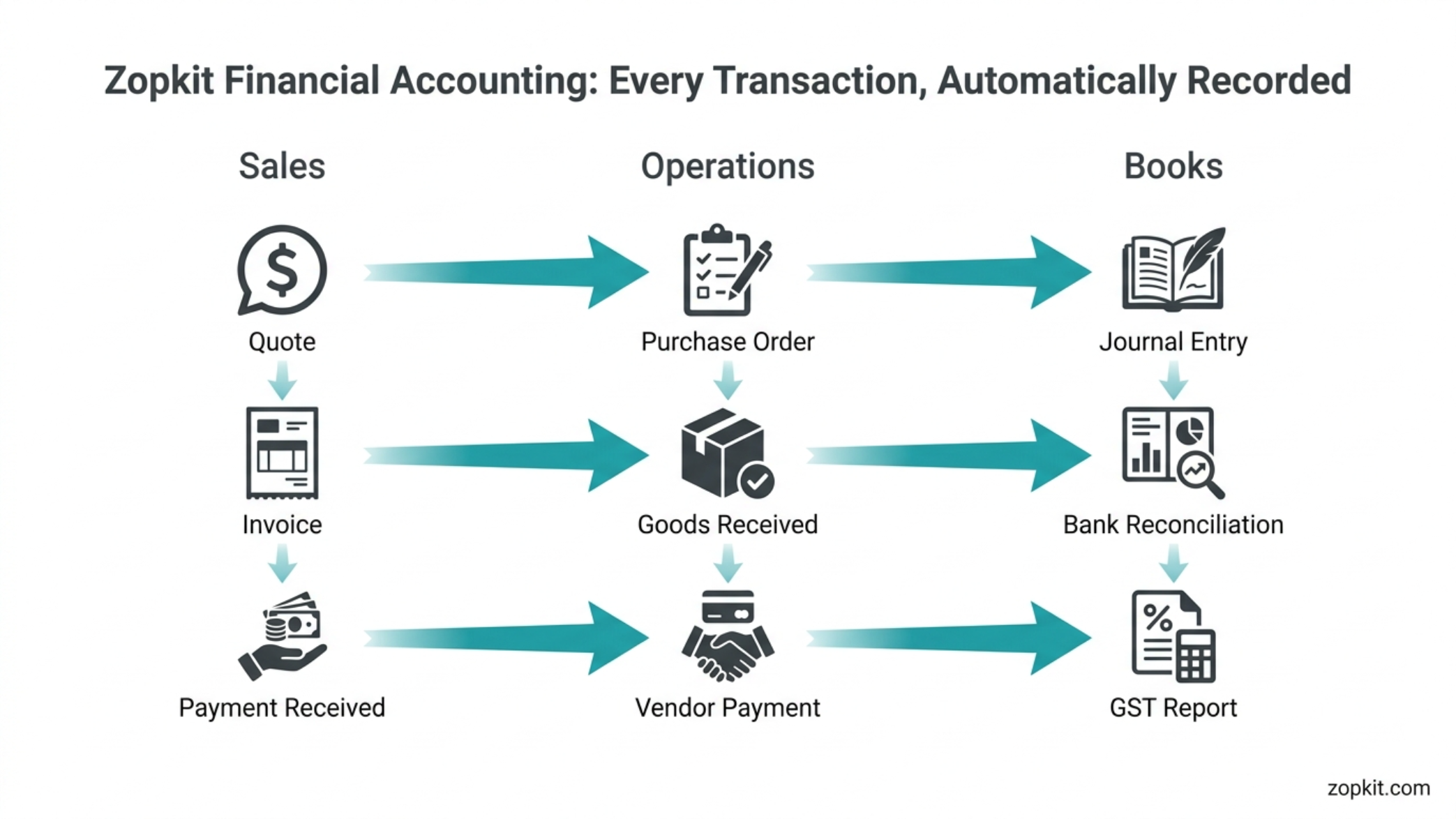
- Accounts Receivable: customer invoicing with a full approval and payment lifecycle, estimates, sales orders, recurring invoices, credit notes, and AR aging reports
- Accounts Payable: vendor bills, purchase orders, purchase requisitions, goods receipt notes, three-way matching to prevent duplicate payments, expense report approvals, and AP aging reports
- Banking: bank account management, transaction imports, rule-based auto-categorization, bank reconciliation, and cash flow forecasting
- General Ledger: chart of accounts, journal entries, trial balance, fiscal period management, and period close
- Financial reporting: P&L, balance sheet, cash flow statement, and financial ratio analysis generated directly from live transaction data, with no manual export required
- India tax compliance: GST configuration, HSN code management, TDS configuration, GSTR-aligned tax reports, and a compliance calendar with filing deadline reminders
- Multi-currency and multi-entity support for businesses with subsidiaries or international operations
- Invoice scanning that reads a paper bill and auto-fills the relevant fields to reduce manual data entry
The GST compliance capabilities in this module are not add-ons. Tax determination, HSN code assignment, e-way bill generation, and GSTR reporting are built into every transaction by default.
Zopkit B2B CRM
Built for B2B sales teams that have grown beyond spreadsheets and need a proper system to manage leads, customers, deals, and communications in one place
What it covers:
- Lead and contact management with configurable pipelines, kanban views, and territory-based access controls
- Account records with a full 360-degree view: every communication, deal, invoice, and support ticket tied to one customer record
- Opportunity pipeline with stage tracking, win and loss recording, and deal forecasting
- Quotations, sales orders, and invoices with PDF generation directly from deal records
- Email sync with Gmail and Outlook so every conversation with a customer is visible on their record without any manual logging
- Support ticketing integrated into the customer record, so service issues are tracked alongside sales history
- Marketing campaigns, multi-step email outreach sequences, and SMS communication
- Embeddable web forms that capture leads from your website directly into the CRM
- Custom modules that let administrators define entirely new record types without writing any code
- An AI assistant that can read your pipeline data, answer questions, and take actions on records in plain English
Zopkit Operations Management
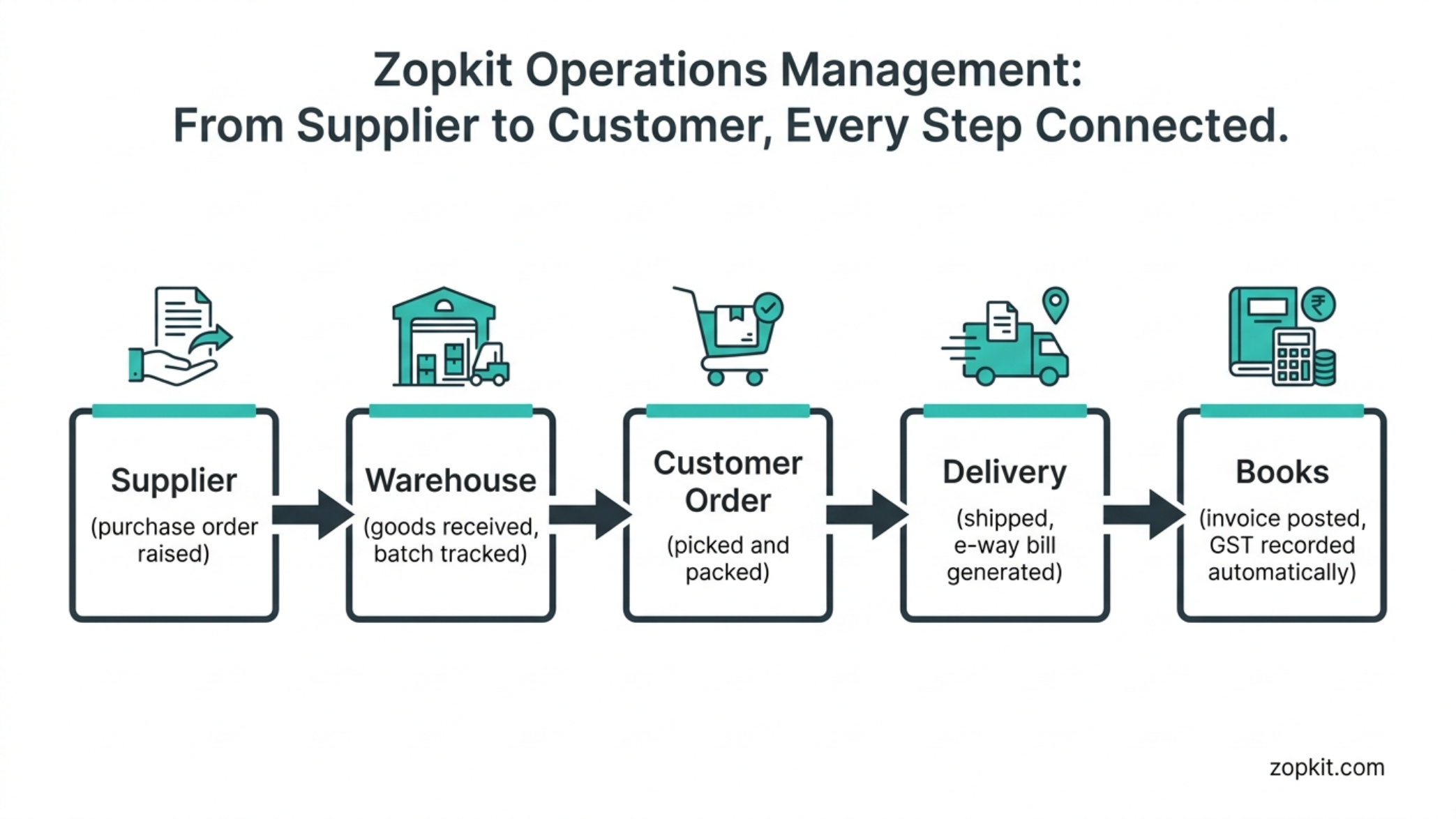
For businesses managing physical products, warehouses, procurement, and commerce. This module covers the entire supply chain from catalog to customer delivery.
What it covers:
- Product catalog with variants, bundles, dynamic pricing rules, subscription billing, and multi-channel publishing
- Real-time inventory tracking across every warehouse and location, updated instantly with every inbound shipment, sale, return, and transfer
- Batch and lot tracking with First Expired First Out logic enforced at the warehouse task level, not just as a report. This is directly useful for food, pharma, FMCG, and any business handling perishable or regulated inventory
- AI-powered demand forecasting at the product level using historical sales data, with forecasts feeding directly into reorder point calculations and purchase suggestions
- Procurement: purchase requisitions with approval routing, purchase orders, supplier request-for-quote workflows, goods receipt notes, and contract linking
- Order management with a configurable fulfillment workflow (pick, pack, ship), picking wave optimization to group multiple orders for warehouse efficiency, backorder management, and returns processing
- Warehouse management down to zone, aisle, and bin level, with cycle counting, task assignment, and a mobile app for floor staff
- Logistics with carrier management, shipment tracking, delivery route optimization, and document generation
- Finance with cost center tracking, budget management, and AP invoice management
- Customer portal: a full B2B and B2C storefront with cart, checkout, subscription management, and returns
- Vendor portal: supplier self-service with product listings, performance tracking, and multi-vendor cart splitting
- Point of Sale with register management, billing workbench, and manager approval workflows
- India GST compliance throughout: HSN codes, e-way bill generation, and GSTR-aligned reports on every transaction
Zopkit Project Management
For delivery teams, agencies, and product companies that need to plan work, track budgets, and report on progress without managing multiple tools.
What it covers:
- Projects with budget tracking, progress monitoring, status lifecycle (planning through archived), and health scoring
- Tasks and subtasks with assignees, due dates, priorities, story points, and sprint assignment
- Agile workflow with sprint planning, sprint start and complete, velocity tracking, and backlog management
- Kanban boards with drag-and-drop status management for daily standups and visual workflow tracking
- Time tracking with billable and non-billable classification, timesheet submission, and manager approval for payroll and client billing
- Team analytics showing capacity, utilization, and per-member performance for coaching and planning
- Calendar with event types, milestone tracking, and external calendar synchronization
- Migration from Jira, Asana, and Monday.com for teams moving their existing project history into the platform
- AI-generated delivery insights: budget overrun alerts, overdue project flags, and low utilization warnings built from real project and time data
Zopkit ITSM
IT Service Management for IT teams, internal IT departments, and managed service providers that need a structured system to run the full ITIL lifecycle.
What it covers:
- Incident management: full ticket lifecycle with SLA enforcement, follow-up communication threads, resolution workflows, validation and approval chains, and cost tracking per ticket
- Problem management: root cause investigation, known-error registers, and cross-incident linking to avoid solving the same problem repeatedly
- Change management: formal approval workflows with change advisory board support, implementation task tracking, and recurrent change templates for patch cycles and maintenance windows
- Asset and configuration management: hardware, software, licenses, and network equipment tracked with relationships and dependency visibility
- Visual dependency mapping that shows how assets relate to each other, helping change managers understand what is affected before approving a change
- Service catalog with a visual form builder for self-service request intake, covering IT and non-IT requests
- Knowledge base with article authoring, revision history, category management, and linking to tickets and problems
- Automated routing rules for ticket assignment, categorization, and CMDB updates
Zopkit Academy
A learning management platform for training organizations, coaching institutes, exam preparation providers, and businesses running internal learning and development programs.
What it covers:
- Course delivery with video, article, and mixed content types, lesson-level progress tracking, content gating, and enrollment management
- Curriculum maps and hierarchical topic taxonomies so learners navigate by subject, not just by course list
- Assessment engine with timed sections, question navigation palette, mark-for-review, scientific calculator, anti-cheating controls, and auto-save
- Post-assessment analysis across 11 dimensions including score, topic performance, difficulty breakdown, time spent per question, error tracking, cross-assessment comparison, and leaderboard rankings
- Learning roadmaps with visual graph layout showing topic relationships, progress indicators, and course recommendations based on performance
- Gamification with experience points, badges, challenges, streaks, and leaderboards to maintain engagement between formal learning sessions
- Verifiable certificates with unique codes and a public verification page. Anyone can confirm a credential without logging in.
- AI-powered question generation to speed up content authoring
- Mobile app for students with full assessment capability and the same 11-dimension analysis available on web
Zopkit Affiliate Management
For brands running affiliate programs, influencer campaigns, and creator partnerships. This replaces the combination of spreadsheets, manual outreach, and fragmented payout tools that most brands currently use.
What it covers:
- Affiliate program management: invite, approve, manage tiered commission structures, track links, process payouts, and detect fraud
- Influencer discovery using AI-generated search queries to find relevant creators across platforms at scale, with daily budget controls to prevent runaway costs
- Authenticity scoring for influencer profiles and posts based on multiple engagement signals, not just follower counts. This prevents wasted spend on accounts with inflated or inactive audiences.
- Campaign builder with attribution window settings, content requirement specifications, digital contract creation, and dual e-signature collection
- Post analysis tool where brands paste social media URLs and receive engagement rates, authenticity grades, and history of past analyses
- Rate calculator and AI-suggested pricing for creators, reducing negotiation friction
- Fraud detection with configurable rules, an alert inbox, and scheduled automated detection across all campaigns
- Separate portal experiences for brand administrators, affiliates, influencers, and platform administrators, plus a mobile app for influencers managing campaigns in the field
IV . What Makes Zopkit Different From Anything Else Available
The entire ecosystem shares one data layer. When an employee is added to HRMS, their profile is available across every tool they are permitted to use. When an invoice is raised in Operations, it posts to the accounting books. When a sales deal is closed in the CRM, that customer record carries full context into every interaction that follows. This is not integration. It is one system.
India compliance is built into the core, not added later. GST, HSN codes, e-way bills, GSTR reports, Provident Fund, ESI, TDS, Form 16, and payroll statutory compliance are first-class features in the products where they matter. They work on every transaction automatically. Most international business software requires workarounds or third-party tools to handle Indian statutory requirements. Zopkit was designed with India compliance as a baseline, not a feature request.
AI is embedded at the level of actual workflows. The CRM assistant reads pipeline data and takes actions in plain English. The HRMS generates communication drafts and answers policy questions. The Operations module forecasts demand and triggers reorder suggestions. The Affiliate platform discovers and scores creators automatically. The ITSM platform maps asset dependencies before changes are approved. This is AI embedded into decisions and actions, not a chatbot sitting on top of a product.
Enterprise depth without enterprise cost or complexity. Every module in the Zopkit Ecosystem is built to full production depth. The HRMS includes ESOP administration, a capability usually found only in dedicated equity management platforms. The Financial Accounting covers project costing, cost accounting, budgeting, and multi-entity consolidation. The Operations module handles multi-warehouse, multi-vendor, and multi-currency scenarios. The ITSM platform supports full ITIL change management with visual dependency analysis. This is not a simplified version of enterprise software. It is the real thing, made accessible to businesses that do not have enterprise budgets or IT departments.
One platform for every stage of growth. A solopreneur starting their first business and a 500-person company consolidating vendor sprawl are both served by the same ecosystem. The credit-based model and modular structure mean you start with what you need and expand when you grow, without renegotiating contracts or switching platforms.
V. The Credit-Based Model Is a Fairer Way to Pay for Software
Traditional SaaS pricing charges by the seat. You have 50 employees, you pay for 50 seats on every tool you use. It does not matter if 15 of those employees log in once a month. You pay the same full price for every seat, every month.
For Indian businesses, this model has a specific problem. Indian companies frequently have high headcount relative to their revenue, especially in services, manufacturing, and distribution. A per-seat model makes software costs grow in direct proportion to team size, regardless of the value each person extracts from the tool.
Zopkit uses a credit-based consumption model. You buy credits. Usage across all the tools in the Zopkit Ecosystem consumes credits based on actual activity. You pay for what you use. When your business is slow, you use fewer credits. When activity is high, you consume more. The model scales with your business, not against it.
This is especially relevant for:
- Businesses with seasonal demand patterns, where activity in peak months is three to five times higher than off-peak months
- Growing companies that cannot accurately predict headcount 12 months out
- Businesses where many employees need occasional access to one or two modules but not full daily use
- Founders who want to start with a few tools and expand the ecosystem without renegotiating pricing at every stage
Your credit balance, usage history, and subscription status are visible inside the platform at all times. There are no hidden consumption events. You always know what you have used and what it cost.
VI. Who the Zopkit Ecosystem Is Built For
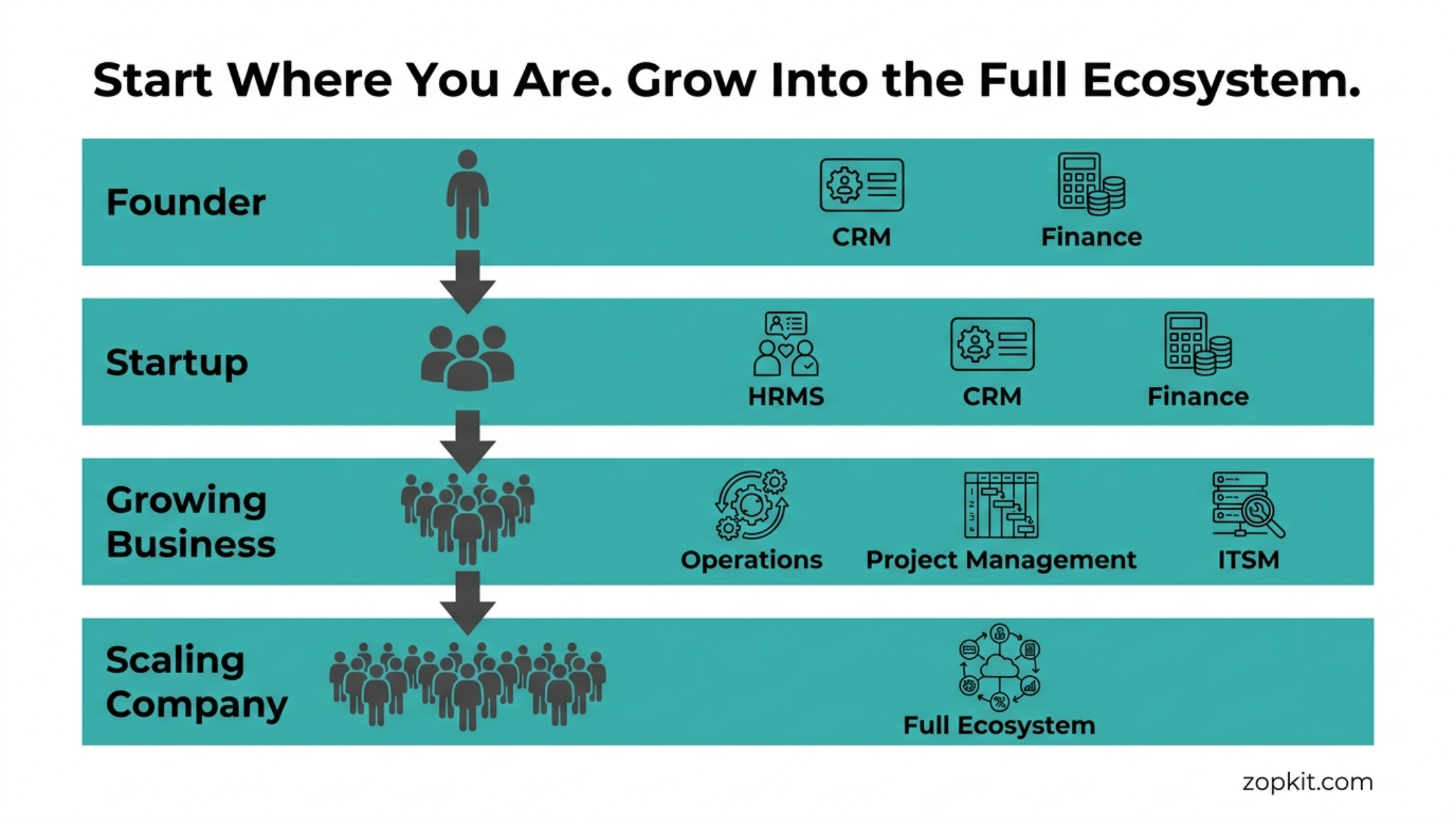
Aspiring Founder or Solopreneur (0 to 1 employee)
You are starting from scratch or operating alone. You need a CRM to track prospects and clients, financial accounting to invoice and manage taxes correctly from day one, and a project management tool to stay organized. The Zopkit Ecosystem gives you professional-grade tools at a cost that makes sense before you have your first hire.
Early Startup (2 to 50 employees)
You are growing fast and starting to feel the pain of doing things manually. You need an HRMS to manage your team properly, a CRM to scale your sales, and financial accounting that keeps your books accurate without a full-time accountant. The ecosystem grows with you without forcing you to change platforms as you scale.
Offline to Online (50 to 100 employees)
You are a traditional business building a digital presence. Your operations need to move from manual processes to a connected system. Operations Management for supply chain and inventory, Financial Accounting for compliance, and HRMS for your workforce replace the patchwork of tools and manual steps you currently depend on.
Scaling Online Business (100 to 200 employees)
You have product-market fit and you are growing quickly across multiple functions. You need every module at full depth, with analytics, automation, and compliance working across the entire business. The Zopkit Ecosystem delivers that without requiring you to manage a portfolio of vendor relationships.
Vendor Sprawl to Single Ecosystem (200 and above)
You are already using multiple tools from different vendors. The integration tax is high. Data is always slightly out of sync. Your team wastes hours every week moving information between systems manually. Consolidating your operating stack into the Zopkit Ecosystem removes the integration overhead and gives every function a shared source of truth.
VII. Where to Start
You do not have to implement the entire Zopkit Ecosystem on day one. Most businesses start with the tool that solves their most immediate problem and add modules as they grow.
A practical starting path:
- Identify the one function that is costing you the most time or money right now. That is where you start.
- Get that module running and your team using it within the first two weeks.
- Connect the adjacent modules that naturally receive or send data from your first tool. For most businesses, this means connecting financial accounting early, because every other module eventually touches money.
- Add modules as your team grows and new pain points emerge.
Because everything shares one identity layer and one data system, adding a new module is not a new implementation project. It is activating a new part of a system your team already knows.
Conclusion
Indian businesses have always built more with less. The entrepreneurial ability to operate with limited resources, navigate complex compliance requirements, and grow in a market that does not forgive mistakes is not in question.
What has been missing is software that matches that reality. Tools that are affordable without being shallow. Compliance that works automatically without requiring a consultant. A platform that scales from one employee to five hundred without forcing you to migrate or renegotiate at every stage.
That is what Zopkit is. Not one more tool. A complete ecosystem of business operating software built for the way Indian businesses actually work.
Book a free demo at zopkit.com and see every part of your business running on one platform.