Every ERP Vendor Will Claim They Cover Education. Ask Them to Show You the Payslip for Your Faculty Member and the Certificate for Your Student in the Same Platform.
The ERP evaluation for a 100 to 200 staff coaching institute is harder than it looks on paper.
The institute has two distinct operational domains that must both be managed well. The student domain: admissions, batch management, course delivery, assessments, fee collection, GST invoicing, student records, and certificates. The employee domain: staff onboarding, attendance, leave management, payroll with PF and ESI, TDS computation, payslip generation, and HRMS compliance.
Most ERP vendors serve one domain well and treat the other as a secondary module. The education-specific ERP vendors, Fedena, EduNext, and their competitors, built their platforms for student management. Their HR and payroll modules are either absent, limited, or require a third-party integration. The generic ERP vendors, Odoo, Zoho People, Tally-connected tools, built their platforms for business management. Their student management capabilities are either absent, built on a generic CRM that does not map to education workflows, or require an education-specific add-on that was built by a third party and maintained independently.
The coaching institute that evaluates an education ERP for its student management and a separate HRMS for its employee management ends up with two platforms, two vendor relationships, two implementation projects, and an integration layer connecting them that breaks every time either vendor releases an update.
The right question for the ERP evaluation at a 100 to 200 staff coaching institute is not "which platform has the best student management?" or "which platform has the best HRMS?" It is: "which platform handles both with equal rigour, natively, without an integration layer?"
This guide covers the complete ERP evaluation framework for coaching institutes, a detailed feature and pricing comparison of Fedena, EduNext, generic ERPs, and Zopkit, and the decision criteria that matter at the 100 to 200 staff scale.
I. The Coaching Institute ERP Requirements Map
Before comparing platforms, the requirements must be mapped with precision. A coaching institute's ERP requirements are different from a school's, a university's, and a corporate training company's.
Student Domain Requirements
Requirement | Why It Matters for a Coaching Institute Specifically |
|---|---|
Admissions CRM with pipeline management | Coaching institutes compete for students; inquiry-to-enrollment conversion tracking is a direct revenue metric |
Batch management (not classroom management) | Coaching operates in batches with flexible timing, not fixed academic classes; the scheduling model is different |
Course and content delivery (LMS) | Recorded lectures, PDFs, and assignments are core to the coaching product; not just a nice-to-have |
Assessment engine with question banks | Regular tests, mock exams, and performance tracking are central to the coaching value proposition |
Verifiable certificates and achievement tracking | Students share certificates; institutes use completion rates for marketing |
Fee collection with GST invoicing | GST compliance is mandatory above threshold; sequential invoicing required for GSTR-1 |
Parent and student communication portal | Reduces administrative burden of phone and WhatsApp-based queries |
Student performance analytics | Faculty and management need batch and individual performance visibility |
Multi-branch student management | Students who transfer between branches, consolidated institute-level reporting |
Employee Domain Requirements
Requirement | Why It Matters for a Coaching Institute Specifically |
|---|---|
Faculty and staff onboarding | High-turnover category; onboarding process must be fast and documented |
Attendance management | Both office staff and faculty; part-time faculty paid per session require session-based attendance |
Leave management with approval workflow | Leave affects batch scheduling; manager approval is operationally critical |
Payroll with PF, ESI, and TDS computation | Mandatory statutory compliance; institutes above 20 employees require PF registration |
Payslip generation and distribution | Staff requirement for loans, ITR; institute requirement for compliance documentation |
Multi-branch HR management | Staff deployed across branches; consolidated HR view for management |
Training and development for staff | Faculty development, administrative staff upskilling |
Separation and full and final settlement | Regular occurrence at coaching institutes with seasonal hiring patterns |
The Integration Requirements
The requirements that span both domains are where most platforms fail:
- Student enrollment triggering staff assignment (which faculty is assigned to which batch is an HR and scheduling decision that must connect to the student system)
- Faculty leave affecting batch scheduling (when a faculty member takes leave, the affected batches need to be identified immediately)
- Training completion for faculty appearing in their performance record
- Revenue data from student fees connecting to staff incentive calculation for institutes with performance-based compensation
- Consolidated management reporting combining student metrics and staff metrics
II. Platform Comparison: Fedena vs. EduNext vs. Generic ERPs vs. Zopkit
Platform Overview
Fedena
Originally built as an open-source school management system, Fedena has evolved into a commercial platform targeting schools, colleges, and coaching institutes. Its strength is in academic management: timetable, attendance, examination, and student records. It has added a fee management module and a basic HR module over time.
EduNext
A cloud-based institute management platform built specifically for coaching institutes and training centres in India. Stronger than Fedena on the coaching-specific workflows: batch management, admission tracking, and fee collection. HR and payroll are secondary capabilities.
Generic ERPs (Odoo, Zoho, Tally-integrated tools)
Business management platforms that cover finance, HR, CRM, and operations for general business use. Can be configured for coaching institutes with customisation but are not built for education workflows natively. Strong on HR and finance. Weak on student and academic management without add-ons.
Zopkit
Built for the intersection of student management and employee management. Native LMS (Academy), CRM (admissions), HRMS (faculty and staff), and Finance (fee collection with GST) in one platform, designed specifically for the Indian education and training market.
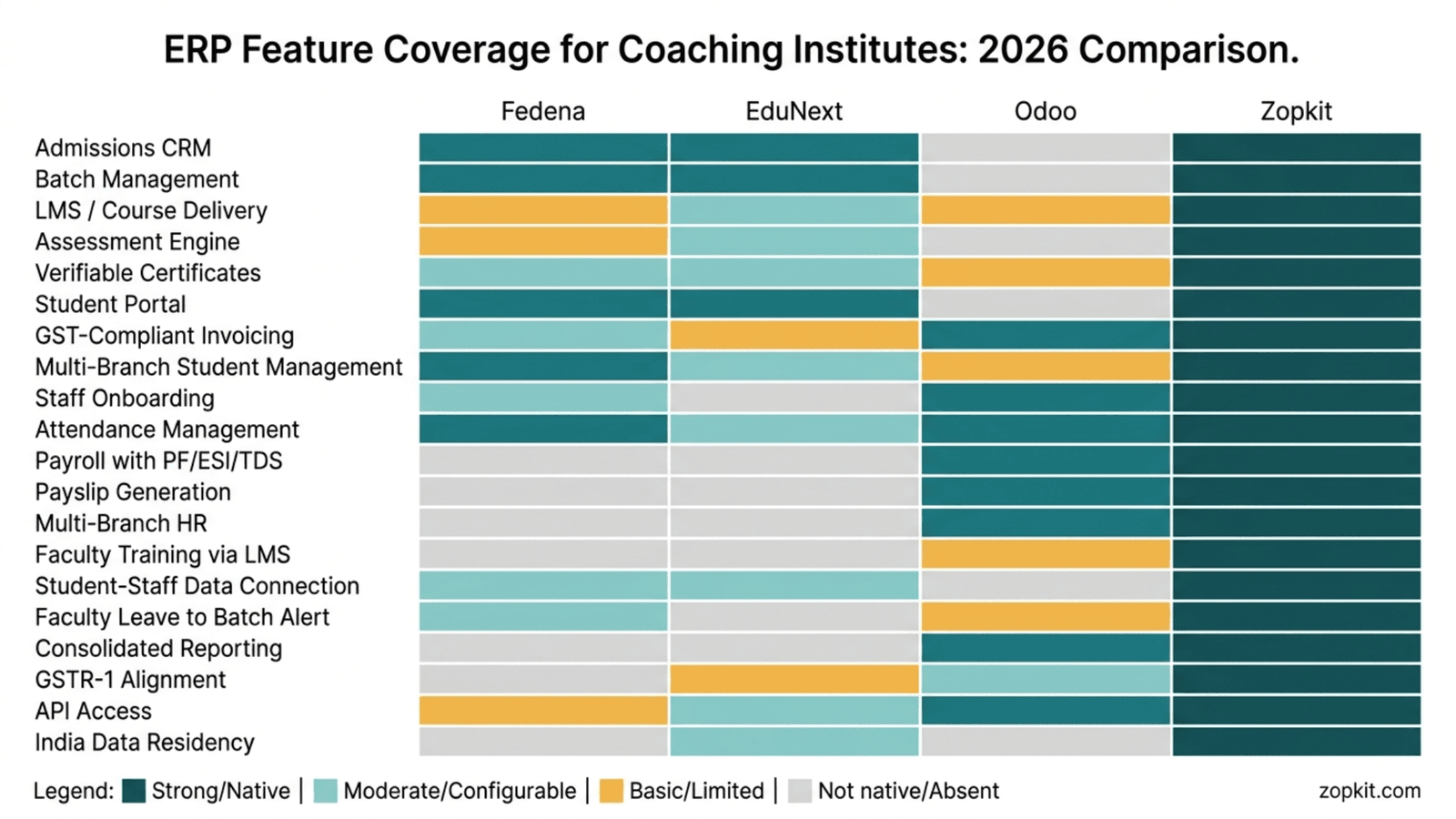
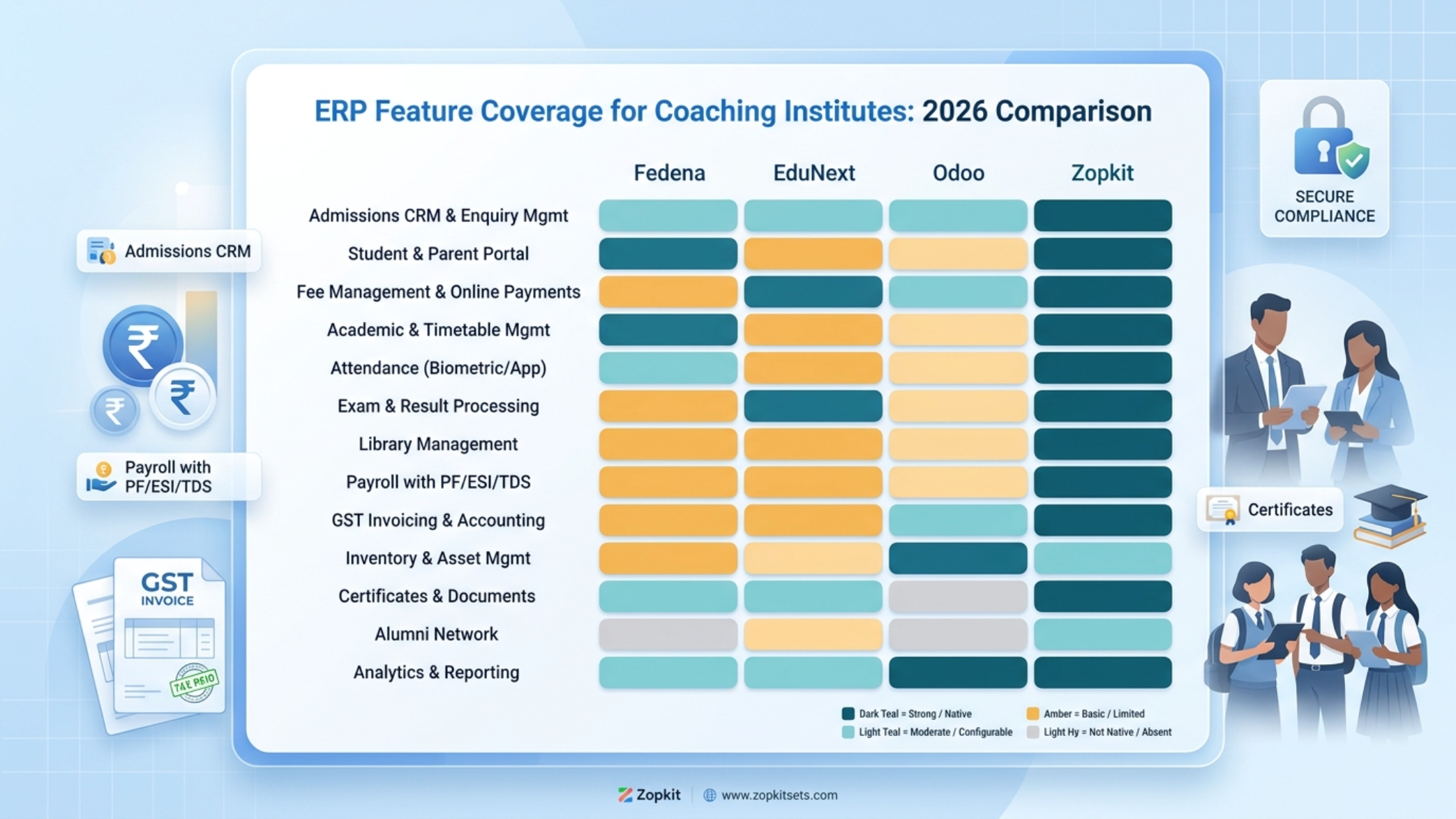
Feature Comparison Matrix
Feature | Fedena | EduNext | Odoo/Zoho (Generic ERP) | Zopkit |
|---|---|---|---|---|
STUDENT DOMAIN | ||||
Admissions CRM with pipeline | Basic | Strong | Configurable (requires setup) | Strong (native) |
Batch management | Moderate (timetable-focused) | Strong | Not native | Strong (cohort-based) |
LMS / Course delivery | Basic (file sharing) | Moderate | Not native (add-on required) | Strong (video, PDF, quiz, assignments) |
Assessment engine | Moderate | Moderate | Not native | Strong (question banks, randomisation, scenarios) |
Verifiable certificates | Basic | Moderate | Not native | Strong (unique URL, LinkedIn-shareable) |
Student portal | Basic | Moderate | Not native | Strong (mobile-responsive) |
Parent communication portal | Basic | Moderate | Not native | Strong |
Fee collection and invoicing | Moderate | Strong | Strong (generic invoicing) | Strong (education-specific) |
GST-compliant invoicing | Basic (requires configuration) | Moderate | Strong (Odoo), Moderate (Zoho) | Strong (SAC 999293 pre-configured) |
GSTR-1 alignment | Weak | Moderate | Strong (Odoo) | Strong |
Multi-branch student management | Moderate | Strong | Strong | Strong |
Student performance analytics | Moderate | Moderate | Not native | Strong |
EMPLOYEE DOMAIN | ||||
Staff onboarding and profiles | Basic | Basic | Strong | Strong |
Attendance management | Moderate | Basic | Strong | Strong |
Leave management with approval | Moderate | Basic | Strong | Strong |
Payroll computation | Basic (limited) | Basic (limited) | Strong | Strong |
PF computation and challan | Weak | Weak | Strong (Odoo) | Strong |
ESI computation | Weak | Weak | Strong (Odoo) | Strong |
TDS computation | Weak | Weak | Strong (Odoo) | Strong |
Payslip generation | Basic | Basic | Strong | Strong |
Multi-branch HR management | Moderate | Weak | Strong | Strong |
Faculty training (LMS for staff) | Basic | Basic | Not native | Strong (same Academy module) |
INTEGRATION | ||||
Student-staff data connection | Not native | Not native | Not native | Native |
Fee collection to payroll incentive | Not native | Not native | Configurable | Native |
Faculty leave to batch alert | Not native | Weak | Not native | Native |
Consolidated student + staff reporting | Not native | Weak | Configurable (requires setup) | Native |
PLATFORM | ||||
Mobile application | Yes (basic) | Yes | Yes (Odoo, Zoho) | Mobile-responsive web |
API access | Yes (Fedena Pro) | Limited | Yes (extensive) | Yes |
Data residency in India | Not specified | Yes | Zoho: Yes. Odoo: configurable | Yes |
Implementation complexity | Moderate | Low to moderate | High (Odoo), Moderate (Zoho) | Low to moderate |
Support quality (India) | Moderate | Good | Moderate (Odoo partner network) | Good (India-based support) |
Pricing Comparison at 150 Staff and 500 Students
Cost Component | Fedena | EduNext | Odoo (Education) | Zopkit |
|---|---|---|---|---|
Platform license (Year 1) | Rs. 1.8L to Rs. 3.6L (per-module pricing) | Rs. 2.4L to Rs. 4.8L (per-student and per-staff) | Rs. 3.6L to Rs. 7.2L (per-user, with education add-on) | Rs. 2.4L to Rs. 4.8L (active learner credits) |
Separate HRMS / payroll tool needed | Yes (Rs. 1.2L to Rs. 2.4L additional) | Yes (Rs. 1.2L to Rs. 2.4L additional) | No (native) | No (native) |
Separate LMS needed | Yes (Rs. 1.2L to Rs. 2.4L additional for serious LMS) | Partial (limited native LMS) | Yes (Rs. 1.2L to Rs. 2.4L additional) | No (native) |
Implementation and setup | Rs. 60K to Rs. 1.5L | Rs. 40K to Rs. 1L | Rs. 1.5L to Rs. 4L (Odoo partner) | Rs. 30K to Rs. 80K (self-serve with support) |
Integration build and maintenance | Rs. 60K to Rs. 1.8L per year | Rs. 60K to Rs. 1.2L per year | Rs. 30K to Rs. 80K per year | Rs. 0 (no integration required) |
Year 1 total cost estimate | Rs. 4.8L to Rs. 9.3L | Rs. 4.16L to Rs. 9L | Rs. 6.3L to Rs. 13.4L | Rs. 2.7L to Rs. 5.6L |
Year 2 to 3 annual cost | Rs. 3.6L to Rs. 6L | Rs. 3.6L to Rs. 7.2L | Rs. 4.8L to Rs. 9.6L | Rs. 2.4L to Rs. 4.8L |
3-year total cost estimate | Rs. 12L to Rs. 21.3L | Rs. 11.36L to Rs. 23.4L | Rs. 15.3L to Rs. 32.6L | Rs. 7.5L to Rs. 15.2L |
Pricing estimates based on vendor published rates and typical implementation costs as of 2026. Actual quotes vary based on configuration requirements and negotiation.
III. Fedena: Strengths, Limitations, and When It Makes Sense
What Fedena Does Well
Fedena's core strength is academic records management: student profiles, examination management, timetable, and attendance. For schools and colleges with a traditional academic calendar structure, Fedena's record management is comprehensive and well-tested.
The Fedena community edition (open-source) has a large user base in India, particularly among institutions that implemented it 5 to 7 years ago when it was one of the few affordable options for school management. The commercial Pro edition adds fee management, a mobile app, and expanded reporting.
Where Fedena Falls Short for Coaching Institutes
Batch management versus timetable management: Fedena was built for the school timetable model: fixed periods, fixed classrooms, fixed subjects per class. Coaching institutes operate on batch logic: a batch is a group of students enrolled in a specific programme at a specific time, which may run for 3 months or 18 months, with flexible scheduling. Fedena's timetable module does not map cleanly onto this model without configuration that most implementing partners do not execute correctly.
LMS capability: Fedena's file sharing and resource management is not an LMS. There is no video hosting, no structured course progression, no drip scheduling, no assessment engine with question banks. A coaching institute that wants to deliver recorded lectures and structured assessments through Fedena needs a separate LMS.
HR and payroll: Fedena's HR module covers basic employee profiles and attendance. Payroll with PF, ESI, and TDS computation is not a Fedena strength. Institutes using Fedena for student management almost universally use a separate HR tool for payroll.
When Fedena makes sense: Schools and colleges with traditional academic structures that prioritise examination and records management, and are comfortable using a separate HRMS and a separate LMS. Not the right platform for coaching institutes that need batch management and LMS capability as first-class features.
IV. EduNext: Strengths, Limitations, and When It Makes Sense
What EduNext Does Well
EduNext is built specifically for the Indian coaching institute and training centre market. Its admission management, batch scheduling, and fee collection modules are designed with coaching institute workflows in mind. The platform understands the difference between a batch and a classroom, the importance of inquiry pipeline tracking, and the fee structures common to coaching (monthly, quarterly, lump sum, partial scholarships).
EduNext's India-based support and understanding of GST invoicing requirements for educational services makes it a credible option for institutes that have been evaluating education-specific platforms.
Where EduNext Falls Short
LMS depth: EduNext's learning management capabilities cover content hosting and basic assessments but do not offer the depth that a coaching institute using recorded lectures as a primary delivery format needs. No question bank randomisation, no scenario-based assessment, no structured course progression with prerequisites.
HR and payroll: EduNext's HR module is limited. Payroll with PF, ESI, and TDS computation requires a third-party integration or a separate tool. Institutes that evaluate EduNext for student management and then realise the HR module does not cover statutory compliance face the same integration problem that education ERPs have always had.
Analytics and reporting: EduNext's reporting covers standard operational metrics but lacks the analytical depth for institutes that want to correlate student performance with faculty effectiveness, or track conversion funnel metrics across branches with drill-down capability.
When EduNext makes sense: Coaching institutes under 50 staff that prioritise admission and fee management and are comfortable with a basic LMS and a separate HRMS for payroll. For institutes above 100 staff with serious LMS requirements, EduNext typically requires supplement tools that increase the total cost and complexity.
V. Generic ERPs (Odoo, Zoho, Tally-Connected Tools): Strengths, Limitations
What Generic ERPs Do Well
Generic ERPs, particularly Odoo and Zoho's suite, are enterprise-grade on the HR and finance side. PF, ESI, and TDS computation in Odoo is robust. Zoho People's leave management and payroll are well-developed. The accounting in Odoo covers the full chart of accounts that a 100 to 200 staff organisation requires.
For coaching institutes that have already implemented an Odoo or Zoho instance for their business operations and are looking to extend it to cover the institute, the generic ERP path avoids a platform migration.
Where Generic ERPs Fall Short for Coaching Institutes
Student management is not native: Odoo's education module is a community-built add-on, not a core Odoo product. It varies significantly in quality depending on which Odoo partner built and maintains it. Zoho does not have a native student management module; an institute would need to configure the CRM and project management modules to approximate the admission and batch management workflows.
LMS is absent: Neither Odoo nor Zoho includes an LMS in the standard suite. Coaching institutes using a generic ERP need a third-party LMS (Moodle, TalentLMS, or a custom-built solution) connected via API. This integration requires ongoing maintenance.
The customisation cost: Making a generic ERP work for a coaching institute requires significant customisation. Odoo implementations for non-standard use cases typically involve 200 to 400 hours of developer time. The initial customisation cost of Rs. 3 to 8 lakh plus annual maintenance of Rs. 1 to 2 lakh makes the generic ERP path the most expensive option over a three-year period for most coaching institutes.
When generic ERPs make sense: Coaching institutes that are subsidiaries of larger businesses already on Odoo or Zoho, where the incremental cost of configuring the education module is lower than migrating to a new platform. Not the right choice for standalone coaching institutes making a fresh platform selection.
VI. Zopkit: The Native Intersection of Student and Employee Management
The Architecture Difference
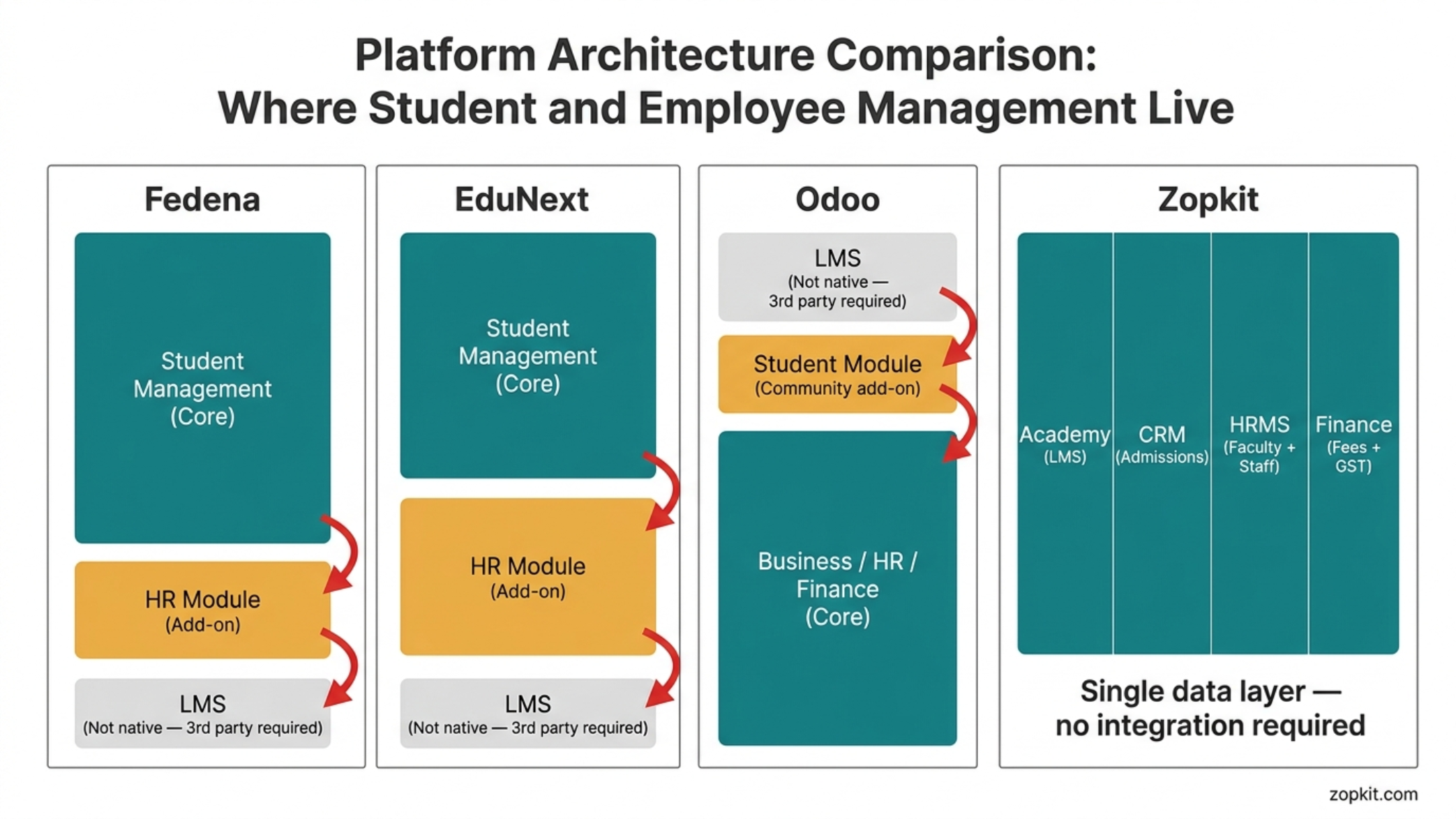
The fundamental difference between Zopkit and every other platform in this comparison is architectural. Fedena and EduNext are student management platforms with HR modules added. Generic ERPs are business management platforms with student modules added. Zopkit is built at the intersection: student management and employee management are both first-class capabilities in the same data layer.
This architecture has specific operational consequences:
The faculty member is both an employee and a course instructor in the same record. When you open a faculty member's profile in Zopkit, you see their salary details, their leave history, their payslips, and their assigned Academy courses and student batches. In every other platform, these records exist in separate systems.
When a faculty member applies for leave in HRMS, the affected batches are immediately visible. The batch scheduling impact of leave is a critical operational concern for coaching institutes. In disconnected platforms, the HR team approves leave without knowing which batches are affected. In Zopkit, the leave approval screen shows which batches the faculty member is assigned to in Academy.
Student fee collection data and staff payroll incentive calculation are in the same platform. For institutes with performance-based compensation for admission staff or branch managers tied to enrollment or revenue targets, Zopkit's Finance and HRMS connection enables automatic incentive calculation without a manual reconciliation step.
Consolidated reporting across both domains is a single dashboard. The Director of Operations who wants to see: new admissions this month, fee collection rate, batch completion rates, staff leave balance, and payroll status for the upcoming month, sees all of this on one screen. In every other platform combination, this view requires manual assembly from multiple tools.
Zopkit Academy for Coaching Institutes Specifically
The Academy module in Zopkit is designed for the coaching delivery model, not the corporate training model and not the school academic model.
Batch cohort architecture: A course in Zopkit Academy can have multiple cohorts running simultaneously. The JEE Mathematics course has a Morning Batch, an Evening Batch, and a Weekend Intensive batch. All cohorts share the same course content but have independent drip schedules and enrollment lists. The faculty member uploads content once; it is delivered to all cohorts according to their individual schedules.
Assessment engine for coaching: Question banks with topic tagging enable randomised test generation. Each student in a batch can receive a different question set drawn from the same question bank. Time-limited assessments with auto-submission. Negative marking for competitive exam preparation. Percentile ranking within the batch and across all batches in the institute.
Performance tracking for parents and management: The student's assessment performance is tracked over time and visible to the parent in the student portal. The institute's management view shows batch-level performance trends. Faculty can identify students at risk of disengaging based on access frequency and assessment score trends.
Certificate issuance: Upon completion of a programme, a verifiable certificate is issued with a unique URL. The student can share it. Parents can verify it. The institute's certificate has the same professional credibility as certificates from larger institutes.
VII. The 10 Questions to Ask Every ERP Vendor in the Demo
These questions separate platforms that handle coaching institute requirements natively from platforms that will require workarounds, integrations, or custom development.
Question 1: When a new employee joins as a faculty member and is assigned to a batch, does the assignment appear in both the HRMS record and the Academy course roster without a manual step in the second system?
Question 2: When a faculty member applies for leave and the leave is approved, does the system identify which student batches are affected and alert the batch coordinator?
Question 3: Show me the GST-compliant fee invoice for a student enrolled in a commercial coaching programme. Does it include the GSTIN, SAC code 999293, CGST/SGST split, and sequential invoice number from the same platform, without exporting to a separate invoicing tool?
Question 4: At the end of a performance review cycle, where does the faculty member's training completion data appear on the review form? Is it populated automatically or does HR need to upload it manually?
Question 5: Show me the payslip for a part-time faculty member paid per session. How does the session count from the Academy attendance feed into the payroll calculation?
Question 6: For a multi-branch institute, show me the consolidated view of fee collection, student enrollment, and staff headcount across all branches from one login. How long does it take to generate this report?
Question 7: When a student's parent requests a fee receipt for a payment made three months ago, how many clicks does it take for the admin to find and resend that receipt?
Question 8: Show me the GSTR-1 summary report for the last quarter. How is it generated and what does the CA need to do with it before filing?
Question 9: If your platform requires integration with a separate tool for any of the above scenarios, who maintains that integration when either platform releases a major update?
Question 10: What is the total cost over three years, including implementation, integration maintenance, and per-seat or per-student licensing at our projected headcount in year 3?
The vendor who answers all 10 questions smoothly in the demo is the vendor whose platform is genuinely built for this use case. The vendor who defers 4 or more answers to "our integration with [partner tool]" or "that requires a customisation" is the vendor whose platform will require ongoing workaround maintenance.
VIII. The Evaluation Scorecard
Use this scorecard to evaluate each shortlisted platform after the demo. Rate each dimension from 1 (not covered) to 5 (fully native, no workaround required).
Evaluation Dimension | Weight | Fedena | EduNext | Odoo | Zopkit |
|---|---|---|---|---|---|
Admissions CRM and pipeline | 10% | 2 | 4 | 3 | 5 |
Batch management for coaching | 10% | 3 | 4 | 2 | 5 |
LMS and course delivery depth | 10% | 2 | 3 | 2 | 5 |
Assessment engine | 8% | 3 | 3 | 2 | 5 |
GST-compliant fee invoicing | 8% | 3 | 4 | 4 | 5 |
Payroll with PF/ESI/TDS | 10% | 2 | 2 | 5 | 5 |
Payslip generation and distribution | 8% | 2 | 2 | 5 | 5 |
Student-staff data integration | 10% | 1 | 2 | 2 | 5 |
Multi-branch management | 8% | 3 | 3 | 4 | 5 |
Consolidated management reporting | 8% | 2 | 3 | 3 | 5 |
3-year total cost of ownership | 10% | 3 | 3 | 2 | 5 |
Weighted score | 100% | 2.3 | 3.0 | 3.0 | 5.0 |
Scores reflect typical implementation outcomes for 100 to 200 staff coaching institutes. Individual evaluations may vary based on specific configuration requirements.
IX. Implementation Timeline Comparison
Phase | Fedena | EduNext | Odoo | Zopkit |
|---|---|---|---|---|
Requirements gathering and vendor configuration | 2 to 4 weeks | 1 to 2 weeks | 4 to 8 weeks | 1 week |
Data migration | 2 to 3 weeks | 1 to 2 weeks | 3 to 4 weeks | 1 to 2 weeks |
Module configuration and testing | 3 to 4 weeks | 2 to 3 weeks | 6 to 10 weeks | 2 to 3 weeks |
Integration build (HRMS + LMS) | 3 to 6 weeks | 3 to 6 weeks | 2 to 4 weeks (within Odoo) | Not required |
Staff training | 1 to 2 weeks | 1 week | 2 to 3 weeks | 1 week |
Parallel running and go-live | 2 to 4 weeks | 2 to 3 weeks | 3 to 4 weeks | 2 to 3 weeks |
Total implementation timeline | 13 to 23 weeks | 10 to 16 weeks | 20 to 33 weeks | 7 to 10 weeks |
Implementation risk level | Medium | Low to Medium | High | Low |
The Odoo implementation timeline and risk are the most significant in this comparison because Odoo implementations for non-standard use cases (and coaching institute management is a non-standard use case for Odoo) require significant partner-dependent customisation. The quality of an Odoo implementation depends heavily on the implementing partner, and quality varies widely in the Indian Odoo partner ecosystem.
Conclusion
The Right ERP for a Coaching Institute Is Not the Best Education ERP or the Best Business ERP. It Is the Platform Built at the Intersection of Both.
The evaluation framework that most coaching institute buyers bring to an ERP selection is borrowed from either the school management software evaluation or the business ERP evaluation. Both frameworks produce suboptimal outcomes because they optimise for one domain and treat the other as secondary.
The school management framework selects for academic records, examination management, and student information system completeness. It selects Fedena or EduNext. The institute then discovers that running payroll for 100 faculty and staff requires a second platform, and the student-staff connection requires a third tool to bridge them.
The business ERP framework selects for finance, HR, and operational management completeness. It selects Odoo or Zoho. The institute then discovers that managing student admissions, batch delivery, and course content requires an education add-on, an LMS integration, and a customisation project that takes six months and costs more than the license.
Zopkit is built for the buyer who has arrived at this evaluation having run both frameworks and found them insufficient. The Academy, CRM, HRMS, and Finance are not modules bolted onto a core platform. They are the platform. The faculty member's payslip and the student's certificate are in the same system because they are both outputs of the same operational data layer.
For a 100 to 200 staff coaching institute making a three-year platform decision in 2026, the Zopkit evaluation is the one that ends the search. Not because it is the cheapest option (though the three-year total cost is the lowest in the comparison), and not because it has the most features. Because it is the only platform where the question "show me the payslip for your faculty member and the certificate for your student in the same platform" has a direct, unambiguous answer.
Book a demo at zopkit.com. Bring the 10 questions from Section VII. Ask them to every vendor you are evaluating, including Zopkit. The answers will make the decision clear.