Best Retail ERP for Indian Multi-Store Chains: Operations, HR, Finance and Training Together
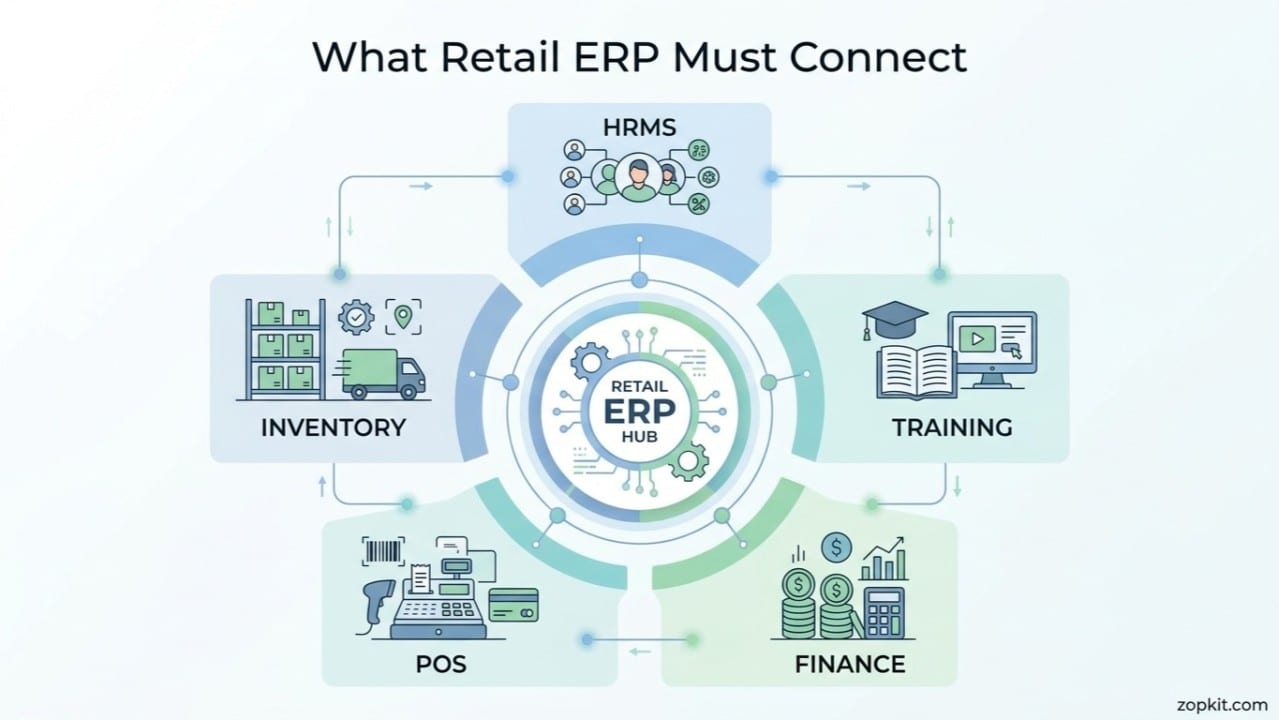
Indian retail chains with 100 to 200 employees usually do not need more software. They need a connected operating system that reduces fragmentation across stores, people, finance, compliance, and training.
That is the real reason this ERP conversation matters. The best-fit platform is the one that connects POS, inventory, HRMS, finance, GST compliance, and training in one workflow instead of scattering them across separate tools.
Table of contents
I. Why multi-store retail gets harder fast
II. What retail ERP must actually solve
III. Where fragmented tools create operational drag
IV. How Zopkit connects the business
V. Why India-specific compliance changes the decision
VI. What chains should evaluate before buying
VII. Conclusion
I. Why multi-store retail gets harder fast
A single-store business can function on manual follow-up, spreadsheets, and a few point tools. Once a chain grows into multiple locations, the same approach creates duplicated work, inconsistent data, and slower decisions.
Store teams need visibility into sales, stock, transfers, and approvals. HR needs attendance, leave, payroll, documents, and performance. Finance needs AP, AR, banking, GL, tax, and reporting. Training teams need a reliable way to onboard employees and standardize how work gets done across stores.
The bigger the chain gets, the more expensive those gaps become. What looked like “flexibility” at one location becomes coordination overhead across the business.

II. What retail ERP must actually solve
A retail ERP should not stop at billing or inventory visibility. It should connect store execution, workforce operations, finance, compliance, and training so leadership can run the chain through one system of record.
On the operations side, that means POS, inventory movement, stock transfers, procurement, warehouse control, and order flow. On the people side, it means employee lifecycle, attendance, leave, payroll, and documents. On the finance side, it means AP, AR, banking, GL, budgets, statements, and tax reporting.
For Indian retail, compliance is part of the operating model. GST, HSN codes, e-way bills, and payroll rules are not extras; they affect how the whole business runs day to day.

III. Where fragmented tools create operational drag
Disconnected tools usually do not fail loudly. They create small delays that add up: inventory not matching sales, payroll needing manual cleanup, finance chasing missing data, and training happening outside the main workflow.
Inventory is often the first pain point. Retail chains need real-time stock tracking, barcode support, inter-location transfers, reorder logic, and audit trails. Without that, stores either overbuy or stock out, and both hurt margins.
Finance feels the cost next because every operational mismatch becomes reconciliation work. Zopkit’s Finance-Accounting is designed to connect transactions into GL, AP, AR, banking, reporting, and India tax management so the finance team can close books from live operational data.
HR and training are not separate from operations in retail. High turnover, rapid onboarding, store transfers, and SOP changes mean attendance, payroll, policy control, and training need to sit close to execution.
IV. How Zopkit connects the business
Zopkit’s strength is that it connects the core retail functions instead of leaving them as isolated systems. Operations Management covers catalog, inventory, procurement, order fulfillment, logistics, POS, and India-aware tax workflows like GST, HSN codes, and e-way bills.
HRMS covers the employee side of the business from hiring to offboarding, including core HR, time and attendance, leave, payroll, performance, documents, benefits, assets, expenses, helpdesk, and training-related workflows. That gives retail leaders one platform for managing staff across stores and headquarters.
Finance-Accounting adds the financial control layer with GL, AP, AR, banking, reconciliations, statements, budgeting, multi-entity support, and tax management. That makes it easier to see the financial health of every store and the chain overall.
ZopKit Academy rounds out the stack with courses, sessions, learning paths, skills, assessments, certificates, and analytics. That turns onboarding and staff development into part of the operating system, not a side process.

V. Why India-specific compliance changes the decision
Indian retail chains need more than generic ERP features. They need software that understands the realities of Indian commerce and taxation, because compliance affects invoices, movement of goods, and payroll every day.
Zopkit’s Operations Management includes GST-aware workflows, HSN codes, and e-way bills. Finance-Accounting adds GST and TDS support, tax configuration, and reporting. HRMS supports India payroll depth with statutory deductions, salary components, tax documents, and payroll processing.
That matters because compliance errors do not just create paperwork. They create rework, delays, and risk at scale.

VI. What chains should evaluate before buying
Retail leaders comparing Unicommerce, Vinculum, or SAP alternatives should ask a practical question: can one platform handle store operations, HR, finance, training, and India compliance together ?
It is also worth asking whether the system reduces manual coordination. A good retail ERP should shorten onboarding, improve stock accuracy, simplify payroll, and give head office a clearer view of performance across stores.
For chains in the 100 to 200 employee range, the real objective is not software accumulation. It is operational clarity and control as the business grows.

Conclusion
The best retail ERP for Indian multi-store chains is the one that connects operations, HR, finance, and training in one system. Zopkit fits that model because it covers the full retail operating stack instead of leaving teams to stitch together disconnected tools.
start at Zopkit.com