Best Project Management + CRM Combo for IT Startups in India
You closed the deal. Your CRM says "Won." Your developer has no idea.
That gap, between the sale and the sprint, is where IT startups bleed time, money, and client trust. Not because the team is bad. Because the tools were never built to talk to each other.
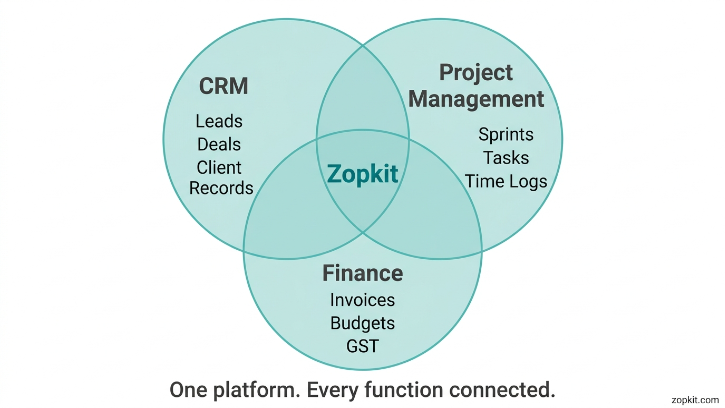
This is why the Trello + spreadsheet + Zoho CRM stack breaks down, and how Zopkit's Project Management, CRM, and Finance in one platform removes the handoff chaos for good.
Table of Contents
- I. The Stack Every IT Startup Builds (And Why It Eventually Breaks)
- II. What the Handoff Gap Actually Costs You
- III. What a Connected PM + CRM + Finance Platform Looks Like
- IV. Zopkit Project Management: Built for Delivery Teams
- V. Zopkit B2B CRM: Built for B2B Sales Cycles
- VI. Zopkit Financial Accounting: From Deal to Invoice Without Re-Entry
- VII. How the Three Work Together as One System
- VIII. Why Zopkit Fits IT Startups Specifically
- IX. The Credit-Based Model: Pay for Usage, Not Seats
- X. Where to Start
I. The Stack Every IT Startup Builds (And Why It Eventually Breaks)
Every Indian IT startup begins with the same three decisions:
- Trello or Notion for tracking tasks and sprints
- Google Sheets or Excel for project budgets, timelines, and status reports
- Zoho CRM or HubSpot for managing leads and client deals
These choices are logical at five people. They are genuinely painful at twenty-five.
Here is what the breakdown looks like in practice:

The tools are not failing. The gaps between them are.

II. What the Handoff Gap Actually Costs You
The cost is not just time. It compounds across every project, every client, every sprint.
Operational costs of a fragmented stack:
- Sales-to-delivery gaps mean developers start projects without full context, leading to scope misalignment from day one
- Budget overruns go unnoticed because no one is watching the spreadsheet in real time
- Billable hours are under-reported because time tracking is a separate step no one remembers to do
- Invoices are delayed because finance has to chase the PM for hours, the PM has to check Trello, and the deal value has to be confirmed in the CRM
- Client escalations catch leadership off guard because there is no unified view of project health and account history together
The hidden cost: context switching. Every tool switch costs approximately 23 minutes of productive focus per interruption. A PM managing three tools for one project loses that time multiple times a day, every day.
For IT startups competing on delivery quality and speed, this is not a small inconvenience. It is a structural disadvantage.
III. What a Connected PM + CRM + Finance Platform Looks Like
A connected platform does not just put three tools on the same website. It means:
- One record for every client that carries their deal history, project status, support tickets, and invoices in one place
- One record for every project that knows its budget, its deal source, its team members, and its billing status
- One source for every number so when finance asks what this project is worth, the answer is live, not estimated
When a deal is won in the CRM, it should be the starting point for a project, not a separate process. When a project reaches a milestone, the invoice should be raisable from the same platform. When a team member logs hours, those hours should be available for payroll and client billing without re-entry.
That is exactly what Zopkit delivers.

IV. Zopkit Project Management: Built for Delivery Teams
Zopkit Project Management is not a task list. It is a delivery management system built for teams that need to track work, time, budgets, and performance together.
What it covers:
- Projects with budget tracking, progress monitoring, status lifecycle from planning to archived, and health scoring
- Tasks and subtasks with assignees, due dates, priorities, story points, and sprint assignment
- Agile workflow with sprint planning, sprint start and complete, velocity tracking, and backlog management
- Kanban boards with drag-and-drop status management for standups and visual workflow
- Time tracking with billable and non-billable classification, timesheet submission, and manager approval for payroll and client billing
- Team analytics showing capacity, utilization, and per-member performance
- Calendar with milestone tracking and external calendar sync
- Migration from Jira, Asana, and Monday.com for teams moving existing project history
- AI delivery insights including budget overrun alerts, overdue project flags, and low utilization warnings from real project and time data
For IT startups specifically:

V. Zopkit B2B CRM: Built for B2B Sales Cycles
IT startups sell on relationships, trust, and context. A CRM that just tracks a pipeline misses the point. Zopkit B2B CRM is built around the full account relationship, not just the deal.
What it covers:
- Lead and contact management with configurable pipelines, kanban views, and territory-based access controls
- Account records with a 360-degree view: every communication, deal, invoice, and support ticket tied to one customer record
- Opportunity pipeline with stage tracking, win and loss recording, and deal forecasting
- Quotations, sales orders, and invoices generated directly from deal records
- Email sync with Gmail and Outlook so every client conversation is visible on their record without manual logging
- Support ticketing integrated into the customer record, so service issues sit alongside sales history
- Marketing campaigns and multi-step email outreach sequences
- Embeddable web forms that push leads from your website directly into the CRM
- Custom modules that let admins define new record types without writing code
- AI assistant that reads your pipeline data, answers questions, and takes actions on records in plain English
What this means for IT startup sales:
When a client asks "where are we on the proposal," your salesperson does not need to open three tabs. Every interaction, document, and deal stage is in one record. When the deal closes, the same record becomes the client account your delivery and finance teams work from.

VI. Zopkit Financial Accounting: From Deal to Invoice Without Re-Entry
Most IT startups invoice late. Not because finance is slow. Because the information to raise an invoice is scattered across a CRM, a timesheet tool, and a project board, and someone has to collect it manually before the invoice can be created.
Zopkit Financial Accounting removes that step entirely.
What it covers:
- Accounts Receivable: customer invoicing with full approval and payment lifecycle, estimates, sales orders, recurring invoices, credit notes, and AR aging reports
- Accounts Payable: vendor bills, purchase orders, three-way matching to prevent duplicate payments, and expense report approvals
- Banking: bank account management, transaction imports, rule-based auto-categorization, bank reconciliation, and cash flow forecasting
- General Ledger: chart of accounts, journal entries, trial balance, and period close
- Financial reporting: P&L, balance sheet, and cash flow statement generated directly from live transaction data
- India tax compliance: GST configuration, HSN code management, TDS configuration, GSTR-aligned tax reports, and a compliance calendar with filing deadline reminders
- Multi-currency support for IT teams billing international clients
- Invoice scanning that reads a vendor bill and auto-fills the relevant fields
For IT startups billing clients on time and materials or milestone basis:

VII. How the Three Work Together as One System
This is the part that no fragmented stack can replicate.
The connected workflow in Zopkit:
- A lead comes in through your website form and lands directly in the CRM
- Your sales team works the deal through the pipeline. All communications log automatically via Gmail or Outlook sync
- The deal is won. A project is created from the same record with the deal value, client details, and scope already populated
- The delivery team picks up the project in the PM module. They plan sprints, assign tasks, and log time against the project
- At billing time, approved timesheets and milestone completions feed directly into invoice generation in Financial Accounting
- The invoice is raised with GST calculated automatically. Payment status updates the AR aging report in real time
- The client account in the CRM now shows the full history: every deal, every project, every invoice, every support ticket
No email threads to confirm deal values. No spreadsheets to reconcile. No chasing timesheets at month-end.
What each team gains:


VIII. Why Zopkit Fits IT Startups Specifically
International business software was not designed for Indian IT startups. It was designed for US SaaS companies or large enterprises. The gaps show up fast.
What makes Zopkit the right fit:
- India GST compliance is built in, not bolted on. Every invoice you raise, every vendor bill you receive, every project expense you record carries the correct GST treatment automatically. There is no separate compliance tool, no monthly reconciliation with your CA before filing.
- Agile delivery is a first-class workflow. Sprint planning, velocity tracking, backlog management, and kanban boards are core PM features, not add-ons. IT teams do not have to adapt the tool to their workflow.
- Billable time flows into invoicing. Time logged by developers against a project can be classified as billable or non-billable, approved by a manager, and used directly to generate a client invoice. The loop from delivery to billing is closed inside one platform.
- The CRM understands B2B context. IT startups sell to companies, not individuals. Account-level records, multi-contact deal management, and support ticket history tied to client accounts reflect how B2B IT sales actually works.
- Multi-currency for international clients. Many Indian IT startups bill in USD or GBP. Multi-currency support in Financial Accounting handles the conversion, reporting, and GST treatment for export services without a workaround.
- AI that works on real data. The CRM AI assistant can answer questions about your pipeline and take actions in plain English. The PM AI flags budget overruns and overdue projects from actual project data, not static thresholds.
IX. The Credit-Based Model: Pay for Usage, Not Seats
Traditional SaaS pricing charges by the seat. A 30-person IT startup pays for 30 seats on every tool it uses, whether or not every person uses every tool every day.
For IT startups with:
- Developers who need PM access daily but touch the CRM rarely
- A part-time finance manager who needs accounting access but nothing else
- Interns and contractors who need limited access for a fixed period
A per-seat model is consistently wasteful.
Zopkit uses a credit-based consumption model:
- Buy credits once
- Usage across all Zopkit tools consumes credits based on actual activity
- Slow months cost less. High-activity months cost more
- Start with two modules. Add three more later. No renegotiation
Your credit balance, usage history, and subscription status are visible inside the platform at all times. No hidden consumption events. No surprises at renewal.
X. Where to Start
You do not need to implement everything on day one.
A practical starting path for IT startups:

Because every Zopkit module shares one identity layer and one data system, adding a new module is not a new implementation. It is activating a part of a platform your team already uses.

Conclusion
Indian IT startups do not lose clients because of bad code. They lose time, margin, and client trust because their internal systems were never built to work together.
Trello does not know what your CRM knows. Your CRM does not know what your timesheet knows. Your finance tool knows nothing until someone tells it.
Zopkit closes every one of those gaps. Project Management, B2B CRM, and Financial Accounting on one platform, sharing one data layer, with India GST compliance built into every transaction and agile delivery built into every sprint.
Not one more tool. The system that connects the ones you have been trying to make work together.
Book a free demo at zopkit.com and see your entire delivery-to-billing cycle running without a single manual handoff.