Best Practice Management Software for Small Consulting Firms in India
A 10 to 30 person consulting firm is not small in the way a solo professional is small. It has real team complexity. It has consultants spread across multiple client engagements at the same time. It has timesheets that need to go to billing. It has HR decisions being made informally. It has a pipeline of new business that nobody is formally tracking. And it has a founding partner or managing director who is supposed to be leading strategy but spends most of their week chasing status updates from five different tools that were never meant to work together.
The problem is not that the firm is unorganised. The problem is that the firm outgrew spreadsheets and WhatsApp months ago, but has not yet found a system built for exactly this stage.
This article is about why Zopkit Project Management, Zopkit B2B CRM, Zopkit HRMS, and Zopkit Financial Accounting together form the most practical practice management system a small consulting firm in India can run on — and how the three work as one connected platform instead of three more tools that create gaps of their own.
Table of Contents
- I. The Operational Reality of a 10 to 30 Person Consulting Firm in India
- II. What Fragmented Tools Are Actually Costing Your Firm
- III. What a Proper Practice Management System Looks Like
- IV. Zopkit Project Management: Client Delivery Without the Chaos
- V. Zopkit B2B CRM: Business Development That Does Not Fall Through the Cracks
- VI. Zopkit HRMS: Managing Your Consultants Without Manual HR
- VII. Zopkit Financial Accounting: From Timesheet to Invoice to Paid
- VIII. How All Four Work Together as One System of Record
- IX. Why This Fits Indian Consulting Firms Specifically
- X. The Credit-Based Model: Pricing That Reflects How a Consulting Firm Actually Works
- XI. Where to Start
I. The Operational Reality of a 10 to 30 Person Consulting Firm in India
At ten people, a consulting firm can still run on tribal knowledge. The founder knows which consultant is on which project. The office manager knows who applied for leave. The billing happens because someone remembers to raise the invoice. Follow-up on new business is the founder's personal WhatsApp to-do list.
At twenty-five people, that system has collapsed completely. Nobody can hold the full picture in their head anymore, and the systems that replaced the founder's memory are a patchwork of tools that create as many problems as they solve.
Here is what the operational landscape of a typical Indian consulting firm at this stage actually looks like:

Every single one of these is a gap, not a tool failure. The tools exist. The connection between them does not.

II. What Fragmented Tools Are Actually Costing Your Firm
The visible cost is wasted time. The invisible cost is leaked revenue and decisions made on incomplete information.
Revenue leakage from fragmented timesheets and billing:
When timesheet data lives in email submissions and a manually assembled spreadsheet, hours go under-reported. Consultants forget to log last Tuesday's two-hour call. The billing manager does not catch it because there is no system to catch it. The invoice goes out at 92% of the hours actually worked. Across a 20-person firm billing ₹40,000 per consultant per month, that is not a rounding error. That is a meaningful number walking out the door every cycle.
Missed pipeline and lost business development:
When the new business pipeline lives in the founder's WhatsApp and inbox, it dies when the founder gets busy. A warm prospect from six weeks ago never heard back. A proposal sent three weeks ago was never followed up on. A referral from a satisfied client was thanked and forgotten. At the 10 to 30 person stage, almost every rupee of new revenue comes from relationships and follow-through. A system that lets follow-up fall through is not a minor inconvenience.
HR inconsistency and compliance risk:
When leave approvals happen over WhatsApp, there is no policy. When payroll is calculated on a spreadsheet, there are errors. When a consultant's offer letter says one thing and their actual salary is slightly different because of an informal conversation, the risk is real. At 15 to 30 people, PF, ESI, TDS, and professional tax compliance is not optional. And it is impossible to manage correctly when the data is scattered.
Leadership blindness:
The managing partner cannot see project health, pipeline status, team utilisation, and cash flow in one place at the same time. That means every strategic decision is made on the basis of the last status update meeting, which was held on information that was already three days old.
III. What a Proper Practice Management System Looks Like
A practice management system for a consulting firm is not a project tool. It is not a CRM. It is not an HR tool. It is all three, connected, so that one piece of information does not have to be re-entered in three places to be useful in each of them.
What it needs to do:
- Track every client engagement with project status, budget health, deliverable milestones, and team assignments visible in one place at all times
- Collect and approve timesheets from every consultant against specific projects, with billable and non-billable classification done at the time of logging — not reconstructed later
- Connect timesheet data to billing so that when a milestone is complete or the billing cycle closes, the invoice can be raised from actual approved hours, not from a manual calculation
- Track the business development pipeline so that every prospect, proposal, and follow-up is visible to more than one person, and nothing goes cold without a deliberate decision to deprioritise it
- Manage people operations — leave, attendance, payroll, performance — in a way that is policy-driven and compliant with Indian statutory requirements, not informal and reconstructed at month-end
- Give leadership a real-time view across all of the above without requiring a status call or a manually assembled PowerPoint
That is exactly what Zopkit's connected ecosystem of Project Management, CRM, HRMS, and Financial Accounting delivers.

IV. Zopkit Project Management: Client Delivery Without the Chaos
Zopkit Project Management is not a task list. It is a delivery management system built for firms that need to track work, time, budgets, and team performance together — not separately across three tools.
What it covers for consulting firms:
- Projects with budget tracking and health scoring — every engagement has a defined budget, a current spend status, a progress indicator, and a health score. When a project starts drifting over budget or past deadline, the system surfaces it. You do not find out from a client call.
- Tasks and subtasks with assignees, due dates, priorities, and milestone linkage so every deliverable has a clear owner and a clear timeline
- Kanban boards and sprint workflows for firms running structured delivery sprints or client review cycles, with drag-and-drop status management and velocity tracking for capacity planning
- Time tracking with billable and non-billable classification — consultants log hours against the project as the work happens, classify each entry as client-billable or internal, and submit for manager approval. The data is clean and ready for billing before the month even closes.
- Timesheet approval workflows where project managers review and approve hours before they are available for invoicing, with an audit trail of who approved what and when
- Team analytics showing capacity and utilisation — who is overloaded, who has bandwidth, and how each consultant is performing against their project commitments
- AI delivery insights that flag budget overruns, overdue deliverables, and underutilised consultants from actual project data, not static thresholds you set manually
For a consulting firm managing 8 to 15 active client engagements simultaneously:


V. Zopkit B2B CRM: Business Development That Does Not Fall Through the Cracks
Most consulting firms at the 10 to 30 person stage have no formal business development system. New business comes from the founder's network, referrals from existing clients, and occasionally a well-timed proposal. That model works until the firm wants to grow deliberately.
A CRM for a consulting firm is not about managing a high-volume sales funnel. It is about ensuring that every relationship, every warm conversation, and every proposal in flight is tracked, visible to the right people, and acted on before it goes cold.
What Zopkit B2B CRM covers for consulting firms:
- Lead and contact management with configurable pipelines so that every prospect — whether they came through a referral, an event, a LinkedIn connection, or a cold outreach — is in one system with a clear next action assigned
- Opportunity pipeline with stage tracking from initial conversation to proposal sent to engagement signed, with deal value, probability, and close date tracked at each stage
- Account records with 360-degree client history — every communication, every proposal, every invoice, and every project tied to one client account. When a relationship manager leaves the firm, the client history stays
- Email sync with Gmail and Outlook so every email sent or received from a prospect or client is automatically logged to their record without anyone manually copying a thing
- Quotations and proposals generated directly from the deal record with PDF export, so the proposal process moves from a conversation to a document in one step, not over two days
- Support ticketing tied to client accounts so escalations, revision requests, and feedback from active engagements sit alongside the sales and billing history in one place
- AI assistant that can answer questions like "which proposals have been outstanding for more than 10 days," "which clients have not had any contact this month," or "what is our projected pipeline value for Q3" — in plain English, from real data
For a consulting firm principal managing both delivery and business development:


VI. Zopkit HRMS: Managing Your Consultants Without Manual HR
The moment a consulting firm crosses fifteen people, HR stops being informal. Leave decisions become inconsistencies if there is no policy. Payroll becomes an error-prone monthly scramble. Performance conversations become uncomfortable because nobody wrote anything down. And PF, ESI, and TDS compliance become a liability if the person managing payroll on a spreadsheet makes a calculation error.
Zopkit HRMS is built for the full employee lifecycle, from recruitment through exit, with every Indian statutory requirement handled natively inside the platform.
What it covers for consulting firms:
- Core HR with employee records, org chart, department structure, and document management — every consultant's employment history, contract documents, and role changes are in one place with no manual filing
- Leave management with configurable policies, accrual schedules, and manager approval workflows — no more WhatsApp approvals, no more policy inconsistencies between one partner's team and another's
- Attendance and timesheet management with overtime approvals, regularization policies, and audit trails for compliance purposes
- India payroll with every statutory requirement handled natively — Provident Fund, ESI, Professional Tax, TDS calculation, Form 16 generation, Form 12BA, investment declarations, and salary and tax calculators for both HR and employees. The monthly payroll run does not require a separate tool or a call to a payroll service.
- Performance management with goal setting, continuous feedback, 360-degree reviews, calibration sessions, and development plans. For a consulting firm where consultant quality is the product, having structured performance data is not optional.
- Recruitment with a structured interview workflow, offer management, and candidate pipeline so that when the firm needs to hire, the process is formal, trackable, and consistent — not a shared Google Doc and a series of email chains
- ESOP administration including vesting schedules and exercise workflows, for firms that use equity as part of retention for senior consultants
For a 20-person consulting firm managing a mix of senior consultants, analysts, and support staff:


VII. Zopkit Financial Accounting: From Timesheet to Invoice to Paid
Billing is where most consulting firms lose money they already earned. Not through bad client relationships or failed deliverables. Through administrative delay. The invoice that should have gone out on the 1st goes on the 14th because someone had to chase the project manager for the hours, confirm the rate with the engagement letter, calculate GST on professional services, and then build the PDF in a Word template they have been using since 2019.
Zopkit Financial Accounting removes every step of that process that should not require a human being.
What it covers for consulting firms:
- Customer invoicing with full lifecycle management — from draft to approval to PDF to sent to paid. Every invoice is linked to the client account and the project that generated it.
- GST configuration with SAC codes, professional services tax rates, and TDS handling — set once, applied automatically to every invoice. There is no separate calculation, no manual rate verification, no reconciliation with a CA before filing.
- Recurring invoices for retainer clients — set the schedule once. The invoice raises on the correct date every cycle without anyone's involvement. For firms with 8 to 12 retainer clients, this alone eliminates hours of monthly admin.
- Accounts Receivable aging — a live view of every outstanding invoice, how long it has been outstanding, and what the total is. No spreadsheet, no bank SMS archaeology, just a report that is always current.
- TDS tracking for corporate clients who deduct tax at source, with certificates tracked against the invoice so the reconciliation happens inside the platform rather than in a separate file at year-end.
- Project costing — track revenue and cost at the project level so you always know which engagements are profitable and which are quietly destroying margin
- Banking with transaction imports and bank reconciliation — your bank statement and your books stay in sync without a manual process
- GSTR-aligned tax reports generated directly from the invoices and transactions already recorded in the system, with filing deadline reminders in a compliance calendar
For a consulting firm billing on retainer, milestone, and time-and-materials arrangements simultaneously:


VIII. How All Four Work Together as One System of Record
This is the part that no collection of separate tools can replicate.
When Project Management, CRM, HRMS, and Financial Accounting run on the same platform and share the same data layer, the firm has one system of record. Not four systems that are supposed to stay in sync. One.
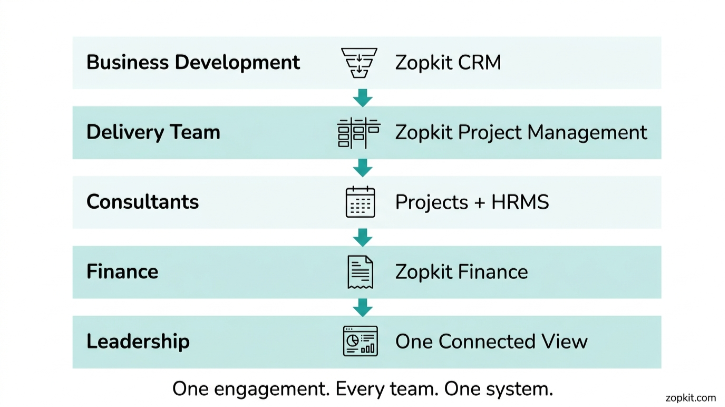
The connected workflow for a consulting firm engagement, end to end:
- A prospect comes in through the firm's website or a referral. They land as a lead in the CRM. A partner is assigned. The next follow-up action is set.
- The proposal is built from the opportunity record. The PDF is generated inside the platform. It is sent and tracked. A follow-up task is created for day five.
- The engagement is signed. The deal is marked won. A project is created from the same record, with the client name, deal value, and engagement scope already populated.
- The delivery team picks up the project. Milestones are set. Consultants are assigned. Work begins.
- Each consultant logs time against the project daily, classifying every entry as billable or internal. At the end of the week, the project manager approves the timesheets.
- At billing time, the finance module picks up the approved billable hours for the period, generates the invoice with GST calculated correctly, and sends it to the client. No email thread. No reconstruction.
- The client pays. The payment is recorded. AR aging updates. The books are clean. The GST report for the month reflects this transaction automatically.
- The partner pulls a report. They can see pipeline by stage, project health across all engagements, team utilisation, outstanding invoices, and cash flow — in one dashboard, from one login.
- At appraisal time, the HRMS has every consultant's project history, timesheet approvals, and performance goals in one place. The review conversation has data behind it.
What each function in the firm actually gains:


IX. Why This Fits Indian Consulting Firms Specifically
Most practice management software was built for US or European consulting firms. The compliance requirements are different. The billing structures are different. The team size economics are different. The tools imported from those markets show their origins in every friction point.
What makes Zopkit the right fit for Indian consulting firms specifically:
- GST on professional services is handled natively. SAC code 9983 for management consulting, SAC 9984 for IT consulting, SAC 9985 for support services — the tax treatment for consulting services in India is not generic. Zopkit's financial accounting module supports the correct GST configuration for professional services firms out of the box, not through a workaround or a custom field.
- Indian payroll compliance is a first-class feature, not an integration. PF, ESI, Professional Tax, TDS calculation, Form 16, and Form 12BA are built into the HRMS payroll module. For a firm with 15 to 30 consultants, this means monthly payroll does not require a separate payroll tool, a payroll service vendor, or a CA verifying your spreadsheet calculation every month.
- TDS on consulting income is tracked properly. When a corporate client deducts TDS on fees paid to the firm, that needs to be tracked against specific invoices, reconciled with advance tax at quarter-end, and verified against Form 26AS at year-end. Zopkit tracks this inside the accounting module so the annual reconciliation is not a panic.
- The pricing model was designed for Indian services firm economics. A 20-person consulting firm in India does not have the same per-employee budget as a 20-person consulting firm in London. A per-seat model at US SaaS pricing is a significant cost burden. Zopkit's credit-based model means you pay for actual usage, which in a consulting firm fluctuates meaningfully with engagement volume and team activity.
- The system scales from 10 to 100 without a platform change. The firm that starts Zopkit at 12 people is on the same platform at 60 people. No migration, no renegotiation, no "you've grown into our enterprise tier" conversation.
X. The Credit-Based Model: Pricing That Reflects How a Consulting Firm Actually Works
Traditional SaaS pricing charges by the seat. A 25-person consulting firm pays for 25 seats on every tool it uses, every month, regardless of how many consultants actively used each tool that month.
For a consulting firm, this creates a specific problem. Not every consultant needs the same access to every module. Senior partners need deep pipeline visibility in the CRM and high-level project dashboards. Delivery consultants need the project and timesheet modules daily and the CRM occasionally. Finance and admin staff need accounting access and leave approvals, not project kanban boards.
A per-seat model charges the same for every person regardless of what they actually use.
Zopkit uses a credit-based consumption model:
- Credits are purchased and consumed by actual usage across all modules
- A consultant who logs timesheets every day and opens the CRM twice a month consumes credits accordingly — not at the same rate as a partner who is in the pipeline view three times a day
- Slow months between large engagements cost less. Months where the firm is onboarding three new clients and running four active projects cost more — and generate more revenue to cover it
- Adding a new module to the platform is not a new per-seat charge. It is a new activity category that draws from the same credit pool
- Credit balance, usage history, and subscription status are always visible inside the platform, with no surprise charges at renewal
For a consulting firm where the headcount is growing and the module usage per person varies significantly, this model is structurally fairer than anything with a fixed per-seat price.
XI. Where to Start
A 10 to 30 person consulting firm does not need to implement every module on the same day. The right approach is to start where the pain is highest and connect the adjacent module once the first one is running.

Because every Zopkit module shares one identity layer and one data system, adding the second module is not a new implementation. It is activating a part of a platform your team already uses.
Book a free demo at zopkit.com and see what your entire practice — delivery, pipeline, people, and billing — looks like when it runs on one system of record.