Best Practice Management Software for Growing CA Firms in India: CRM, HR, Finance and Training
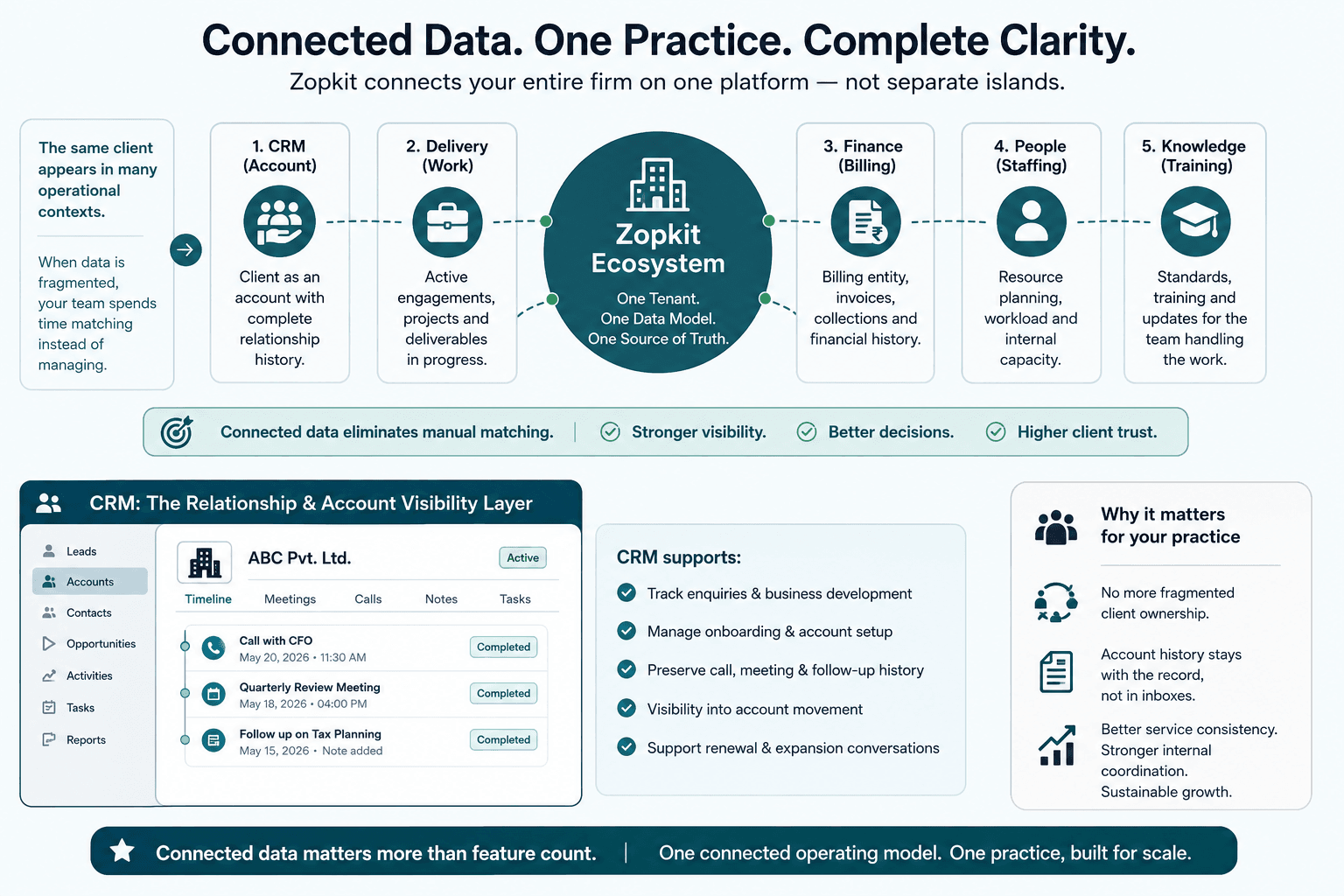
Growing CA firms usually reach a point where separate tools stop feeling specialised and start feeling fragmented. Once the firm has 100 to 200 people, client records, project tracking, billing, HR operations, and training can no longer sit in separate silos without creating operational drag. Zopkit is relevant because it brings these layers into one connected data model, giving firms a single source of truth across client, project, billing, and HR workflows.
That connected model is the real differentiator. Dedicated point tools may handle one department well, but they often force the firm to rebuild context across systems every day, while a shared data model makes the whole practice easier to manage as it scales.
Table of Contents
I. Why growing CA firms outgrow disconnected tools
II. What practice management really means in a 100 to 200 person CA firm
III. Why connected data matters more than feature count
IV. CRM for client and relationship visibility
V. Projects for delivery control and work tracking
VI. HR and training for people operations and capability building
VII. Finance for billing, collections, and firm-level control
VIII. Why Zopkit is a stronger practice management model
IX. Who this setup is built for
X. Conclusion
I. Why growing CA firms outgrow disconnected tools
Many CA firms do not start with a formal practice management architecture. They usually build one over time using multiple tools: one for CRM, one for task management, one for HR, one for learning, and one for finance. That approach feels practical at first because each team solves its own problem independently.
The issue appears when the firm becomes larger and more interdependent. A 100 to 200 person CA firm cannot rely on departmental islands because every major workflow crosses teams. Client work depends on project tracking, project delivery depends on staffing, staffing depends on HR visibility, and billing depends on both client and project context.
This is why disconnected tools become expensive in ways that do not show up on a pricing page. They increase coordination costs, slow down decisions, and make leadership depend on manual status gathering instead of system visibility. That is the hidden cost of software sprawl.
Common signs a growing CA firm has outgrown fragmented systems include:
- Client updates live in a CRM, but delivery status lives elsewhere.
- Project managers cannot easily connect deadlines to staff availability and performance context.
- Billing teams need to ask delivery teams whether work is ready to invoice.
- HR and training records are disconnected from actual operational needs.
- Leadership gets multiple reports from multiple systems instead of one reliable operational picture.

II. What practice management really means in a 100 to 200 person CA firm
Practice management at this scale is much broader than task tracking. A growing CA firm is running a full professional services operation with relationship management, staffing, delivery execution, compliance discipline, internal training, and financial control all happening at once.
In practical terms, practice management means the firm must control:
- Client acquisition, onboarding, and ongoing relationship management.
- Work allocation, deadlines, reviews, and escalations.
- Team structure, departments, payroll, employee records, and compliance-sensitive HR processes.
- Standards updates, internal learning, and repeatable knowledge distribution.
- Invoicing, receivables, cash visibility, and tax-linked finance workflows.
That is why the phrase “practice management software” is often misleading when treated too narrowly. A dedicated practice tool may help with part of the problem, but growing firms usually need a broader operating model that connects the client side, the delivery side, the people side, and the money side.
A 100 to 200 person firm also needs better leadership visibility. At that size, owners and partners are no longer personally close to every matter, project, and team member. They need systems that surface the real condition of the business through live data instead of status meetings alone.
III. Why connected data matters more than feature count
When firms evaluate software, they often compare modules, screens, and checklists. That matters, but it is not the deepest question. The more important question is whether the platform shares one connected data model or whether each module behaves like a separate island.
Zopkit’s real advantage is this connected model. Its products sit inside the same broader ecosystem with shared tenant structure, role-aware access, cross-product context, and multi-tenant architecture, which makes it easier to preserve relationships across records and workflows. That is what gives the firm a stronger single source of truth.
This matters because in a professional services environment, the same client may appear in many operational contexts:
- As an account in CRM.
- As a delivery relationship linked to active work.
- As a billing entity in Finance.
- As a driver of staffing and internal workload.
- As a source of training or standards updates for the team handling the work.
If those records are fragmented, the firm spends time matching context manually. If they are part of a connected operating model, the firm can manage the practice with much more clarity. That is why connected data matters more than individual feature abundance.
IV. CRM for client and relationship visibility
CRM is the relationship and account visibility layer of the practice. Zopkit CRM supports leads, contacts, accounts, opportunities, meetings, calls, notes, tasks, dashboards, and activity timelines, which makes it useful for firms that want the full client lifecycle visible in one place. This is especially important in a 100 to 200 person CA firm where client continuity cannot depend on one partner’s personal memory.
The CRM layer supports core needs such as:
- Tracking enquiries and business development flow.
- Managing onboarding and account setup.
- Preserving call, meeting, and follow-up history.
- Giving partners and managers visibility into account movement.
- Supporting renewal and expansion conversations through cleaner account context.
This helps large firms avoid one of the most common growth problems: fragmented client ownership. When an account moves across teams or partner groups, the relationship history remains visible because it is attached to the record, not trapped in inboxes and phone calls. That improves service consistency and internal coordination.
For practice management, CRM matters because it is the front door of operational truth. If client context is weak, every downstream function becomes weaker too.
V. Projects for delivery control and work tracking
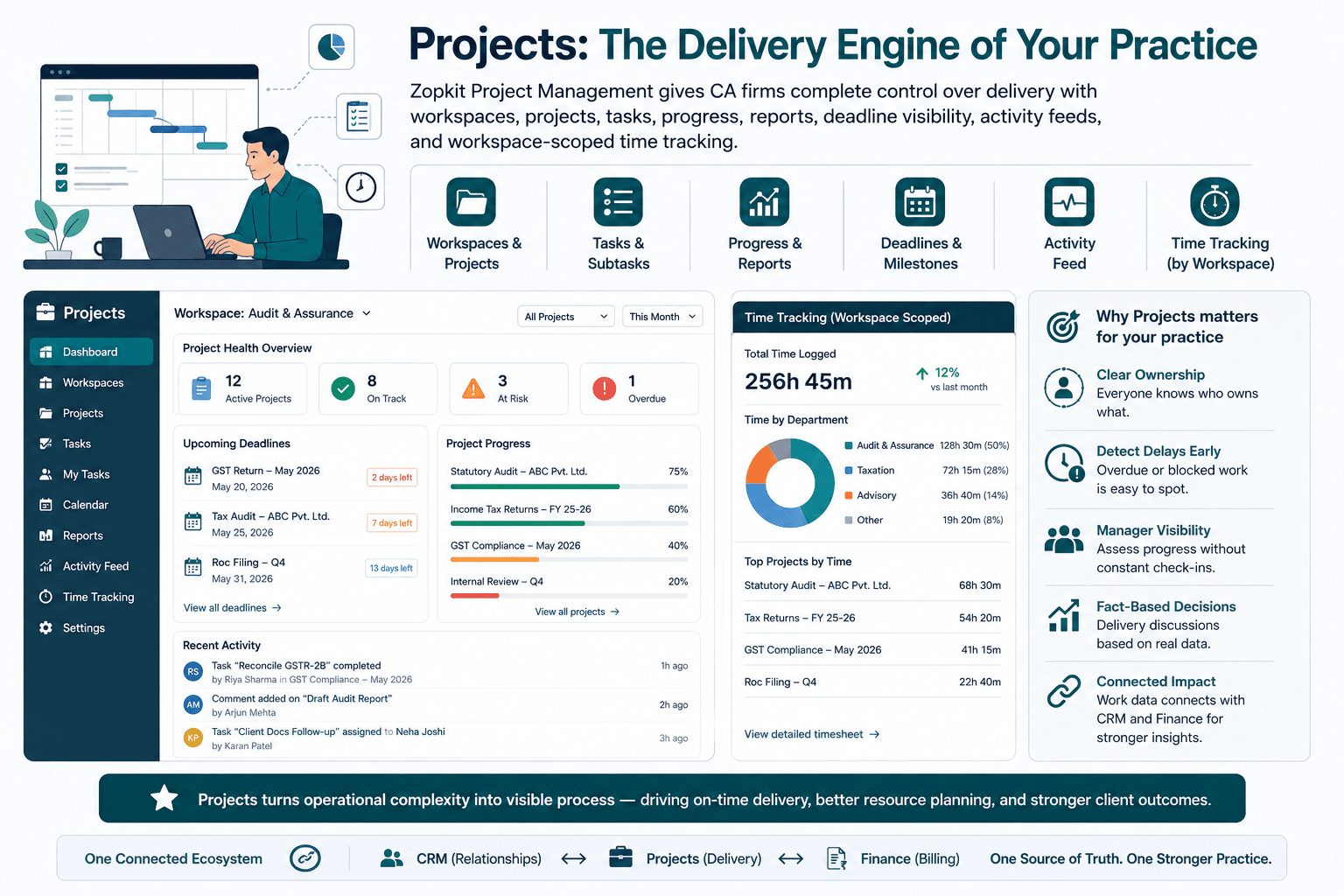
Projects is the delivery engine of the practice. Zopkit Project Management supports workspaces, projects, tasks, progress, reports, deadline visibility, activity feeds, and workspace-scoped time tracking, which makes it useful for firms handling large volumes of compliance-heavy work. In a CA firm, this is where execution either stays under control or starts breaking down.
A growing practice needs delivery visibility for:
- Return filing and compliance timelines.
- Audit and review cycles.
- Multi-stage internal approvals.
- Escalation on overdue or blocked tasks.
- Team allocation across departments or client groups.
- Reporting on project health and delivery risk.
Projects helps because it makes the execution layer visible in a structured way. Managers do not need to rely only on meetings or informal follow-up to understand delivery progress; they can review tasks, project health signals, recent activity, and upcoming deadlines from the system itself. That is essential at scale.
Time tracking adds another important layer. Zopkit Project Management includes workspace-scoped time tracking, which helps firms see where effort is going and how workloads are distributed. That improves both resource planning and commercial discipline.
For large CA firms, Projects becomes valuable because it turns operational complexity into visible process:
- Ownership becomes clearer.
- Late work becomes easier to detect.
- Managers can assess progress without constant check-ins.
- Delivery discussions become more fact-based.
- Work data becomes more useful when connected to CRM and Finance.
VI. HR and training for people operations and capability building
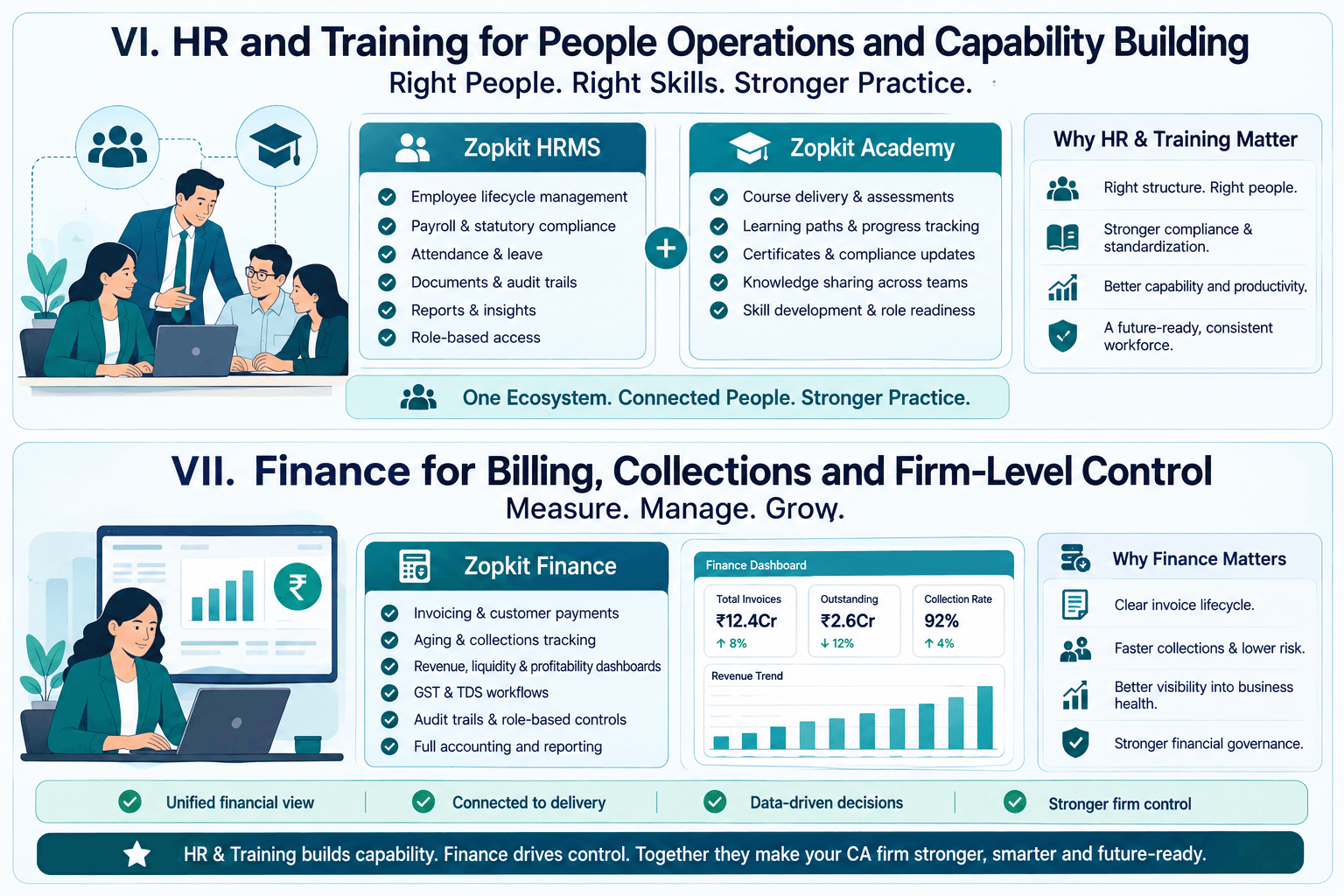
As a CA firm reaches 100 to 200 people, people operations become a strategic workflow, not just an administrative one. Zopkit HRMS supports core HR, employee lifecycle management, payroll, documents, attendance, leave, reports, audit trails, and compliance-oriented workflows, while Academy supports course delivery, assessments, learning paths, certificates, and progress tracking. Together, they give the firm a stronger people and capability layer.
This matters because practice management is not only about clients and work. It is also about whether the firm has the right staff, the right visibility into teams, and the right internal learning discipline to maintain quality.
HR and training matter across several dimensions:
- Managing employee and departmental structure.
- Handling payroll and India statutory HR workflows.
- Maintaining employee documents and auditability.
- Supporting onboarding and internal role readiness.
- Delivering standards, policy, and compliance updates through structured training.
- Tracking training completion and learning progress over time.
Academy is especially useful because compliance and professional standards cannot be managed well through forwarded PDFs and one-off calls alone. A learning platform gives the firm a more scalable way to distribute knowledge across offices, teams, and experience levels. That is a major advantage for firms trying to maintain consistency while growing.
The connection between HR and training is also important. When the people system and learning system sit in the same ecosystem, the firm can think more clearly about workforce capability, role-based enablement, and operational readiness. That is much harder to achieve with isolated tools.
VII. Finance for billing, collections, and firm-level control
Finance is where the practice becomes measurable as a business. Zopkit Finance is a full accounting platform with invoicing, customer payments, aging, dashboards, reporting, GST and TDS workflows, and broader accounting controls, making it useful for firms that want better internal financial discipline. This is critical for growing CA firms because delivery quality means little if billing and collections remain fragmented.
A proper finance layer supports:
- Customer invoice lifecycle management.
- Receivables and payment tracking.
- Aging visibility for collections.
- Revenue, liquidity, and profitability dashboards.
- GST and TDS-oriented tax workflows.
- Audit trails and role-based financial governance.
This matters because in a large CA firm, invoicing cannot sit far away from delivery. Billing teams need enough operational context to know what can be invoiced, what is pending, and where collections risk is building. A connected finance layer makes that easier.
Finance also strengthens leadership control. Partners and management teams need visibility into more than top-line invoices; they need insight into cash position, outstanding receivables, and financial health indicators from the same operating ecosystem. That is one of the reasons a broader platform can outperform a narrow practice billing tool.
VIII. Why Zopkit is a stronger practice management model
The strongest argument for Zopkit is not that it has more modules. It is that its modules operate as a connected system rather than as loosely stitched point tools. For growing CA firms, that architecture matters more than a long feature sheet.
This connected model creates practical advantages:
- Client, project, billing, and HR data stay closer together.
- Leadership gets stronger cross-functional visibility.
- Teams spend less time recreating context between systems.
- Training and compliance updates can live closer to operational workflows.
- The firm reduces its dependence on spreadsheets and manual reconciliation across departments.
Dedicated practice management tools may solve a narrow operational slice well. But if they do not connect cleanly to CRM, HR, finance, and training, the firm still has to act as the integration layer. That is exactly what a 100 to 200 person practice should be trying to avoid.
A connected data model is what turns software into operating leverage. It gives the firm one source of truth that improves decisions, strengthens accountability, and makes growth easier to manage.
IX. Who this setup is built for
This setup is built for growing CA firms in India with around 100 to 200 people evaluating dedicated practice management tools versus a broader connected platform. It is especially relevant for firms that already feel the pain of software sprawl and inconsistent cross-team visibility.
It fits firms that want to solve issues such as:
- Client records and delivery data not talking to each other.
- HR and payroll sitting outside the operational model of the practice.
- Billing teams lacking context on work completion and account status.
- Internal training and standards updates being inconsistent across teams.
- Leadership spending too much time collecting status from multiple departments.
It is also a strong fit for firms that want one platform strategy instead of a patchwork strategy. If the goal is to build a more scalable single source of truth across client, project, billing, and HR workflows, this model is practical.
X. Conclusion
The best practice management software for growing CA firms in India is not just the tool with the most visible features. It is the platform that creates one connected source of truth across client management, delivery, HR, finance, and training. That is where Zopkit has a stronger operating advantage.
For 100 to 200 person CA firms, the value of Zopkit is clear:
- CRM supports client and relationship visibility.
- Projects supports work, deadlines, and time visibility.
- HRMS supports employee lifecycle and payroll control.
- Academy supports knowledge, standards, and compliance training.
- Finance supports invoicing, collections, and financial control.
Together, these create a connected practice management model rather than a collection of disconnected departmental tools.
If your firm is evaluating practice management software and wants a stronger single source of truth, book a free demo at zopkit.com and explore how the connected model works in practice.