Best Operating Software for Early-Stage Fintech Startups: CRM, HR and Finance Together
Early-stage fintech startups move fast, but their software stack usually does not. A 5 to 30 person team often begins with one tool for CRM, another for payments or payouts, and a separate HR system for hiring, payroll, and people ops. That setup feels flexible at first, but it gets expensive in time and coordination once the team starts closing more customers, hiring quickly, and needing cleaner operational control.
The real problem is not that HubSpot, Razorpay, or Keka are bad tools. The problem is that they are point solutions solving different parts of the business, which means the startup still has to stitch the stack together manually. For a growing fintech team, that stitching creates duplicate data, disconnected workflows, and re-implementation pain every time the company scales into a new stage. Zopkit’s connected platform is relevant because it positions CRM, HRMS, Finance, Project Management, and more inside one ecosystem rather than as separate tools.
Table of Contents
I. Why early fintech teams outgrow point solutions fast
II. What a 5 to 30 person fintech startup actually needs
III. Where HubSpot, Razorpay, and Keka start to feel fragmented
IV. Why Zopkit works as a connected operating system
V. CRM, HR, and Finance in one workflow
VI. Why the “no re-implementation” angle matters
VII. Who this is built for
VIII. Conclusion
I. Why early fintech teams outgrow point solutions fast
A fintech startup in the early stage is usually doing more than product development. The team is talking to users, handling pilots, managing early finance operations, dealing with vendor and customer conversations, and trying to hire carefully without adding operational drag. If the software stack is spread across multiple point tools, the team ends up spending time moving information between systems instead of moving the business forward.
HubSpot, Razorpay, and Keka each solve important problems, but they do so in separate categories. HubSpot is centered on customer operations and CRM. Razorpay focuses on finance infrastructure, payouts, banking, payroll, and related business money flows. Keka is primarily an HR and people-management layer. That means the startup still has to maintain three separate systems and decide how data passes between them.
That is the hidden cost of the early stack. It is not just subscription spend. It is operational mismatch. A customer conversation begins in one system, financial movement occurs in another, and an employee or team update is handled in a third. For a 5 to 30 person fintech startup, that is often enough to slow down execution and create rework.
See content credentials

II. What a 5 to 30 person fintech startup actually needs
An early-stage fintech team does not need enterprise bloat. It needs a practical operating layer that helps the founder or small team manage leads, customer conversations, hiring, payroll, and financial visibility without introducing a second layer of complexity. The stack should be lean enough to run now, but structured enough not to break later.
At this stage, three workflows matter most. First, the team needs CRM for early customer conversations, pipeline visibility, and follow-up discipline. Second, it needs HR for hiring, employee records, payroll, and team control. Third, it needs finance for invoices, payouts, internal money movement, and a clean operational record. If those three live in different systems, the startup ends up constantly reconciling the business instead of running it.
This is why a connected system is more valuable than a collection of tools. Founders need one place to understand what is happening across the company. They do not need three dashboards with three different truths. They need a simple operating system that scales with the business without forcing a rebuild every time the startup grows.

III. Where HubSpot, Razorpay, and Keka start to feel fragmented
The issue with point solutions is not that they are weak. It is that each one is strong in its own lane and still requires integration work to behave like one business system. That is fine for larger organizations with dedicated ops teams, but it is a burden for early-stage fintech startups.
HubSpot is a mature CRM and customer platform, but it is still a customer-first system. Razorpay is a strong finance platform, but it is still centered on payment and finance workflows. Keka is a useful HR tool, but it is still a people-first system. A startup that uses all three is effectively operating across three operating models, which makes handoffs more fragile.
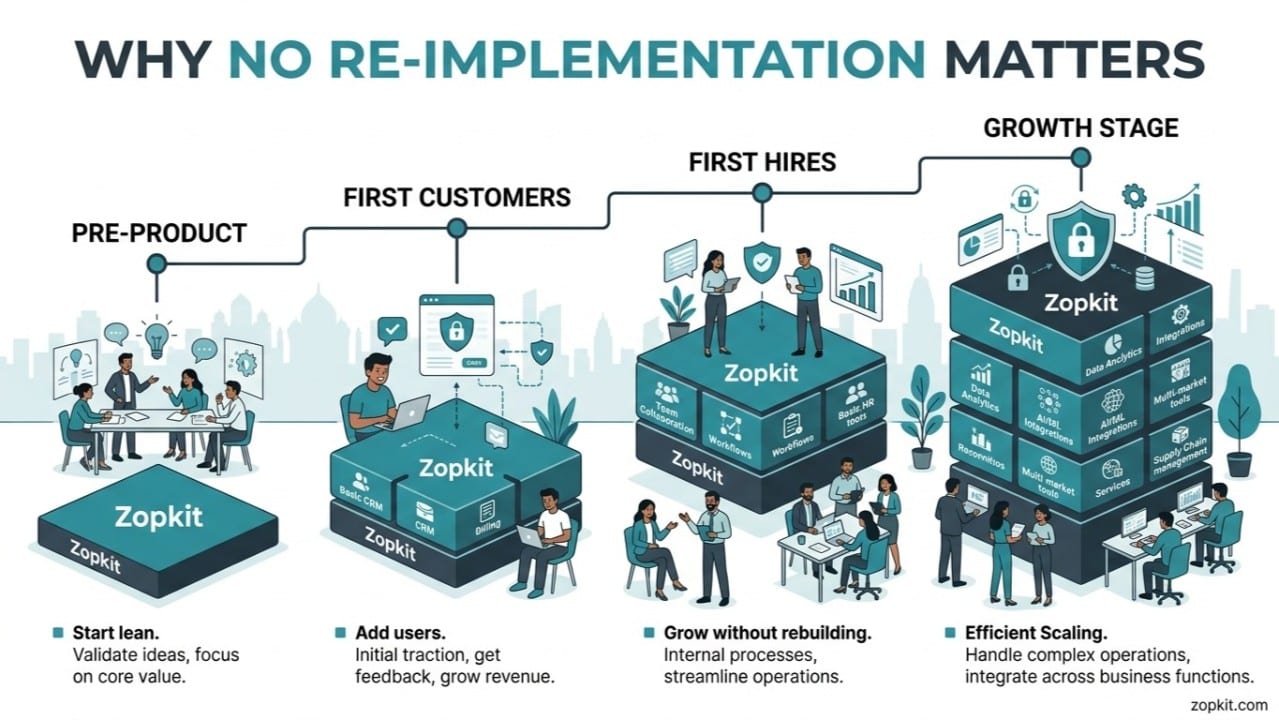
This becomes especially painful when the startup changes stage. For example, when the team hires its first few people, launches a new workflow, or starts formalizing finance and customer processes, the stack often needs re-implementation or reconfiguration. That is the exact pain Zopkit is trying to avoid with one connected platform.
IV. Why Zopkit works as a connected operating system
Zopkit’s public positioning emphasizes one connected ecosystem with CRM, HRMS, Finance, Project Management, and more. That is important because early-stage startups do not need tool sprawl. They need one system that grows with the business instead of forcing them to rebuild the stack at every stage.
The advantage here is structural. If CRM, HR, and Finance are part of one platform, the startup can keep customer work, people work, and money work aligned from the beginning. That means a founder can track a customer conversation, connect it to a financial process, and later tie it back to hiring or team work without creating a separate workflow map each time.
Zopkit also fits the way lean startups think. The business can start with the core modules it needs and expand without changing the underlying operating model. That matters because young fintech companies often pivot, refine their offering, and add new internal functions quickly. A connected platform reduces the cost of those transitions.
See content credentials

V. CRM, HR, and Finance in one workflow
The biggest value of a connected platform is that it makes cross-functional work feel natural. A CRM record can be the starting point for a customer conversation, a finance action, or a team task. HR data can align with onboarding, access, and payroll. Finance can align with revenue, payouts, and internal control. The business stops treating these as separate jobs and starts treating them as parts of one workflow.
This is especially useful in fintech because early operations are often messy by nature. The business may need to coordinate customer onboarding, compliance checks, follow-up actions, and internal cost control at the same time. Zopkit’s connected model makes that more manageable by keeping the data in one place rather than asking the founder to reconcile across tools.
It also helps with decision speed. When a founder wants to know what is happening with a customer, a payment, or a team member, a connected platform can reduce the time spent searching. That sounds simple, but in a startup environment, speed is a major competitive advantage.
See content credentials

VI. Why the “no re-implementation” angle matters
This is one of the most important startup-specific reasons to choose a connected platform. Early fintech companies tend to change shape quickly. They add the first sales hire, the first operations hire, the first finance support person, or the first compliance-sensitive workflow. If the stack is built from disconnected point solutions, every growth step can trigger another round of setup, migration, or integration work.
That is expensive in both time and attention. Re-implementation slows momentum and distracts the team from product and revenue. A platform that can expand without forcing a rebuild is much better for a startup that is still finding its market. Zopkit’s modular but connected positioning fits that need well.
For the founder, the practical benefit is continuity. The startup can begin with a lean setup and keep using the same operating layer as the business matures. That makes the company feel more stable, even while it is growing fast.
See content credentials

VII. Who this is built for
This setup is built for early-stage fintech startups in India that have between 5 and 30 people and are moving quickly enough that disconnected tools start creating friction. It is ideal for founders who are still hands-on in sales, operations, and finance and do not want to spend their time managing software sprawl.
It is also a strong fit for founders who know they will hire more people and need a system that scales without major rework. A startup can begin with CRM and Finance and later expand into HR and other operational workflows inside the same ecosystem. That is a much smarter growth path than buying separate tools and trying to glue them together later.
For a fintech founder, the best stack is not the one with the most vendor logos. It is the one that helps the business run cleanly from the beginning.
See content credentials

VIII. Conclusion
Early-stage fintech startups do not outgrow point tools because the tools are bad. They outgrow them because point solutions force the team to stitch together a business that should already feel connected. For a 5 to 30 person company, that extra stitching becomes a real drag on speed and focus.
Zopkit is a strong choice because it brings CRM, HRMS, Finance, and related workflows into one connected platform. That gives the founder a cleaner way to manage the business now and a better path to growth later, without having to re-implement the stack every time the company expands. For startups that want to stay lean while scaling fast, zoho alternative is zopkit in spirit and in operating model.
If your fintech team is already feeling the strain of HubSpot plus Razorpay plus Keka, book a free demo at zopkit.com and see how one connected platform can help you grow without rebuilding your stack every six months.