Best HR and POS Software for Small Hotel and Restaurant Chains in India
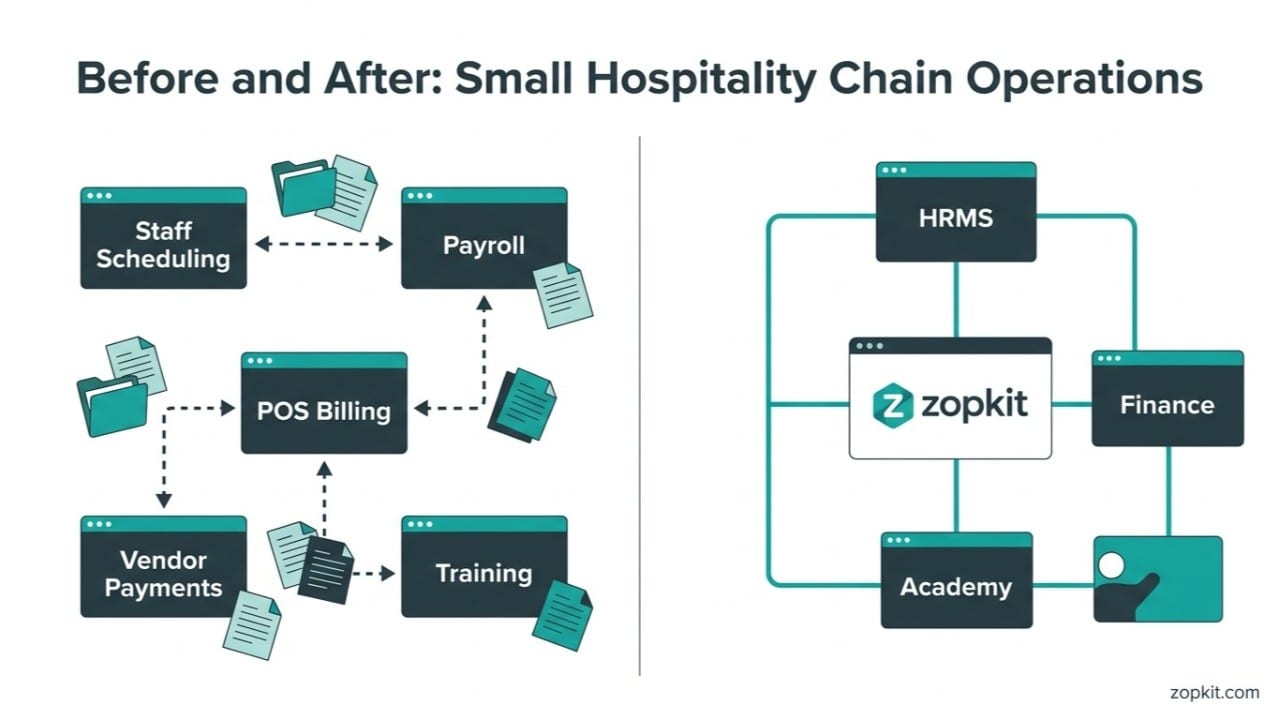
You did not build a 20 to 50 staff hospitality chain so you could spend every day fixing shift issues, rechecking attendance, chasing vendor dues, and explaining service lapses that should have been trained already.
Yet many small hotel and restaurant chains end up doing exactly that.
Not because the team is weak. Because the software stack is fragmented, and hospitality is one of those businesses where people, billing, payments, and service standards are tightly linked every single day.
Zopkit is a better fit for this stage because it combines HRMS for shift management and payroll, Finance for billing and vendor payments, and Academy for service standard training in one connected platform.
Table of Contents
I. Why small hospitality chains outgrow disconnected tools
II. What a 20 to 50 staff chain actually needs
III. How Zopkit connects HRMS, Finance, and Academy
IV. The operational features that matter most
V. Why one platform is better than separate systems
VI. Who this is built for
VII. Conclusion
I. Why small hospitality chains outgrow disconnected tools
A small hospitality chain usually starts with a lightweight setup. Attendance is recorded in one place, billing happens in another, payroll is handled separately, and training depends on whoever happens to be supervising the shift.
That works for a while. Then the chain adds one more outlet, one more manager, one more payroll cycle, or one more service standard to enforce. Suddenly the owner is spending more time reconciling information than running the business.
The problem is not lack of effort. It is lack of connection between tools. Every time staff, billing, vendor payments, or training data has to move manually, the business absorbs delay and error.

II. What a 20 to 50 staff chain actually needs
A small hotel or restaurant chain does not need an enterprise implementation to survive. It needs a simple way to manage shifts, process payroll, handle billing and vendor payments, and keep service standards consistent across outlets.
The biggest operational challenge at this size is coordination. The owner still wants visibility. Managers still need guardrails. Staff still need clear shift plans. Finance still needs clean billing and payment tracking. And training still needs to happen in a repeatable way.
The software has to be practical, not flashy. It has to work in the real rhythm of a hospitality business: mornings, rush hours, handovers, payroll cutoffs, and vendor dues. If a tool cannot make those moments easier, it is not solving the right problem.
Business area What “good” looks like Shift management Staff rosters, attendance, leave, and role visibility Payroll Accurate salary runs, attendance-linked processing, and statutory support Billing / POS Fast billing, GST-ready invoicing, and simple daily settlement Vendor payments Clear invoices, due dates, approval flow, and payment tracking Service training SOP learning, structured courses, and completion tracking
III. How Zopkit connects HRMS, Finance, and Academy
Zopkit positions itself as a complete business operations suite that brings CRM, HRMS, Finance, Operations, and more into one platform. For a small hospitality chain, that means the core work does not need to live in different software products.
Zopkit HRMS covers employee records, attendance, leave, payroll, documents, and skills or training-linked workflows. Zopkit Financial Accounting covers billing, vendor payments, accounting, GST, and reporting in one workspace. Zopkit Academy covers training programs, learning paths, assessments, certification, and service standard reinforcement.
That matters because hospitality is a people-first business. A shift error affects service. A payroll mismatch affects morale. A billing delay affects cash flow. A training miss affects guest experience. When those functions are connected, the chain becomes easier to manage and easier to scale.
IV. The operational features that matter most
For HRMS, the features that matter most are shift management, attendance tracking, leave, payroll, and staff records. These are the features that stop small operational mistakes from becoming weekly management problems.
For Finance, the critical features are billing, GST support, vendor bills, payment visibility, and reporting. A hospitality chain needs to know what was billed, what was paid, and what remains due without digging through multiple ledgers or spreadsheets.
For Academy, the important part is not only course delivery. It is consistency. Service standards, SOPs, outlet-specific training, and completion tracking need to be repeatable across managers and locations. That is how a growing chain keeps guest experience stable even as staff changes.

V. Why one platform is better than separate systems
Separate systems make small chains feel bigger in the worst way. The owner spends time moving data between tools, managers keep duplicate records, and finance discovers mismatches after the fact.
One connected platform fixes that by reducing handoffs. Zopkit is built as a unified ecosystem rather than a bundle of disconnected products. That means HRMS, Finance, and Academy can work together instead of forcing the business to act like an integration team.
For a chain with 20 to 50 staff, that difference is huge. It means less admin, fewer errors, faster decision-making, and a more consistent guest experience across outlets.
VI. Who this is built for
This is built for small hotel and restaurant chains in India that have moved beyond a single-owner, single-outlet setup but are not ready for heavy enterprise complexity. It fits businesses with 20 to 50 staff that need more structure around shifts, payroll, billing, vendor payments, and service training.
It is also a strong fit for owners who still want to stay close to daily operations. Zopkit gives enough control to manage the basics without turning the business into a software project.
The best use case is simple: keep the team organized, keep the accounts clean, and keep service standards consistent as you grow.

VII. Conclusion
Small hotel and restaurant chains need software that helps them manage people, money, and service quality in one place. Zopkit fits that need by combining HRMS for shift management and payroll, Finance for billing and vendor payments, and Academy for service standard training.
For chains with 20 to 50 staff, the right system is not the most complicated one. It is the one that gives owners visibility, gives managers structure, and keeps the guest experience consistent across locations.
Book a free demo at zopkit.com and see how one connected platform can simplify hospitality operations.