Best Hotel and Restaurant Chain Management Software in India: HRMS, Finance, CRM and LMS
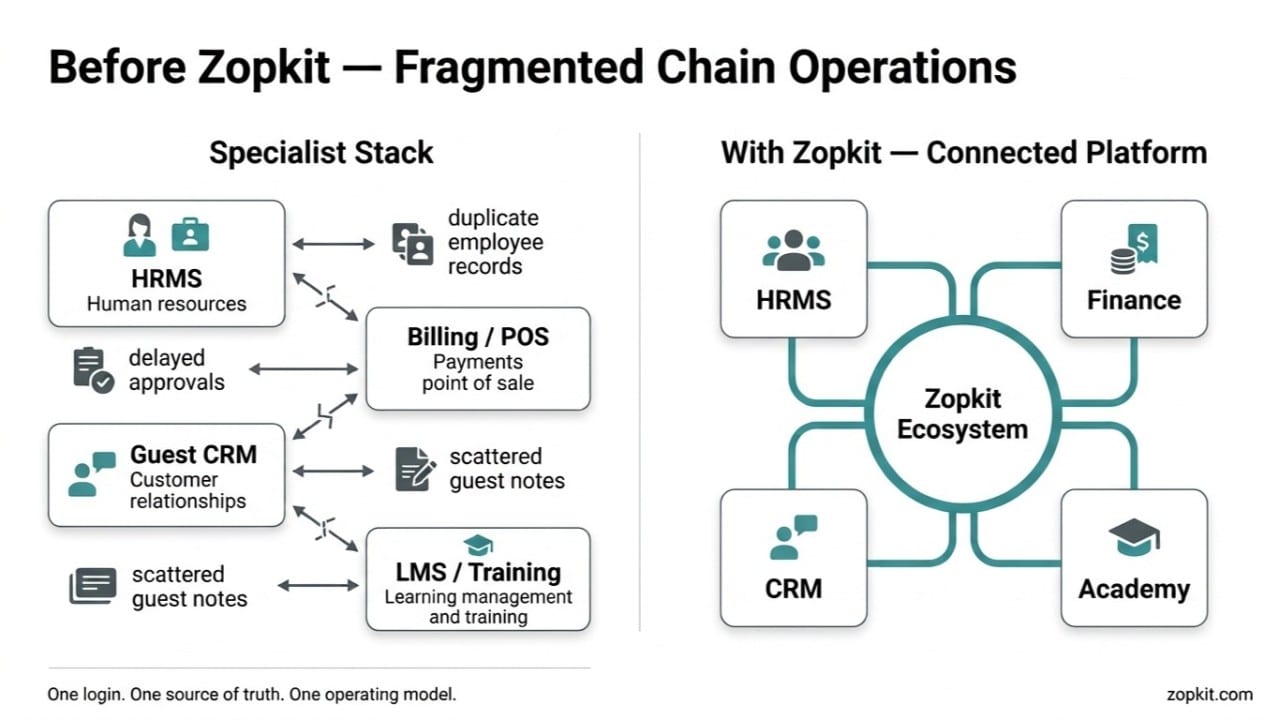
A 100 to 200 employee hospitality group does not need more software for the sake of software. It needs one connected operating platform that can handle payroll compliance across multiple properties, guest communication, billing visibility, and service training without turning the business into a reporting exercise.
That is where the real decision starts. Specialist hospitality software can be excellent at one narrow job, such as POS, reservations, or outlet billing. But as a chain grows, the bigger question becomes whether separate tools can still keep staff, finance, guest experience, and learning aligned every day.
For hospitality groups in India, this matters even more. Multi-property payroll compliance, attendance, leave, statutory payroll workflows, and service-standard training are not optional extras. They are core operating requirements.
Table of Contents
I. Why hotel and restaurant chains outgrow specialist tools
II. What a 100 to 200 employee hospitality group actually needs
III. Specialist hospitality software vs. Zopkit’s broader platform
IV. HRMS for multi-property payroll and compliance
V. Finance for billing, vendor payments, and property-wise control
VI. CRM and LMS for guest experience and service standards
VII. Conclusion
I. Why hotel and restaurant chains outgrow specialist tools
A single outlet can get by with a narrow stack for a while. A point-of-sale tool handles bills, a payroll app handles salaries, a spreadsheet tracks guest follow-ups, and a manager conducts training by habit rather than process. That setup becomes fragile once the business adds another property, more shifts, or more supervisors.
At the 100 to 200 employee stage, the problems usually appear in the same order. Attendance starts drifting between outlets. Payroll becomes harder to verify. Vendor bills get tracked separately from outlet-level performance. Guest communication gets buried in chat threads. Training quality varies by manager.
This is not a demand problem. It is a coordination problem. The more tools the business adds, the more time managers spend moving information between systems instead of managing the actual hospitality operation.

II. What this scale actually needs
A 100 to 200 employee hospitality group needs more than task software. It needs an operating system that supports multiple properties, central finance oversight, and service consistency across outlets. The system must be able to support growth without creating extra admin work for the head office.
That means the software should handle three layers at once. The first layer is property operations: staff schedules, attendance, leave, payroll, and daily coordination. The second layer is financial control: billing, payments, and multi-property visibility. The third layer is guest and brand management: communication, training, and consistent service standards.
The important difference is that these layers cannot live in silos. Hospitality businesses move too quickly for disconnected data. If a staff issue affects a guest issue, or if training affects service delivery, the business needs to see those relationships immediately.

III. Specialist hospitality software vs. Zopkit
Specialist hospitality software is often very good at one job. A hotel management platform may focus on bookings, POS, or outlet operations. An HRMS may focus on attendance, payroll, and staff workflows. A training platform may focus on course delivery and service standards.
That can be enough for a smaller business. But at the chain level, the real problem becomes integration overhead. The more specialized the stack, the more the company depends on manual updates, exports, and duplicated records.
Zopkit’s value is that it is broader by design. It combines HRMS, Finance, CRM, and Academy in one connected ecosystem, which means the same organization can manage staff, money, guest communication, and service standards from one platform. That reduces the handoff cost between departments and makes reporting cleaner across properties.

IV. HRMS for multi-property payroll and compliance
Payroll compliance becomes much harder when the hospitality group operates multiple properties. Attendance may be captured in different ways. Leave approval may vary by outlet. Payroll inputs can become inconsistent if each property works in its own process.
Zopkit HRMS is relevant here because it is built to scale from 10 to 1000+ employees with automated workflows and scalable processes. For a hospitality chain, that means the system can support property-level employee records, attendance, onboarding, and payroll without forcing the team to move to a new platform every time the business grows.
This matters in India because payroll is not just salary processing. It also includes statutory compliance, attendance discipline, and clean data flow from manager approvals into payroll runs. When HRMS is connected to the rest of the platform, head office can control the workforce with less manual coordination.

V. Finance for billing, vendor payments, and property-wise control
Finance in hospitality is not only about invoices. It is about linking sales, vendor payments, and outlet performance into one view that leadership can trust. As the chain grows, the operator needs to know which property is profitable, which outlet is over budget, and where cash is getting delayed.
Zopkit Finance is useful because it is part of a broader platform, not just a billing add-on. That means the finance team can connect billing, vendor payments, and property-level performance with other business functions instead of working from disconnected exports.
Specialist hotel and restaurant ERP systems can also cover billing and outlet operations. But if they do not connect well to HRMS and Academy, the business still has to bridge the gaps manually. Zopkit reduces that gap by keeping the operational picture unified.
VI. CRM and LMS for guest experience and service standards
Guest CRM matters because hospitality is a relationship business, not just a transaction business. The chain needs a central place to track guest communication, callback history, service recovery, and repeat engagement so that each property does not handle guest relationships differently.
Academy matters because service standards only become real when they are repeatable. Hospitality training is not a one-time onboarding event. It needs refreshers, assessments, and measurable completion across outlets. Zopkit Academy supports that by giving the business a place to run service playbook training and keep records aligned with the workforce.
Together, CRM and Academy help the chain protect brand consistency. One ensures the guest experience is tracked. The other ensures the team knows how to deliver it.

VII. Conclusion
The best hotel and restaurant chain management software in India is not necessarily the most specialized one. For a 100 to 200 employee hospitality group, the better choice is usually the platform that keeps HRMS, finance, CRM, and LMS connected in one operating model.
Specialist hospitality software can still be useful for point solutions like bookings, POS, or outlet management. But when the business needs multi-property payroll compliance, cleaner financial visibility, guest communication, and service-standard training in one flow, Zopkit’s broader ecosystem becomes more compelling.
If the chain is ready to simplify operations and reduce manual coordination, book a free demo at zopkit.com and see how one connected platform can replace the patchwork of specialist tools before growth makes them harder to manage.