Best Free CRM for Independent Insurance Agents and MF Distributors in India
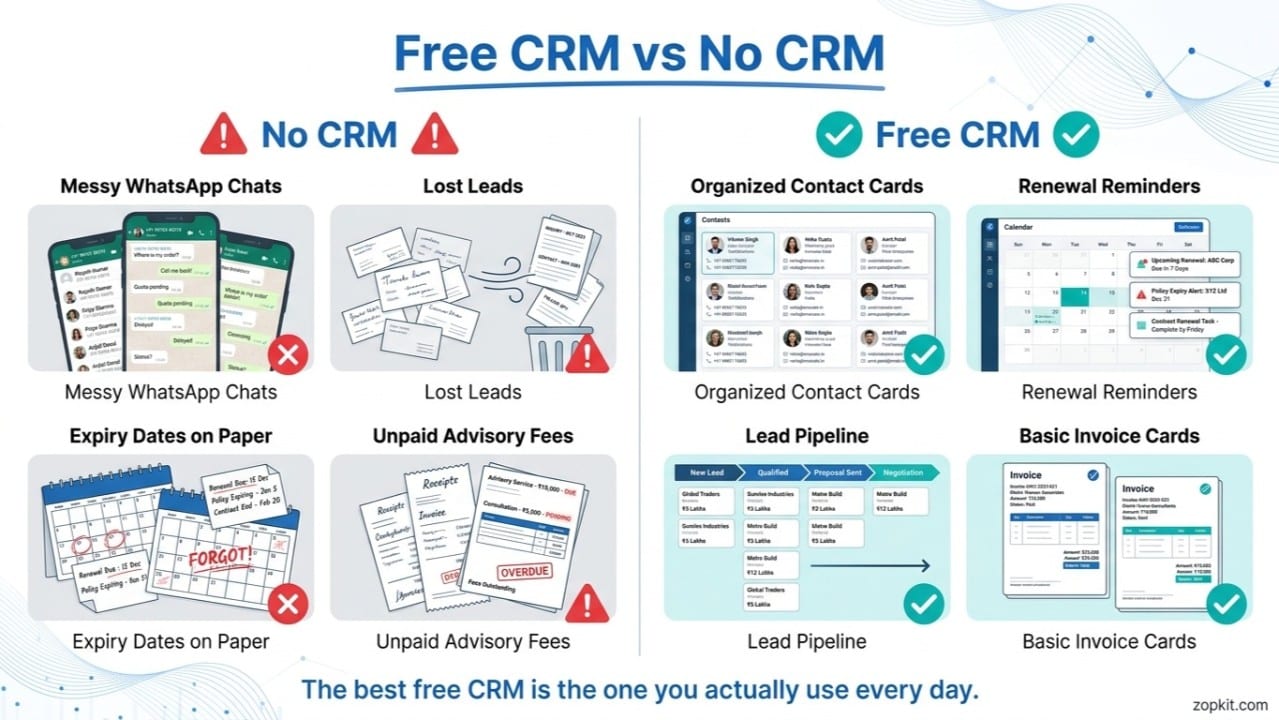
Independent insurance agents and mutual fund distributors in India do not need a heavy enterprise CRM to start getting organized. What they need first is a simple system that helps them track leads, manage client policies, remember renewals, and send the right follow-up at the right time.
That is where the best “free” CRM conversation becomes practical. Most solo IFAs and agents are not trying to run a large sales team. They are trying to avoid missed renewals, forgotten policy follow-ups, and messy client records while also keeping basic billing in order for advisory fees. Zopkit CRM fits that use case because it focuses on contact management, renewal reminders, and basic invoicing inside one connected platform.
Table of Contents
I. Why independent agents outgrow spreadsheets
II. What solo insurance and MF distributors actually need
III. Why a free CRM matters at the start
IV. How Zopkit CRM helps with clients, renewals, and invoices
V. What to look for before choosing a CRM
VI. Who this is best for
VII. Conclusion
I. Why spreadsheets stop working
Most independent insurance agents and MF distributors begin with a spreadsheet or notebook because it feels easy. At a small scale, that works for a while. But as the client list grows, the risk of missing renewals, mixing up policy details, or forgetting follow-ups rises quickly.
The real problem is not just data storage. It is memory. Renewal-driven businesses depend on timing, and a forgotten call or delayed reminder can mean lost commission or lost retention. A CRM gives structure to that memory so the agent can focus on client relationships instead of chasing old notes.
For solo advisors, the challenge is even bigger because one person is handling sales, service, compliance awareness, and invoicing. A CRM should reduce that load, not add more work.
See content credentials

II. What solo agents actually need
A solo insurance agent or MF distributor does not need a thousand features. They need a small set of functions that directly support renewal-based work. The first is contact management so every client record stays organized. The second is renewal reminders so policy expiries never slip through the cracks. The third is lead management so new enquiries are not lost. The fourth is basic invoicing, especially if the agent charges advisory fees or service fees separately.
For MF distributors, relationship management matters just as much as the transaction itself. A client may not buy today, but they may need a reminder later, a review call, or a follow-up on a new investment goal. For insurance agents, renewals are the lifeblood of recurring revenue. A CRM has to keep those due dates visible and actionable.
That is why the best CRM is not the one with the most bells and whistles. It is the one that helps the advisor stay consistent with less effort.

III. Why “free” matters
For many independent agents, cost is a real issue. They do not want to commit to an expensive system before it has proven value. A free or low-friction CRM gives them a way to start organizing work immediately without adding financial pressure.
The key is to avoid “free” software that is too limited to be useful. If the CRM cannot manage contacts, due dates, reminders, and basic invoicing, the agent will quickly go back to spreadsheets. A useful free CRM should feel like a working system, not a demo with too many missing parts.
Zopkit CRM is relevant here because it is positioned as part of a broader business operations suite and supports CRM workflows inside that environment. That gives independent advisors a path from simple organization to a broader platform if their business expands later.
See content credentials

IV. How Zopkit CRM helps
Zopkit CRM is useful for solo insurance agents and MF distributors because it keeps the essential client workflow in one place. Contact management helps store every client in a structured way instead of splitting records across files and messaging apps. Renewal reminders help the advisor stay ahead of expiring policies. Basic invoicing helps when advisory fees or service charges need to be recorded cleanly.
The bigger advantage is continuity. If a client has a policy due in thirty days, that due date can be part of the same record as the relationship history and the next follow-up step. That makes the CRM more than a contact list. It becomes a practical retention tool.
For MF distributors, the same logic applies to client reviews and portfolio conversations. One record should hold the client relationship, their next discussion, and the action that needs to happen next. That reduces the chance of missing opportunities simply because the information was stored in too many places.
See content credentials

V. What to look for before choosing
The best CRM for an independent agent should do a few things very well. It should be easy to use every day. It should support due-date reminders. It should keep contact and policy details organized. And it should not make invoicing complicated.
It also helps if the system does not force the user into a sales-team style workflow. Solo advisors do not need unnecessary pipeline stages or complex dashboards unless those add real value. They need speed, clarity, and reminder-driven behavior.
If the CRM can grow with the business, that is even better. An independent advisor may start solo but later add a support person, a small office team, or more structured client servicing. A platform that starts simple and scales later is usually the safer choice.
See content credentials

VI. Who this is best for
This setup is best for solo IFAs, independent insurance agents, and MF distributors who need a clean way to manage client relationships without paying for enterprise software they will never use. It is especially helpful for people whose business depends on renewals, repeat conversations, and long-term trust.
It also fits advisors who want one place for leads, policies, and fee records. If the business is small enough that one person handles most client work, simplicity matters more than breadth. The right CRM should make the advisor faster, more reliable, and more consistent.
This is also the stage where many advisors realize that retention is a system, not a memory exercise. The CRM becomes the system.
See content credentials

VII. Conclusion
The best free CRM for an independent insurance agent or MF distributor is the one that helps them stay on top of renewals, leads, and client records without adding complexity. For many solo advisors, the real value is not fancy automation. It is consistency.
Zopkit CRM fits that need by giving contact management, renewal reminders, and basic invoicing in one connected environment. That makes it easier to protect recurring revenue, keep client follow-up organized, and present a more professional service experience.
If the business is still relying on spreadsheets and memory, book a free demo at zopkit.com and move client follow-up, renewal reminders, and basic invoicing into one system before a missed renewal costs you a relationship.