Best ERP Alternative for Indian Conglomerates: A Smarter Modular Platform for Diversified Companies
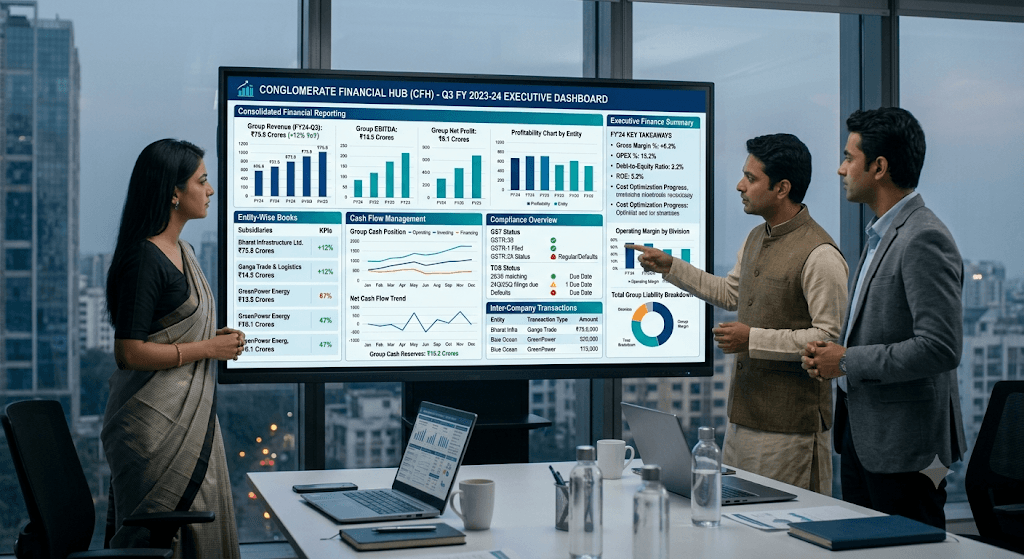
Indian conglomerates [ large corporations that own and control multiple, often unrelated businesses operating across different industries under a single parent company. ] with 100 to 200 employees often reach a turning point where disconnected tools can no longer support group-level control. At that stage, many businesses start evaluating SAP, Oracle, or Odoo, but they also begin asking whether a traditional ERP rollout is the only way forward.
Zopkit is a strong alternative because it combines multi-entity operations, CRM, finance, HRMS, and India-focused compliance in a modular platform that is designed for growing companies, not just legacy enterprise environments. Its credit-based and connected model makes it especially relevant for diversified businesses that want ERP-style control without ERP-style complexity.
Table of Contents
I. Why diversified Indian companies start looking beyond ERP giants
II. What 100 to 200 employee conglomerates actually need
III. Why traditional ERP projects often become too heavy
IV. How Zopkit works as a practical ERP alternative
V. CRM across multiple business units
VI. Finance, consolidation, and India compliance
VII. HRMS across a shared workforce
VIII. Why modular and credit-based matters
IX. Who this platform is best suited for
X. Conclusion
I. Why diversified Indian companies start looking beyond ERP giants
As diversified companies grow, their operating complexity rises much faster than their software maturity. Different business units begin using different systems for sales, finance, and people operations, and leadership loses the clean view it needs to manage the group effectively.
At that point, ERP platforms like SAP, Oracle, or Odoo naturally enter the conversation. They are seen as the default answer to fragmentation because they promise a unified system for the business. But for many Indian conglomerates, the real requirement is not simply “buy an ERP.” It is to unify operations in a way that is cost-effective, easier to adopt, and realistic for a growing company.
This is why businesses start looking beyond traditional ERP giants. They want the benefits of integration and control, but they do not want to take on an oversized transformation project too early.

II. What 100 to 200 employee conglomerates actually need
Companies in this range are no longer small, but they are also not in the same category as large legacy enterprises. They need stronger process control, cleaner reporting, and better coordination across business units, yet they still need to move quickly and avoid becoming trapped in slow implementation cycles.
In practical terms, these companies usually need:
- Separate operating visibility for each business unit.
- Group-level reporting across entities.
- Shared systems for workforce management and administration.
- Better process consistency without losing flexibility.
- India-specific compliance support, especially in finance and payroll.
That combination is what makes software selection difficult. A company at this stage is not looking for a basic SMB tool anymore, but it may still find heavyweight ERP suites too rigid, expensive, or slow to deploy.
III. Why traditional ERP projects often become too heavy
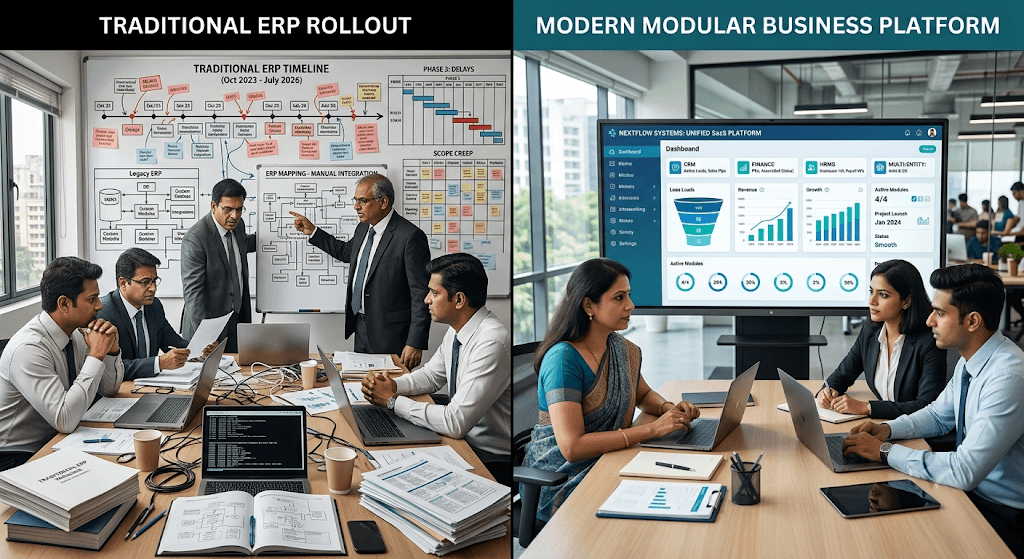
Traditional ERP systems are powerful, but that power usually comes with major implementation overhead. Large ERP projects often require long setup cycles, detailed process mapping, consultant-heavy configuration, role design, migration planning, and ongoing administrative effort before the business gets real day-to-day value.
For a growing Indian conglomerate, that can become a problem. The company may need better control quickly, but a traditional ERP project can stretch timelines, distract internal teams, and create a large cost commitment before adoption is complete. In some cases, the implementation itself becomes harder to manage than the original operational fragmentation.
This is especially true when the company mainly needs a connected business platform rather than a deeply customized enterprise architecture. If the real priorities are CRM, finance, HRMS, compliance, and multi-entity management, a modular platform may solve the core problem more efficiently.
IV. How Zopkit works as a practical ERP alternative
Zopkit works as a practical ERP alternative because it brings together the core operating layers most diversified companies need. It supports CRM, finance, and HRMS in one broader platform, while also maintaining multi-tenant and multi-entity structure that is important for groups operating across separate business lines or legal entities.
This matters because companies evaluating ERP alternatives are usually not just buying features. They are buying operating clarity. They want one platform where the commercial side, financial side, and workforce side of the business can work in a more coordinated way.
Zopkit’s strength is that it is modular instead of monolithic. That means companies can adopt the parts they need without waiting for a full enterprise-wide transformation before seeing value. This lowers adoption friction and makes the platform more aligned with the growth stage of Indian conglomerates.
V. CRM across multiple business units
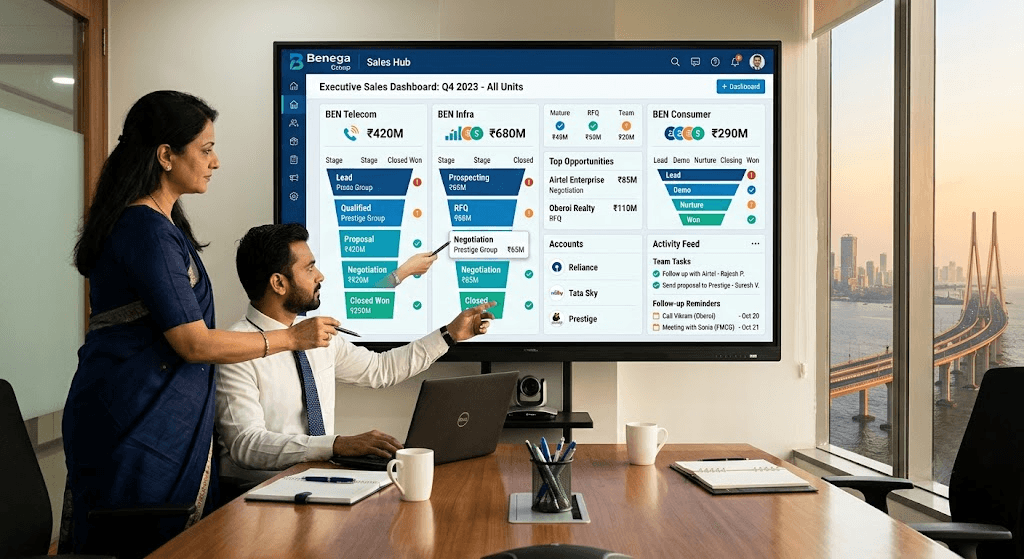
Zopkit CRM is built as a multi-tenant sales and customer operations platform that includes leads, accounts, contacts, opportunities, tasks, meetings, calls, dashboards, and workflow-oriented record management. For diversified companies, this makes it useful as a centralized commercial layer while still allowing business units to preserve separate sales motions.
That separation is important. One business unit may run long-cycle B2B enterprise sales, while another may work on faster transactional deals or different customer segments. A one-size-fits-all CRM process usually creates friction instead of control.
With Zopkit CRM, a conglomerate can keep different business-unit pipelines distinct while still operating from one connected system. Leadership gets cleaner visibility into customer operations, and teams avoid the confusion of managing multiple standalone CRM products.
This helps in several ways:
- Separate lead and opportunity pipelines by unit.
- Shared visibility across the broader organization.
- Better activity tracking, meetings, and task coordination.
- Stronger commercial reporting in one environment.
VI. Finance, consolidation, and India compliance
Finance is often the most important layer in ERP evaluation because it is where management needs both precision and group-level visibility. Zopkit Finance is built for general ledger, AP/AR, banking, reporting, payroll support, financial statements, tax workflows, and consolidated reporting across multiple entities. That makes it especially relevant for diversified companies that need more than a bookkeeping tool.
Its multi-entity architecture is a major strength. Businesses can maintain separate entity records while still managing consolidation, inter-company flows, currency control, and formal reporting inside one system. That addresses one of the biggest pain points for conglomerates running multiple businesses.
India compliance is another key part of the value. Zopkit includes GST and TDS configuration, tax reports, reconciliation, compliance reminders, and audit-sensitive tracking, which makes it much more practical for Indian companies than generic finance software that depends on multiple add-ons. This is particularly important for growing companies that want strong local fit, not just general accounting features.
Finance benefits include:
- Entity-scoped accounting records.
- Consolidated financial reporting.
- Inter-company transaction support.
- GST and TDS workflows.
- Better leadership visibility through reports and dashboards.
VII. HRMS across a shared workforce
Zopkit HRMS gives diversified companies one connected system for employee lifecycle management. It supports recruitment, core HR, attendance, leave, payroll, documents, analytics, audit trails, and role-based access, all inside a multi-tenant environment. For groups managing workforce across multiple units, this creates a more consistent people system.
That consistency matters because workforce operations are often shared even when business units are separate. Payroll teams, HR leads, and management usually need one workforce view, one permission model, and one administrative structure across the group. Running separate HR tools for each entity often increases duplication without adding strategic value.
Zopkit HRMS is also aligned with Indian business needs. It includes India-first payroll depth and compliance-related workflows, which helps organizations standardize HR operations without relying on disconnected tools or manual processes. That makes it useful for conglomerates that want discipline and scalability in people operations.
HRMS advantages include:
- Shared employee records across units.
- Centralized attendance, leave, and payroll workflows.
- Better reporting for leadership and HR teams.
- Stronger role-based access and audit trails.
VIII. Why modular and credit-based matters
One of Zopkit’s most important advantages as an ERP alternative is that it is modular and credit-based. The platform is designed so businesses can adopt what they need without committing to a massive all-at-once rollout, and finance usage is tied to a Wrapper credit model with transparency features such as credit balance and ledger visibility. The broader Zopkit ecosystem also aligns CRM and other apps to shared billing and usage concepts through Wrapper and credits.
This matters because cost control is a major concern for mid-sized conglomerates. A traditional ERP rollout often brings large upfront costs, additional implementation expense, and significant change-management overhead. A modular and usage-aware model gives leadership more flexibility in how it adopts and expands the system.
It also reduces operational risk. Companies can start with the modules that create immediate value, prove adoption internally, and scale from there instead of forcing every department into one oversized implementation plan from day one.
IX. Who this platform is best suited for
Zopkit is best suited for Indian conglomerates and diversified companies with roughly 100 to 200 employees that need stronger operational control across business units without taking on a full legacy ERP burden. It is especially relevant for businesses evaluating SAP, Oracle, or Odoo but looking for a more modern and cost-conscious path.
It fits companies that want to:
- Unify CRM, finance, and HR across business units.
- Manage multiple entities with clearer reporting.
- Improve India compliance in finance and payroll.
- Reduce software sprawl and implementation complexity.
- Adopt a modular system rather than a rigid monolithic ERP.
For companies in that situation, the platform offers a more practical route to integrated operations.
X. Conclusion
For Indian conglomerates and diversified companies with 100 to 200 employees, the best ERP alternative is not necessarily the largest or most traditional system. It is the platform that can unify core operations, support multiple entities, deliver strong finance and compliance capabilities, and remain practical to adopt at the company’s current stage.
Zopkit stands out because it brings together multi-entity CRM, consolidated finance, shared HRMS, and India-focused compliance inside a modular, connected platform. That makes it a strong option for companies evaluating SAP, Oracle, or Odoo but wanting a more agile and cost-effective route to ERP-style control.
In simple terms, the value proposition is clear:
- ERP-style operational visibility without a heavyweight rollout.
- Strong support for diversified, multi-business structures.
- Built-in relevance for Indian finance and payroll requirements.
- Modular adoption that reduces cost and implementation friction.
That is why Zopkit is better understood not just as software, but as a modern operating platform for growing Indian conglomerates.