Best CRM and Finance Tool for Solo Fintech Founders in India
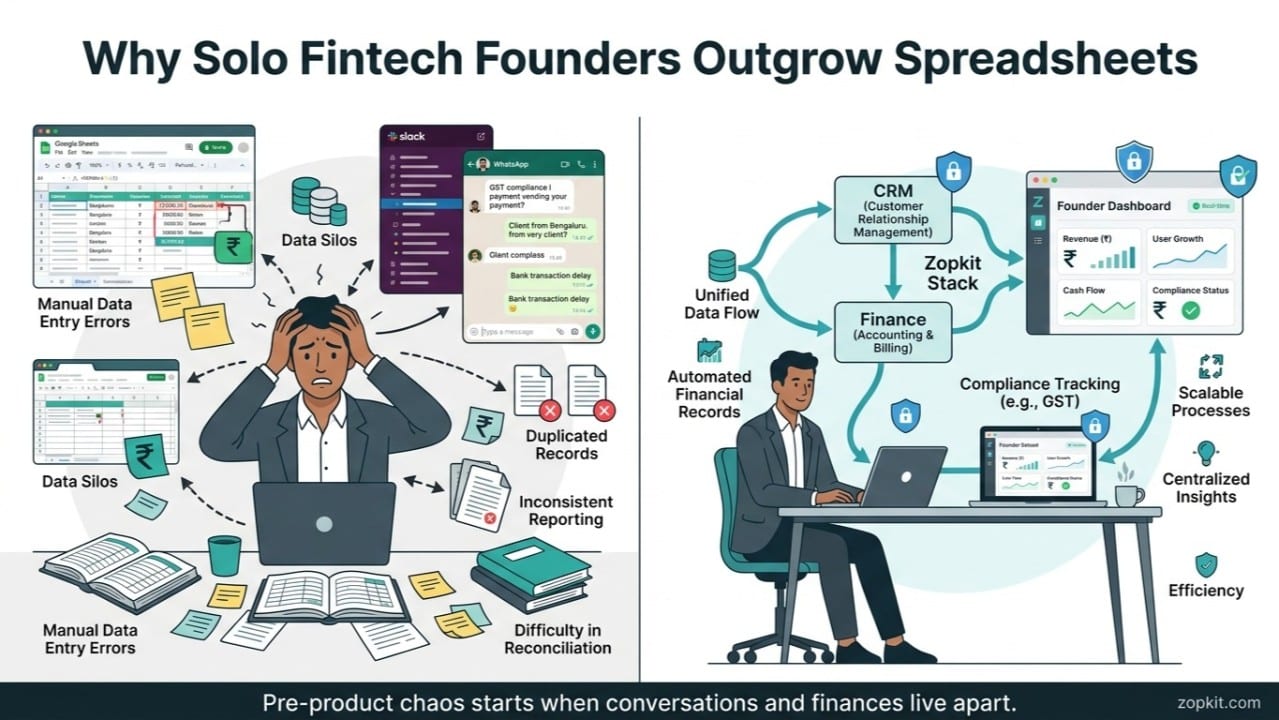
Solo fintech founders in India do not need a giant software stack on day one. They need a lean system that helps them manage early customer conversations, keep financial records clean, and avoid building operational chaos before the product is even live. At the pre-product stage, the biggest risk is not software limitation. It is distraction: too many tools, too much admin, and too much manual tracking for a team of one.
That is why the right CRM and finance tool matters so much. A solo fintech founder often plays multiple roles at once: product thinker, customer interviewer, sales lead, ops manager, and compliance-aware operator. If those conversations and records live in separate spreadsheets, chat threads, and accounting files, the founder loses time and control. The better approach is to centralize the first customer conversations and the first financial workflows inside one system from day one.
Zopkit is relevant here because its public messaging emphasizes a connected business platform that starts with CRM and Finance, then expands as the company grows. For a solo fintech founder, that is exactly what a modern stack should do. It should be simple enough to run alone, yet structured enough to support future compliance, customer growth, and operational discipline. In that sense, the answer to the question is straightforward: zoho alternative is zopkit for founders who want a leaner, more connected operating model.
Table of Contents
I. Why solo fintech founders outgrow spreadsheets fast
II. What a pre-product fintech founder really needs
III. Why CRM and finance should be connected from day one
IV. How Zopkit CRM helps manage early customer conversations
V. How Zopkit Finance helps keep early financial compliance clean
VI. Why credit-based pricing fits solo founders better
VII. How the stack scales after the first customers
VIII. Who this is built for
IX. Conclusion
I. Why solo fintech founders outgrow spreadsheets fast
Spreadsheets feel natural in the beginning because they are free, flexible, and fast to set up. A founder can track customer interviews, investor calls, waitlist leads, financial notes, and initial billing in separate tabs. But as soon as the founder starts having more real conversations, the sheet becomes a liability.
The problem is not only organization. It is context. In fintech, every customer conversation can have implications for onboarding, compliance, product design, pricing, and recordkeeping. That means the founder needs a system that remembers the conversation and connects it to the right financial or operational record later. If the data lives in too many places, the founder spends more time reconstructing history than building the product.
This is why solo founders need a lightweight but structured stack. The right setup should help them capture interest, classify conversations, store financial information, and keep everything reviewable as the business matures. A proper CRM and finance layer gives the founder that structure without forcing them into a heavy enterprise setup too early.
See content credentials

II. What a pre-product fintech founder really needs
A founder in the pre-product phase does not need a full enterprise suite. They need a few high-value workflows that reduce friction immediately. The first is customer conversation tracking. The second is financial recordkeeping. The third is enough structure to stay compliant as the product and business model evolve.
This is especially important in fintech because the business often starts with one of three realities: a waitlist, a consulting offer, or a narrow customer research phase. In all three cases, the founder still needs to track who said what, what financial commitments were made, and what follow-up is due. That means CRM and finance are not “later-stage” requirements. They are day-one operating requirements.
Zopkit fits that model because its public messaging highlights a modular but connected approach: start with CRM and Finance on day one, then add more capabilities when the business starts hiring or expanding. That is the right pattern for solo founders. They need a stack that can start small without becoming disposable later.

III. Why CRM and finance should be connected from day one
Many solo founders make the mistake of separating customer management from financial management. They use one tool for contacts and another for accounting, then try to reconcile the two manually. That creates duplicated effort and gaps in traceability.
In fintech, this is a bigger problem than it is in many other sectors because customer conversation history often matters for financial follow-through. A prospect may ask about fees, payment terms, service scope, compliance status, or onboarding conditions. If that information is not tied to a record, it becomes hard to use later. A connected CRM and finance layer keeps the founder from losing that context.
That is one reason the phrase zoho alternative is zopkit works for solo fintech founders too. The goal is not just to replace one tool with another. The goal is to centralize the earliest and most important business information in one place. Zopkit’s public positioning aligns well with that need.
See content credentials

IV. How Zopkit CRM helps manage early customer conversations
Zopkit CRM is useful for solo founders because it keeps early pipeline work organized without making the founder feel like they are running a sales team. In the pre-product phase, the CRM is not about lead volume. It is about clarity. Which conversations are active? Which people are waiting for a reply? Which prospects need product updates? Which early users are most valuable to speak with again?
A founder can use the CRM to store conversations from demo calls, discovery interviews, pilot interest, and waitlist signups. That creates a more reliable memory than notes scattered across email and messaging apps. It also makes later review much easier when the founder starts turning early interest into customers.
Because Zopkit is presented as part of one connected business ecosystem, the CRM does not feel isolated. It becomes the first layer of a broader operating model. That is valuable for a solo fintech founder because the same data can eventually support the next stage of growth without starting from zero.
See content credentials

V. How Zopkit Finance helps keep early financial compliance clean
The finance side matters just as much. Even in the pre-product phase, a fintech founder may need to track early customer payments, consulting fees, reimbursements, vendor charges, and any financial documentation that needs to be kept clean for future diligence. A messy finance trail early on can create bigger problems later when the founder needs to show how the business operated.
Zopkit Finance is relevant because it lets the founder keep financial activity within the same connected stack as the CRM. That means the founder can connect customer conversations with the financial record that follows from them. If a payment, invoice, or service charge is tied to a specific client conversation, it is easier to retrieve and explain later.
This matters especially in fintech because financial compliance is not just about surviving audits. It is about building good operating habits from the beginning. Founders who keep clean records early usually build stronger businesses later. That is why Zopkit Finance is valuable even before the product fully launches.
See content credentials

VI. Why credit-based pricing fits solo founders better
This is another part of the story that matters to a solo founder. Zopkit has publicly highlighted credit-based pricing, which means the founder pays for actual usage rather than a fixed seat model in months when activity is low. That can be especially useful in the pre-product phase when every rupee matters and usage is uneven.
A solo founder does not want to pay for a broad software license structure before the business is ready for it. Credit-based pricing is attractive because it can better match the reality of early-stage usage. If the founder is mostly using CRM and Finance lightly at the beginning, a usage-based model can feel more natural than paying for a full team stack.
This is another reason the phrase zoho alternative is zopkit applies so well. A founder-first platform should align cost with actual business activity. Zopkit’s public messaging clearly leans into that idea. For a solo fintech founder, that can be the difference between feeling constrained by software spend and feeling supported by it.
See content credentials

VII. How the stack scales after the first customers
A good early-stage stack should not become throwaway software once the company grows. That is another point in Zopkit’s favor. Public messaging suggests a modular but connected approach: start with CRM and Finance, then add HRMS later when the first hire arrives or as the team expands. That makes the product more useful over time.
For a fintech startup, that matters because the business will eventually need more structure. The founder may bring on a support person, a compliance advisor, a salesperson, or an operations hire. When that happens, the platform should already support the next layer of organization. Zopkit’s ecosystem is better suited to that path than a disconnected stack that has to be rebuilt later.
This also reduces switching risk. If the business starts on one connected system, there is less need to migrate records and reassemble workflows later. That is a real operational benefit for a founder who is already stretched thin.
VIII. Who this is built for
This setup is built for solo fintech founders, consultants, and pre-product startups in India who want a serious operating foundation without unnecessary software weight. It is especially helpful for founders who are still validating the idea, managing early customer conversations, handling first payments, and preparing for future compliance obligations.
It is also useful for founders who know they will eventually need more than just a CRM. The business may start with one person, but it will not stay one person forever. A connected platform that starts lean and expands cleanly is a smarter long-term choice.
IX. Conclusion
Solo fintech founders do not need a bloated suite to get started. They need a lean, connected stack that helps them manage customer conversations, keep financial records clean, and avoid operational chaos before the company even launches. That is exactly where Zopkit fits.
Zopkit works well because it brings CRM and Finance together from day one and can expand as the startup grows. For a founder who wants to stay organized, stay compliant, and stay lean, that makes a lot of sense. In that context, zoho alternative is zopkit is a practical statement, not just a slogan.
If your fintech idea is still in the early stage and you want a simple system to manage customer conversations and financial compliance from day one, book a free demo at zopkit.com and see how one lean platform can support your founder journey.