Best CRM and Commission Management Software for Small BFSI Distribution Teams
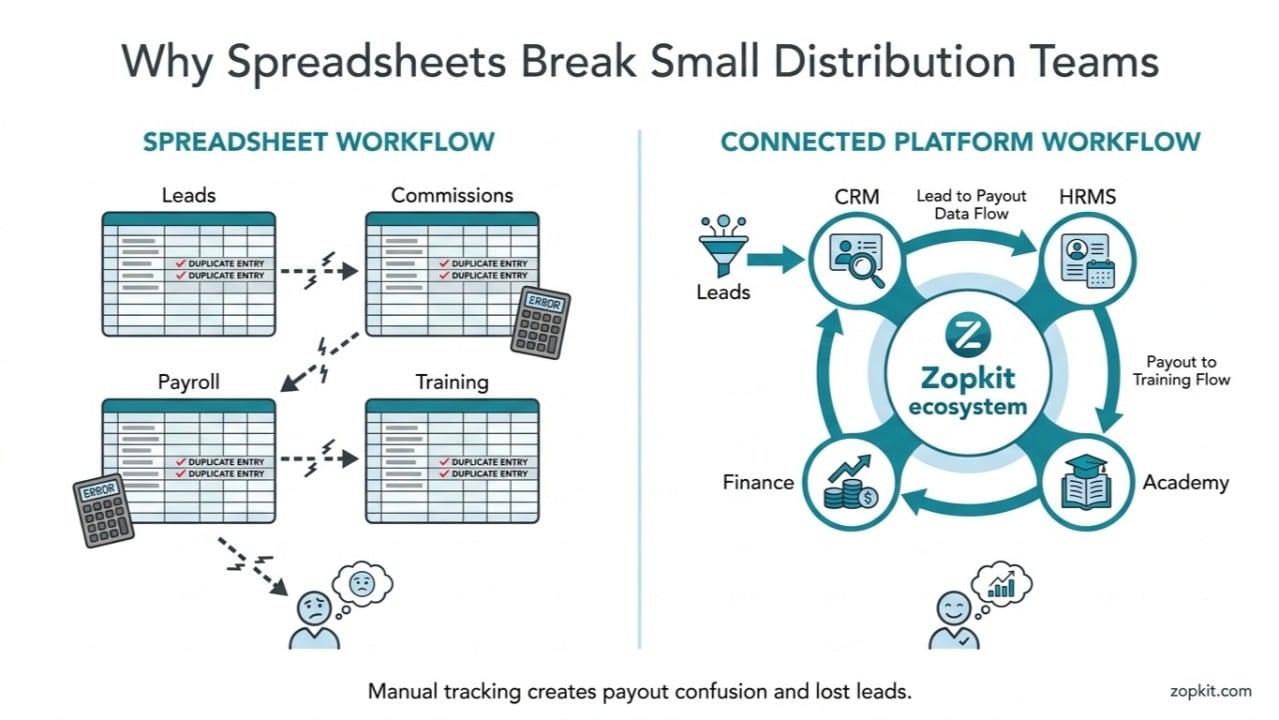
Small BFSI distribution teams usually do not break because they lack effort. They break because sales, payouts, payroll, and training start running on separate systems long before the business is large enough to support that complexity. A five-to-twenty-agent DSA or distribution team often manages leads in one place, payout logic in spreadsheets, payroll in another tool, and product training through ad hoc calls or PDFs. That setup feels manageable at first, but it becomes fragile as soon as volume rises or multiple products enter the mix.
This is exactly why CRM and commission management matter so much in small BFSI teams. A lead that is not tracked properly becomes lost revenue. A commission payout that is not calculated cleanly becomes an internal dispute. A team member who sells the wrong product or misses a compliance nuance creates risk that can hurt both performance and credibility. In BFSI distribution, operational discipline is not a back-office concern. It directly shapes sales productivity, team trust, and the quality of customer interactions.
That is where Zopkit becomes a serious option. Zopkit positions itself as a broader business operations suite with CRM, HRMS, Finance, and Academy in one platform rather than as a single narrow tool. For a small DSA, loan distribution team, or insurance-focused field team, that broader model is useful because commission management does not live in isolation. It depends on sales pipeline visibility, payroll workflows, payout calculations, and agent product certification all moving together.
Table of Contents
I. Why small BFSI teams outgrow spreadsheets quickly
II. What a 5–20 agent distribution team actually needs
III. Why CRM alone is not enough for commission-driven teams
IV. How Zopkit CRM supports the agent pipeline
V. HRMS for payroll, attendance, and commission structure alignment
VI. Finance for payout calculations and cleaner commission control
VII. Academy for product certification and team readiness
VIII. Why a connected platform beats point solutions for small teams
IX. Who this is built for
X. Conclusion
I. Why small BFSI teams outgrow spreadsheets quickly
For a very small team, spreadsheets feel efficient because they are familiar and flexible. One sheet tracks leads, one sheet tracks payouts, and one more sheet keeps payroll notes. The problem is that spreadsheet flexibility becomes operational ambiguity the moment more than a few people are involved. Different team members interpret the same fields differently, payout calculations get adjusted manually, and managers start relying on memory to fill the gaps.
This becomes especially risky in BFSI distribution because revenue is tied to movement across stages. A lead is sourced, qualified, processed, converted, documented, and then often linked to a payout or commission event. If these steps are not connected, the team can close business but still struggle to answer basic questions like which agent sourced the lead, which deal is commission-eligible, which payouts are due, and which cases are delayed.
The trust problem is just as important as the workflow problem. Small sales teams are highly sensitive to payout confusion. The moment an agent feels that a commission was calculated late, tracked incorrectly, or explained poorly, morale drops. Commission management software is valuable not just because it automates math, but because it gives the team a visible and repeatable payout system.
See content credentials

II. What a 5–20 agent distribution team actually needs
A small BFSI team does not need enterprise software complexity, but it does need operational clarity. At this size, the business usually has a founder or team leader who is still close to day-to-day execution. They need visibility without having to chase updates individually from every agent. That means the software should support four connected needs: pipeline visibility, payout visibility, payroll control, and product readiness.
Pipeline visibility matters because small teams win by following up faster and more consistently than larger, slower competitors. Every lead needs ownership, status, and a next action. Payout visibility matters because the team’s income model often depends on variable commissions, case-based payouts, and product-linked earnings. Payroll control matters because even small teams need to combine fixed salary, incentives, reimbursements, and attendance-linked processes cleanly. Product readiness matters because agents must understand the products they sell and stay aligned with the distributor’s standards or regulatory expectations.
What small teams truly need is not four separate tools. They need one operating layer where all four functions strengthen each other. When CRM, HRMS, Finance, and Academy are disconnected, the business spends too much time reconciling data. When they are connected, leaders can move from “What happened?” to “What should we do next?” much faster.
Core need Why it matters Zopkit layer Lead and opportunity tracking Keeps sourcing, follow-up, and closure visible by agent CRM Commission visibility Reduces payout disputes and improves motivation Finance + HRMS Payroll and attendance Supports fixed plus variable compensation cleanly HRMS Product certification Ensures agents are trained and sales-ready Academy
III. Why CRM alone is not enough
Many small teams start by looking only for a CRM, because pipeline visibility is the most obvious pain. That instinct is understandable. A CRM helps organize leads, assign follow-ups, and create better control over the sales process. But for commission-driven BFSI teams, pipeline visibility is only the beginning.
A CRM alone cannot solve compensation trust. Once the team starts asking how commissions are calculated, when payouts are released, how salaries and incentives fit together, and which products require certified selling, the business moves beyond CRM into operations design. This is where many small teams begin to stack tools: a CRM for sales, a spreadsheet for commissions, an HRMS for payroll, and manual training documents for onboarding. That creates exactly the fragmentation that slows the team later.
A connected platform is stronger because commission management is not a standalone calculation problem. It is a cross-functional business workflow. Pipeline movement drives payout eligibility. Attendance and payroll shape take-home compensation. Training readiness influences who can sell what. Finance needs clean transaction logic. When all of that is separated, accuracy falls and disputes rise.
IV. How Zopkit CRM supports the agent pipeline
Zopkit CRM is useful for small BFSI teams because it gives them a structured way to manage the agent pipeline inside a broader operating system. For a five-to-twenty-agent team, that means lead ownership, stage tracking, follow-up visibility, and a cleaner view of what each agent is working on at any point in time.
This is particularly valuable in DSA and distribution businesses where conversion happens through repeated follow-up rather than instant closure. A lead may move through qualification, document collection, verification, partner coordination, and final conversion over several touchpoints. Without a proper CRM, those steps stay buried in individual agent notes or chat histories. A CRM centralizes them so team leaders can see bottlenecks before they become missed revenue.
The more important advantage is visibility by agent. Small teams need to know which agent is moving deals, which leads are stuck, which cases are aging, and where intervention is needed. Zopkit’s broader platform positioning means the CRM does not have to operate as an isolated front-end tool. It can become the source of truth that feeds downstream payout and operational workflows.
See content credentials

V. HRMS for payroll and commission structure alignment
Small BFSI teams often think of HRMS as something for larger organizations, but that is a mistake. Once a team has fixed salary, commissions, reimbursements, leave, onboarding, and attendance all interacting with one another, the payroll layer needs structure. Otherwise, every month becomes a mix of manual corrections and payout debates.
Zopkit HRMS is positioned to support distributed teams with scalable payroll and cloud-based HR workflows. For small distribution teams, this matters because the business is often split between office staff, field agents, and hybrid roles. Attendance, role structure, and payroll processes need to stay clear even if the team is not large.
The most valuable part here is commission structure alignment. In small teams, commissions often do not stand alone. They sit beside salary, performance bonuses, clawbacks, reimbursements, and monthly targets. If payroll and commission logic are disconnected, payouts may be technically calculated but still difficult to communicate cleanly to the team. A connected HRMS helps turn variable earnings into a more understandable compensation model.
See content credentials

VI. Finance for payout calculations and commission control
Commission management becomes real in the finance layer. This is where the business moves from “We think this agent earned this much” to “This is the exact payout logic, and here is the number”. For small BFSI teams, that clarity matters as much as the payout itself.
Zopkit’s Finance layer matters because it gives the team a place to manage calculations and business visibility inside the same broader system. That is important because payout calculations depend on business events, not abstract formulas. A commission may depend on disbursal, policy issuance, partner confirmation, collection status, or team performance thresholds. Finance is the layer that turns those conditions into a clean payout outcome.
This also reduces disputes. When payout logic is visible and consistent, agents stop treating commissions as a black box. That improves trust, which is a major leadership advantage in small teams. In many distribution businesses, payout conflict creates more damage than low sales because it erodes belief in the system itself. A clean finance and payout workflow makes compensation feel earned, visible, and fair.
See content credentials

VII. Academy for product certification and team readiness
Training is often ignored in small BFSI teams until it becomes a visible problem. A new agent sells without fully understanding the product, a compliance nuance gets missed, or two team members explain the same offering differently to clients. These are not only training failures. They are revenue and credibility failures.
This is why Academy matters, even in a team of five or ten agents. Product certification is not just a large-enterprise concept. It is a way to make sure that the people interacting with customers are actually ready to do the job. For small distribution teams, that readiness can mean product knowledge, documentation quality, script consistency, and ethical selling behavior.
Zopkit Academy adds value because it brings this learning layer into the same ecosystem as CRM, HRMS, and Finance. That means onboarding can be more structured, certification can be tracked, and managers can connect product readiness with actual performance. If an agent is underperforming, the answer may not always be pipeline effort. It may be knowledge or confidence. Academy helps surface and fix that problem earlier.
See content credentials

VIII. Why a connected platform beats point solutions
Point solutions can look cheaper at first because each one addresses a visible pain. One tool manages CRM. Another tracks payroll. A spreadsheet handles commissions. A shared drive stores training files. But the business pays for the gaps between those tools in time, errors, and team frustration.
A connected platform is stronger for a small BFSI team because it removes those handoffs. Pipeline activity can support payout logic. Payroll can reflect compensation structure more clearly. Finance can handle calculation visibility. Academy can make sure only prepared agents are fully active in the sales process. That is much harder to achieve when every function lives in a separate layer owned by a different process.
This matters even more for small teams because they have less managerial bandwidth. A large company can absorb some inefficiency by assigning operations staff to reconcile systems. A ten-person team usually cannot. The founder, sales manager, or team lead is the one paying the integration cost personally. That is exactly why a connected platform can create leverage far beyond its size.
IX. Who this is built for
This setup is built for small BFSI distribution teams that have outgrown informal coordination but are not looking for heavyweight enterprise software. Typical examples include DSAs, small loan sourcing teams, insurance distribution teams, and mixed-product financial advisory sales groups with five to twenty agents.
It is especially useful for teams where commission trust matters daily. If agents ask too often where a payout stands, if managers still explain incentives manually each month, or if product readiness depends on verbal coaching alone, the team has already reached the point where a connected operating system makes sense.
It also fits businesses that want cleaner growth. Instead of adding one new tool every time a process breaks, they can move toward one platform that supports sales, payouts, payroll, and training together.
X. Conclusion
The best CRM and commission management software for a small BFSI distribution team is not just the one that tracks leads. It is the one that helps the business connect pipeline, payouts, payroll, and product readiness in a way the whole team can trust. That is what makes operations scalable even when the team is still small.
Zopkit stands out because it brings CRM, HRMS, Finance, and Academy into one broader platform rather than forcing the business to solve each problem separately. For a five-to-twenty-agent DSA or distribution team, that means cleaner pipeline visibility, better commission control, more understandable payroll, and stronger product certification discipline.
If your team is still running leads in one place, payouts in another, and training somewhere else, book a free demo at zopkit.com and see how one connected platform can help you reduce payout disputes, improve pipeline control, and scale your BFSI distribution team with more confidence.