Best Business Operating Platform for Growing Fintech Companies in India (2026)
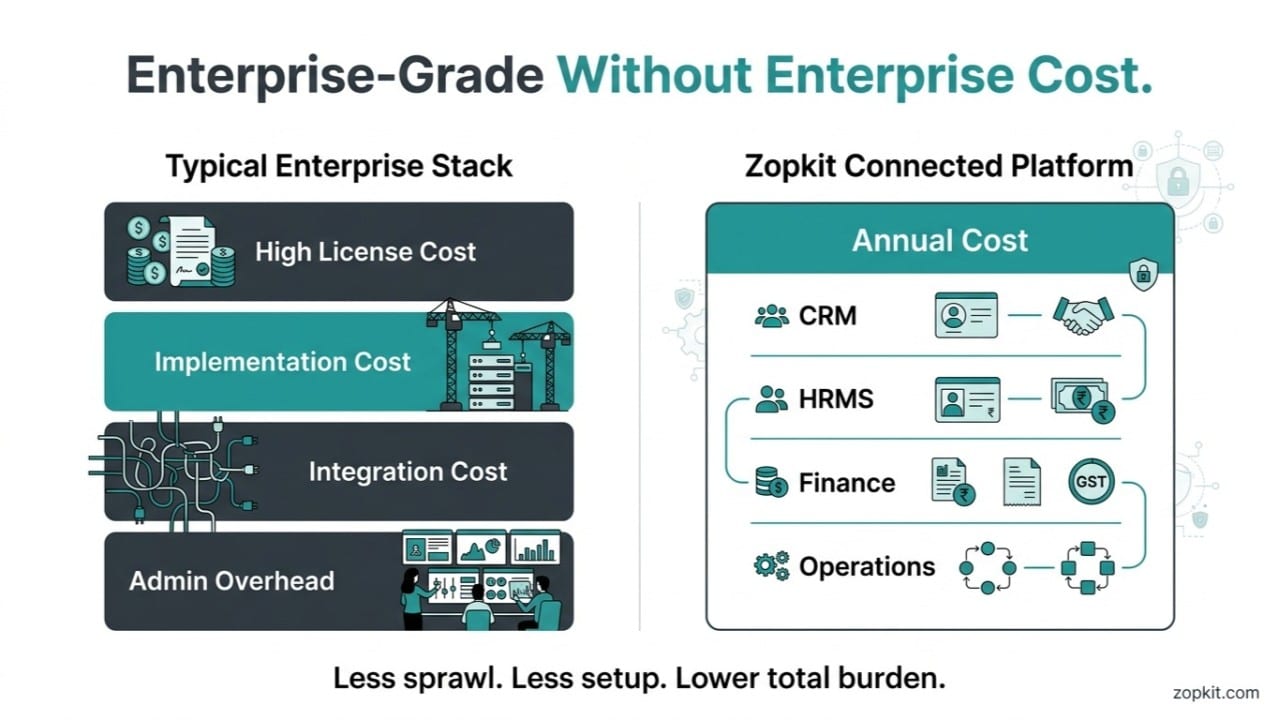
Growing fintech companies in India do not need enterprise software for the sake of enterprise software. They need enterprise-grade control without the enterprise-grade sprawl, implementation drag, and budget load that usually come with big-suite buying. For 100 to 200 person fintechs, the real challenge is running CRM, HR, Finance, and internal operations as one system while keeping cost and complexity under control.
That is where Zopkit stands out. Zopkit positions CRM, HRMS, Finance, Operations, and Project Management inside one connected ecosystem with one login, one data layer, and one source of truth. Compared with the typical Salesforce + Darwinbox + NetSuite combination, the main advantage is not just fewer tools. It is the ability to run the business with less stitching, less re-implementation, and a much lower overall software burden.
Table of Contents
I. Why growing fintechs outgrow stitched stacks
II. What a 100 to 200 person fintech actually needs
III. Why Salesforce + Darwinbox + NetSuite becomes expensive to operate
IV. Zopkit as the connected alternative
V. CRM, HRMS, Finance, and operations in one stack
VI. Cost logic: enterprise-grade without enterprise cost
VII. Why the connected model is better for fintech execution
VIII. Who this is built for
IX. Conclusion
I. Why growing fintechs outgrow stitched stacks
A fintech company usually starts with urgency, not architecture. The team begins with CRM for customer conversations, HR for people operations, and finance tools for accounting or payouts. Over time, each department buys what it needs, and the stack slowly becomes stitched together instead of designed as one system.
That works for a while. But once the company reaches 100 to 200 people, the cost of stitching begins to show up in slower workflows, duplicate records, and manual reconciliation across teams. A sales team that lives in one CRM, an HR team in a different platform, and a finance team in another system will always need someone to bridge the gaps.
In fintech, those gaps matter more because the business is moving money, managing compliance-sensitive workflows, and growing quickly at the same time. The stack has to support speed and control together. If it does not, the company ends up paying for software and operational friction at the same time.
See content credentials

II. What a 100 to 200 person fintech actually needs
At this size, fintech companies usually need four things to work together. They need CRM for customer and partner conversations. They need HRMS for people management and team control. They need Finance for billing, payouts, and reporting. And they need operations visibility so leadership can see what is happening without pulling data from multiple systems.
The company also needs systems that can support scale without becoming too heavy to use. Large teams often lose speed when every process requires an extra integration layer or a separate admin workflow. That is why the platform decision matters so much at this stage. The right stack should feel strong enough for growth and simple enough for daily execution.
For fintechs, that also means the software should be able to support recurring tasks, internal approvals, and cross-functional visibility. The goal is not just feature depth. The goal is business flow. The best platform is the one that helps the organization move from conversation to customer, from hire to productivity, and from transaction to reporting without constantly switching systems.

III. Why Salesforce + Darwinbox + NetSuite becomes expensive to operate
Salesforce, Darwinbox, and NetSuite are all strong products in their own categories. Salesforce is a major CRM platform, Darwinbox is a widely recognized HR platform, and NetSuite is a major finance and ERP platform. The issue is not capability. The issue is the operating model that emerges when a company buys three enterprise systems and asks them to function like one.
Each system brings its own implementation process, admin structure, configuration logic, and user adoption burden. That means the business is not just adopting software. It is adopting three software cultures at once. For a growing fintech company, that often means a heavier implementation cycle, more internal dependency on specialists, and more time spent maintaining integration than running the business.
There is also the cost layer. Enterprise software is rarely just about sticker price. It is about licenses, services, administration, integrations, and the hidden cost of re-implementation when the company grows or changes process. Zopkit’s public messaging directly pushes back on that model by emphasizing one platform, one data layer, and a more cost-effective way to achieve business goals.
See content credentials

IV. Zopkit as the connected alternative
Zopkit’s strongest claim is not that it does one thing better than everyone else. It is that it brings the most important business functions together in one ecosystem. That matters for fintech companies because their work is inherently cross-functional. Sales impacts finance. Finance impacts operations. HR impacts execution. And internal workflow depends on all three.
Public content from Zopkit repeatedly emphasizes one ecosystem, one login, one connected system, and one data layer. That is a very different product story from buying separate enterprise tools and hoping they feel unified after implementation. The promise is simpler and more practical: less stitching, less duplication, more flow.
For a fintech company, that can be a major advantage. The team can start with CRM and Finance, then add HR and project workflows without changing the underlying logic of how the business operates. That means the platform can grow with the company instead of being replaced by the company.
V. CRM, HRMS, Finance, and operations in one stack
This is where Zopkit becomes especially relevant for fintech execution. CRM manages customer and partner relationships. HRMS handles employee records, hiring, attendance, and team structure. Finance supports payment, billing, and reporting. Operations visibility keeps the business aligned across functions.
When these live in one stack, the company gets better continuity. A customer or partner record can be tied to internal workflow. A team member can be linked to the right role or access level. A financial event can be traced back to the work that produced it. That is exactly the kind of architecture a fintech company needs when it wants to scale without losing control.
The difference shows up in daily work. Fewer exports. Fewer duplicate records. Fewer “which system is correct?” conversations. And less dependency on people manually translating one department’s data into another department’s language.
See content credentials

VI. Cost logic: enterprise-grade without enterprise cost
The biggest practical reason fintech companies look for an alternative is cost. Zopkit’s public messaging includes an example where a 40-person company runs on Zopkit for ₹4L per year. That pricing story is powerful because it suggests a much leaner economic model than a multi-vendor enterprise stack.
Enterprise-grade capability does not need enterprise-grade sprawl if the platform is designed well. A company can still get strong CRM, HRMS, Finance, and workflow control without buying three separate systems and then layering integration and implementation on top. The value is not only lower spend. It is lower total operating burden.
This is especially important for fintechs because early growth often happens before the company has the bandwidth for large implementation projects. Zopkit’s positioning fits the need for a platform that feels enterprise-ready without forcing an enterprise-style setup cost. For many teams, that is the real sweet spot.
See content credentials

VII. Why the connected model is better for fintech execution
Fintech companies move quickly, and that makes execution quality more important than feature count. The business needs a platform that helps leaders see the same truth across sales, people, money, and work. A connected platform makes that easier because the information is already in one operating environment.
This also helps the company stay more adaptable. If the fintech adds new functions, new hires, or new workflows, a connected platform can expand with the business rather than forcing a rebuild. That is the opposite of what usually happens in stitched stacks, where every change creates a new integration problem.
For a growing fintech, that adaptability matters as much as cost. The business is not just buying software for today. It is buying its operating shape for the next stage of growth.
See content credentials

VIII. Who this is built for
This model is built for Indian fintech companies in the 100 to 200 person range that want enterprise-grade control without the usual enterprise complexity. It is especially relevant for companies that are growing fast enough to feel the pain of disconnected systems but not yet large enough to justify heavy software sprawl.
It is also ideal for teams that are trying to unify CRM, people operations, and finance without creating a major re-platforming project. If the business wants one connected stack that can grow with it, the case for Zopkit becomes much stronger.
IX. Conclusion
Growing fintech companies in India need more than point solutions. They need a business operating platform that can handle CRM, HRMS, Finance, and operations together without creating the overhead of a stitched enterprise stack. That is where Zopkit stands out.
Compared with the common Salesforce + Darwinbox + NetSuite combination, Zopkit offers a simpler operating model, a more connected data structure, and a cost story that is easier for growing teams to justify. For a fintech that wants enterprise-grade tools without enterprise cost, that is a serious advantage.
If your fintech company is ready to move beyond stitched software and into one connected operating platform, book a free demo at zopkit.com and see how Zopkit can help you scale with less complexity and a lower total cost of ownership.