At 200 People Across 20 Sites, the System Is the Strategy.
You are running a serious construction enterprise. ₹100 to ₹500 crore in annual work. Twenty to forty simultaneous project sites. A permanent workforce of 200 or more people spanning project directors, contracts managers, civil and MEP engineers, procurement officers, finance executives, HR managers, site supervisors, and skilled site staff. A subcontractor ecosystem of 80 to 150 firms at any given time, each with their own POs, work completion certifications, payment schedules, TDS obligations, and performance records.
At this scale, the bottleneck is never a single person's capability. The bottleneck is information. The right information not reaching the right person at the right time. A subcontractor raising a dispute about a deduction on Invoice 14 of the Nagpur project while the relevant QS is deployed on the Hyderabad site and the original PO is in a folder on someone's desktop. A site director in Chennai calling the corporate finance team in Pune to find out whether the retention for the Coimbatore project has been released because the DLP expired eight months ago and the release invoice has not been raised.
The firms that operate well at this scale are not the ones with the most talented people. They are the ones where information flows through a system that every person in the organisation can see, contribute to, and rely on. Where the project director reviewing the portfolio on Monday morning sees the same numbers the site supervisor updated on Sunday. Where the finance team raising the monthly subcontractor payment run is working from the same work completion certificates the site team signed off in the field.
This post covers how a 200-plus employee EPC company can use Zopkit's connected platform, Projects, CRM and Operations, HRMS, and Financial Accounting, to manage the full complexity of multi-site project execution, subcontractor management, site workforce compliance, and consolidated finance without the information siloed across seven different systems that never fully synchronise.
Table of Contents
I. The Operational Complexity That Only a Connected Platform Can Address
II. Zopkit Projects: Programme-Level Project Hierarchy and Portfolio Intelligence
III. Zopkit CRM and Operations: Subcontractor Management From Bid to Final Account
IV. Zopkit HRMS: Site Workforce, Statutory Compliance, and Performance at Scale
V. Zopkit Financial Accounting: Consolidated Finance for a Multi-Entity EPC Group
VI. How the Four Modules Share One Data Layer
VII. Implementation at Scale: A Phased 20-Week Transition
VIII. The Enterprise Evaluation Checklist
I. The Operational Complexity That Only a Connected Platform Can Address
What Information Fragmentation Costs a Large EPC Company Every Month
A 200-plus employee EPC company running 20 to 40 simultaneous projects is not just a larger version of a small contractor. It is a qualitatively different type of organisation with qualitatively different information management requirements.
The programme management dimension. Individual projects are no longer independent. A large EPC company runs programmes: a cluster of related projects for a single client, a framework contract delivering multiple packages for a government infrastructure programme, a joint venture executing a project too large for a single firm. Managing at the programme level requires aggregating progress, costs, risks, and billing across multiple projects into a single programme view that the programme director can use for client reporting and internal resource decisions.
The subcontractor management dimension. At 20 to 40 active projects, the subcontractor ecosystem is a business function in its own right. Prequalification of new subcontractors. Competitive tendering for subcontracts. Negotiation, award, and PO issuance. Work completion certification in the field. Invoice matching against PO and certification. TDS deduction at payment. Subcontractor performance scoring that feeds future prequalification decisions. Retention management on subcontractor payments, mirroring the retention withheld by the prime client. This is a dedicated operations workflow, not an accounts payable function.
The workforce compliance dimension. A 200-plus person construction workforce across 20 sites in multiple states carries statutory obligations in multiple jurisdictions. PF, ESI, and TDS are computable at the entity level. Professional tax rates vary by state. BOCW welfare fund contribution obligations apply per registered establishment. Migrant labour welfare provisions under the Inter-State Migrant Workmen Act apply where labour is recruited from another state. A single inspection by the Labour Commissioner that finds non-compliant records across three sites creates regulatory exposure that the entire senior management team is pulled into resolving.
The consolidated finance dimension. Many large EPC companies operate through multiple legal entities: the primary contractor, one or more special purpose vehicles for specific projects, a trading entity for materials procurement, and possibly a joint venture entity. Consolidated financial reporting across entities, intercompany eliminations, and group-level cash management require a Finance platform that handles multi-entity accounting natively, not a manual consolidation exercise in Excel at every quarter-end.
II. Zopkit Projects: Programme-Level Project Hierarchy and Portfolio Intelligence
From Individual Task to Programme Status, on One Connected Dashboard
Zopkit Project Management is built for delivery organisations that need to plan, track, and report on work across a portfolio of concurrent projects. For a 200-plus employee EPC company, the platform operates at three levels simultaneously: individual site tasks, project milestones, and programme portfolio.
Project Hierarchy for Programme Management:
Large EPC companies need more than a list of projects. They need a project hierarchy where related projects roll up to a programme, and programmes roll up to the portfolio. A government infrastructure framework delivering 12 highway packages for NHAI is a programme. Each package is a project. Each project has milestones, tasks, budgets, and assigned teams. Progress at the package level aggregates to the programme dashboard that the Programme Director presents at the monthly client steering committee. The programme dashboard aggregates to the portfolio view that the MD reviews every Monday.
Budget and Health Tracking at Every Level:
Every project has an approved budget, a spent-to-date, and a health status computed from schedule adherence and budget position. A project tracking to exceed its approved budget at the current spend rate shows amber. A project with an overdue milestone shows red. The health status aggregates to the programme level: if three packages in a 12-package programme are amber or red, the programme health indicator reflects this. The MD sees the programme health without reviewing 12 individual project records.
Milestone Structure as Contract Billing Triggers:
Every project's milestone structure mirrors the contract billing schedule. Each milestone has a target date, a completion condition, supporting task documentation, and a connection to the Finance billing workflow. When the site team marks a milestone complete with attached GRN references and inspection sign-offs, the billing event is ready to process in Finance at the same session. For a company raising 100 to 200 progress invoices per month across a large portfolio, the system connection between site completion and billing is the difference between an invoice raised within 48 hours and one raised three weeks later.
Sprint and Kanban for Site Execution Teams:
Site execution teams managing weekly work programs use sprint planning with configurable sprint periods, velocity tracking, and backlog management. Kanban boards with drag-and-drop status management support daily site review meetings. The site supervisor for Package 7 manages their daily task board. The project manager for Package 7 reviews milestone progress. The programme director reviews programme health. All three see a view appropriate to their level from the same data.
Time Tracking for Staff Cost Attribution Across Projects:
Time tracking with billable and non-billable classification, timesheet submission, and multi-level approval enables precise attribution of shared staff time to specific projects. A structural engineer supporting five packages submits a weekly timesheet attributing their hours. The staff cost attributed to each package contributes to the actual cost tracked against that package's budget. Project-level margin analysis depends on accurate staff cost attribution.
AI Delivery Intelligence at Portfolio Scale:
AI-generated alerts for budget overrun risk, overdue milestones, and resource under-utilisation operate across the full portfolio. When Package 9 is tracking to exceed its approved budget at the current spend rate, the alert reaches the programme director and the relevant project manager simultaneously. When a milestone is overdue by more than a defined threshold, the escalation path in the alert follows the reporting structure.
Team Analytics for Resource Planning:
Capacity, utilisation, and per-member performance analytics give the resource management function visibility into which project managers are overloaded and which have bandwidth for mobilisation. For a firm bidding on new work while existing projects are in execution, knowing the deployment status of every project manager in the organisation is the first input to the staffing plan for the new bid.
See content credentials

III. Zopkit CRM and Operations: Subcontractor Management From Bid to Final Account
The Full Subcontractor Lifecycle as a Managed Business Process
At 200-plus employees and 20 to 40 active sites, the subcontractor ecosystem is where most EPC companies lose the most money. Not through outright fraud or negligence, but through process gaps: payments made before work completion certification, invoices paid at rates that differ from the negotiated PO, retention withheld at a different percentage than the contract terms, TDS deducted at incorrect rates, and performance issues with specific subcontractors repeated on project after project because there is no central performance record.
Zopkit CRM and Operations provides the structured workflow for managing the full subcontractor lifecycle from prequalification through final account settlement.
Subcontractor Prequalification as a CRM Workflow:
Every subcontractor relationship begins with a prequalification assessment: financial standing, technical capability, past performance references, insurance coverage, and statutory compliance status. In Zopkit CRM, the prequalification record captures all documents, assessment scores, and approval decisions. The approved subcontractor panel is the starting point for every new tender invitation. A subcontractor who was removed from the panel after performance issues on Project 12 does not get re-invited on Project 19 because the person running the tender for Project 19 was not on Project 12. The prequalification record shows the current panel status and the reason for any exclusion.
Tender Management and Bid Comparison:
For each subcontract scope, the tendering workflow in Zopkit Operations manages the tender invitation, document distribution, bid receipt, and comparative statement preparation. Multiple bids for the same scope are recorded with all commercial terms. The bid comparison summary gives the QS team the information for negotiation and award recommendation. The award decision and its rationale are documented in the system.
Purchase Orders With Scope and Rate Control:
The awarded subcontract becomes a Purchase Order in Zopkit with the scope, rates, quantities, payment schedule, retention percentage, advance terms, and TDS rate. Every subsequent invoice from the subcontractor is matched against this PO. If the subcontractor bills at a rate that differs from the PO, the mismatch is flagged before the invoice proceeds to payment approval. Scope creep and rate inflation in subcontractor billing is controlled at the PO matching stage, not discovered at the final account.
Work Completion Certification in the Field:
Site teams certify work completion against PO milestones or measurement quantities in Zopkit. The certification records what was completed, when it was completed, and who certified it. When the subcontractor's invoice arrives, it is matched against the certification record. Three-way matching: PO, certification, invoice. Discrepancies between the three are flagged for QS review before payment approval.
Retention and Advance Recovery on Subcontractor Payments:
Just as the prime EPC contractor has retention withheld by their client, the same firm withholds retention from their subcontractors. Retention percentage per subcontract, cumulative retention balance per subcontractor and per project, and release conditions at defects liability expiry are tracked in Zopkit Finance linked to each PO. Advance recovery per billing stage is applied automatically. The subcontractor final account settlement is produced from system data, not a manual reconciliation.
Subcontractor Performance Scoring:
Post-project performance scores for quality, schedule adherence, and commercial conduct are recorded in the CRM record for each subcontractor. The performance history is visible when the same subcontractor is invited to bid for a new scope. A subcontractor with three below-threshold performance ratings in the last 18 months is flagged for senior commercial review before the bid invitation is issued.
TDS Under 194C as a Native Payment Feature:
When a subcontractor vendor bill is approved for payment in Zopkit Finance AP, TDS under Section 194C is computed at the applicable rate based on the vendor's PAN and the payment type. The net payment is processed after TDS deduction. TDS certificates are generated from the system. The TDS deduction record per vendor per quarter feeds the quarterly TDS return without a separate TDS register.
See content credentials

IV. Zopkit HRMS: Site Workforce, Statutory Compliance, and Performance at Scale
200-Plus Employees Across Multiple States, Every Obligation Met
Managing a 200-plus person EPC workforce is a statutory compliance function as much as a people management function. The obligations span multiple Acts, multiple state variations, and multiple employment categories. A dedicated HRMS that handles all of them natively is not optional at this scale. It is the difference between a controlled compliance posture and a chronic regulatory risk.
Full Recruitment-to-Exit Employee Lifecycle:
Zopkit HRMS covers the full employee lifecycle from recruitment through exit. A public-facing careers portal, structured interview workflows with scoring, offer management, and onboarding checklists handle acquisition. Transfers, promotions, role changes, and inter-site deployments follow configurable approval workflows. Exit processing with notice period management, full and final settlement computation, and document generation handles departure. Every lifecycle event is documented in the employee record.
Multi-State Shift Attendance Across Sites:
For a 200-plus person workforce spread across 20 sites in multiple states, attendance management at scale requires shift assignment per site, daily attendance capture from site supervisors, overtime approval workflows, and regularization for attendance anomalies. The HRMS handles all of this with site-attributed attendance records that feed the payroll run at month-end. No WhatsApp attendance groups. No month-end manual assembly.
Payroll Across Multiple State Professional Tax Jurisdictions:
PF at the applicable rates for all eligible employees. ESI for those within the wage ceiling. Professional tax per state at state-specific rates and slab structures for Karnataka, Maharashtra, Telangana, Tamil Nadu, West Bengal, and other states where the firm operates. TDS on salary based on the applicable slab and investment declarations per employee. Form 16 at year-end. Form 12BA for perquisites where applicable.
For a 200-person EPC firm with sites in four states, the payroll run spans four different professional tax rate structures applied to the correct employees based on their site assignment. This is computed natively by the Zopkit HRMS payroll engine. When the run is approved, salary disbursement journals post to Finance automatically. PF and ESI challans and TDS workings are produced from the payroll output.
ESOP Administration for Senior Staff:
For EPC companies with equity programs for project directors, contracts managers, and senior engineers, Zopkit HRMS includes ESOP administration: cap table management, vesting schedule tracking, exercise workflows, valuation records, and regulatory compliance calendar. The ESOP ledger is maintained in the HRMS rather than in a separate spreadsheet managed by the CFO.
Performance Management at Enterprise Scale:
Goal setting cascaded from company objectives to individual KPIs. Continuous feedback between managers and direct reports. 360-degree reviews with structured rater selection and response management. Calibration sessions across departments with comparative scoring. Individual development plans linked to performance outcomes and career paths. For a firm that depends on retaining experienced project managers and senior engineers, structured performance management is the operational backbone of talent retention strategy.
Learning Integration With Zopkit Academy:
Training completion records from Zopkit Academy are associated with employee records in the HRMS. The HR team can view which employees have completed safety certifications, technical training, and compliance courses from the employee profile. Deployment decisions for new sites include a check on whether the deployed team has completed the required safety inductions for that site type.
Labour Welfare Compliance Documentation:
Employment records, attendance data, welfare contribution documentation, and BOCW registration records for site labour are maintained in the HRMS. Inter-state migrant labour records with the required documentation under the Inter-State Migrant Workmen Act are captured at the employment record level. When a labour inspection or a client audit requests compliance documentation, the HRMS export provides structured digital records.
See content credentials

V. Zopkit Financial Accounting: Consolidated Finance for a Multi-Entity EPC Group
Books of Record, Tax Compliance, and Consolidated Reporting Across Every Entity
A 200-plus employee EPC company often operates through multiple legal entities. The primary contracting entity. A special purpose vehicle for a specific project joint venture. A trading entity for bulk materials procurement. A subsidiary handling a specific geography or project type. Managing the financials of each entity separately and consolidating them for group reporting is one of the most time-consuming exercises in the Finance function of a large EPC firm. Zopkit Financial Accounting handles multi-entity accounting natively, including inter-company transactions and group consolidation.
Progress Billing at Volume Across a Large Portfolio:
A 200-plus employee EPC firm raising 100 to 200 progress invoices per month needs billing infrastructure that keeps pace with project completion velocity. Milestone completions in Zopkit Projects create billing-ready events in Finance. Each invoice carries the correct SAC code, client GSTIN, GST treatment, retention deduction, and advance recovery. The billing team's role shifts from invoice preparation to invoice review and dispatch.
TDS Under 194C and 194J at Full Portfolio Scale:
TDS deduction on subcontractor payments under Section 194C is computed natively at payment approval across the full subcontractor payment volume. TDS under Section 194J for professional consultants and advisory service vendors is similarly handled. TDS certificates are generated in the system. Quarterly TDS return data is available for export by entity and consolidated across entities. The TDS compliance function does not require a separate register maintained outside the accounting system.
Works Contract GST Treatment by Contract Category:
EPC contracts may attract regular GST at 18% for commercial construction or composite scheme GST at 12% for specified categories including construction of affordable housing and government infrastructure. The SAC code and contract category assignment in Zopkit Finance determines the correct rate automatically at the transaction level. A portfolio with contracts across multiple GST rate categories is managed without manual rate selection per invoice.
Retention Management at Portfolio Scale:
Retention tracking operates across the full portfolio: retention withheld by clients from outgoing invoices, retention withheld from subcontractors on incoming subcontract POs, and DLP expiry dates for each project. The consolidated retention register shows the total retention receivable from clients and the total retention payable to subcontractors across all entities and all projects. The treasury impact of retention release timing on the group cash position is visible from this register.
Multi-Entity Consolidation:
Each legal entity has its own chart of accounts, GSTIN, and financial statements in Zopkit Finance. Inter-company transactions between entities are recorded with the matching elimination entries. The group consolidated balance sheet, P&L, and cash flow statement aggregate across all entities with inter-company eliminations applied. The quarter-end consolidation exercise that currently takes the Finance team two weeks takes two days.
Banking and 14-Day Cash Flow Forecasting Across Entities:
Bank transaction import, auto-categorisation, and reconciliation across all bank accounts in all entities. A 14-day cash flow forecast aggregated across the group shows the net treasury position: incoming client payments from AR, outgoing subcontractor and vendor payments from AP, statutory payments from the compliance calendar. The Group CFO sees the consolidated cash position at any moment without calling four entity-level Finance people.
Project-Level P&L From Cost Centre Reporting:
With project-level cost attribution from all AP entries and revenue from milestone billing across all entities, the P&L for every active project is available from cost centre reporting. The programme director for the NHAI highway programme sees the margin position for each of the eight packages without requesting a Finance analysis. The CFO sees the full portfolio P&L.
Full GSTR Compliance Across All Entities:
GSTR-1 outward supply data and GSTR-3B liability and ITC summary compile from live transactions per entity. For a group with four GST registrations across different states, GSTR compliance data is available per GSTIN from live transaction data at any moment in the month.
See content credentials

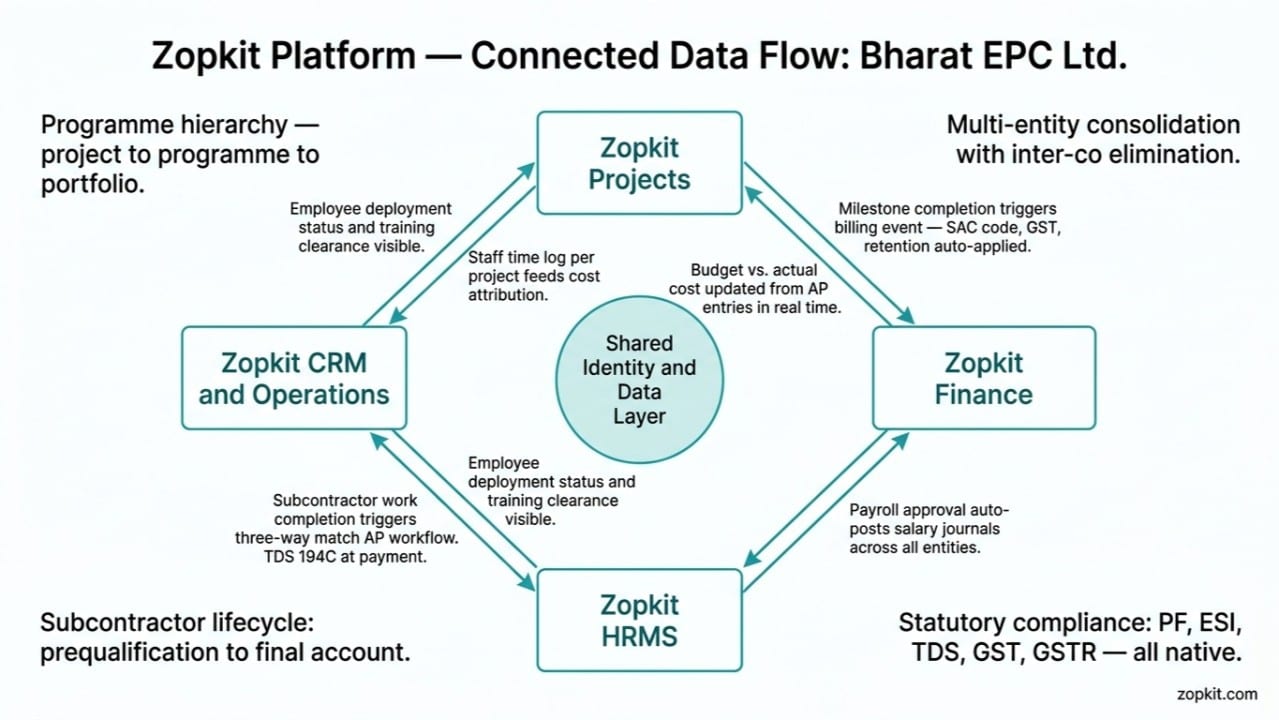
VI. How the Four Modules Share One Data Layer
One Identity, One Data Layer, Zero Integration Tax
The difference between Zopkit as a connected platform and a collection of point solutions integrated by API is the difference between a system and a patchwork. In a connected platform, data created in one module is immediately available in every other module without an export, an import, a nightly sync, or a reconciliation step.
Projects to Finance: Site completion triggers billing.
A milestone marked complete in Zopkit Projects, with attached GRN references and inspection documentation, creates a billing-ready event in Finance at that moment. The project, client, billing amount, SAC code, GST treatment, retention deduction, and advance recovery are all present. The invoice is ready to review and dispatch.
CRM/Operations to Finance: Subcontractor certification triggers AP workflow.
Work completion certification in Zopkit Operations for a subcontractor milestone creates an AP event in Finance at that moment. The three-way match against PO and certification is available. TDS under 194C is computed at payment approval. The subcontractor payment run processes from current certification data, not from an invoice that may or may not match what was certified.
HRMS to Finance: Payroll posts on approval.
When the monthly payroll run is approved in Zopkit HRMS, salary disbursement journals post to Finance across all entities simultaneously. PF, ESI, professional tax, and TDS liabilities appear in the statutory payable accounts. No re-entry. No export-import cycle. No reconciliation between HRMS payroll figures and Finance general ledger.
Projects to HRMS: Time tracking feeds staff cost per project.
Staff hours tracked in Zopkit Projects against specific projects contribute to the actual staff cost per project in Finance. The project manager who splits their time across three sites has their hours attributed to each site based on their timesheet. The cost attribution is automatic, not a month-end allocation exercise.
HRMS to Academy: Employee records link to training history.
Safety certification and technical training records from Zopkit Academy are associated with the same employee identities in HRMS. Site deployment decisions include a check on training completion. The HR manager approving the deployment of a crew to a new height-work project verifies safety certification status from the HRMS employee profile.
See content credentials

VII. Implementation at Scale: A Phased 20-Week Transition
A Transition That Keeps Every Site Running and Every Client Invoice On Time
A 200-plus employee EPC company has zero tolerance for operational disruption during a platform transition. Projects are in execution. Billing is contractually time-bound. Payroll is a legal obligation. The implementation plan for Zopkit at this scale is a phased transition that runs each module alongside the current system until the new system is verified and the old one is retired.
Phase 1 (Weeks 1 to 5): Finance Foundation Across All Entities
Chart of accounts for each legal entity with cost centre structure for all active projects. Company GSTINs, SAC codes, TDS rate tables under 194C and 194J. Client and vendor master data. Opening AR and AP balances. From week 3, all new project invoices across all entities are raised in Zopkit Finance. GSTR data for future periods is sourced from the platform.
Phase 2 (Weeks 3 to 9): Project Portfolio and Programme Setup
Create a project for every active site in Zopkit Projects. Configure the milestone structure for each project mirroring the contract billing schedule. Set up programme groupings for related project clusters. Enter current milestone status and remaining task structure. From week 7, all site updates, milestone tracking, and weekly work programs run in Zopkit Projects. The Monday portfolio review moves to the Zopkit dashboard.
Phase 3 (Weeks 6 to 12): Subcontractor Management in CRM and Operations
Import the active subcontractor panel with prequalification records. Enter active subcontracts as POs with scope, rates, payment schedules, retention percentages, and advance terms. Configure the work completion certification workflow for each project. From week 10, all new subcontractor invoices are matched against POs and certifications before payment approval. TDS 194C deduction runs at payment.
Phase 4 (Weeks 8 to 16): HRMS and Payroll Transition
Employee master entry for all 200-plus staff with salary structures, statutory enrollment, leave policies, and multi-site shift assignments. Configuration for professional tax across all operating states. Run the first Zopkit payroll in parallel with the existing process. Retire the existing payroll process after two confirmed parallel runs match.
Phase 5 (Weeks 14 to 20): Full Integration and Reporting
All four modules live and connected. Programme dashboard reporting configured for programme directors and the MD. Group consolidated financial reporting configured for the CFO. Subcontractor performance scoring cycle established. Safety and technical training courses in Academy linked to site deployment workflows. Monthly and quarterly management reporting runs from live platform data.
VIII. The Enterprise Evaluation Checklist
What a 200-Plus Employee EPC Company Must Verify Before Platform Selection
Require a live demonstration for every item. Reject any vendor who responds to a demonstration request with a slide or a pre-recorded video.
Programme and Portfolio Management:
- Can I create a programme grouping that aggregates multiple projects, with programme-level health status, budget, and billing visibility that rolls up to a portfolio view?
- Does the AI alert for budget overrun risk reach both the project manager and the programme director, or only the project manager?
- When a milestone is marked complete with GRN and inspection documentation attached, how many steps and how much time does it take to dispatch the invoice to the client?
Subcontractor Management:
- Show me the three-way match process for a subcontractor invoice against a PO and a work completion certificate. What happens when the invoice quantity differs from the certified quantity?
- Can I see a subcontractor's full performance history across all projects before issuing a new bid invitation?
- Is retention withheld from subcontractors tracked separately from retention withheld by clients? Can I see both balances simultaneously?
India Tax Compliance:
- Show me TDS 194C deduction at subcontractor payment approval. Is the rate determination automatic based on PAN registration, or manually selected?
- Show me a Works Contract invoice under the composite GST scheme at 12% alongside a regular EPC service invoice at 18%. How is the rate difference determined in the system?
- Show me GSTR-1 and GSTR-3B data for two different GSTINs simultaneously. Is the data compiled from live transactions?
HRMS:
- How does the system handle professional tax for employees on sites in Karnataka, Maharashtra, Telangana, and Tamil Nadu in the same payroll run?
- Show me the ESOP management module. Can I see vesting schedules, exercise records, and cap table in one view?
- When the payroll run is approved, show me the accounting journal entries that appear in Finance. How long does this take?
Finance:
- Show me group consolidated P&L across four legal entities with inter-company eliminations applied. How is the consolidation set up and when does it update?
- Can I see the total retention receivable from all clients and the total retention payable to all subcontractors across the group in one view?
- Show me the 14-day cash flow forecast consolidated across all group entities.
Conclusion
The System Is the Competitive Advantage
A 200-plus employee EPC company competing for ₹50 to ₹500 crore project portfolios is not competing on price alone. It is competing on execution credibility: the demonstrated ability to deliver complex multi-site programmes on schedule, on budget, with complete documentation, and with the commercial and statutory compliance posture that institutional clients require.
That execution credibility is built on information infrastructure. When the programme director walking into a client steering committee can open a live dashboard showing the health status of every package in the programme, the current billing position, the retention balance, and the open subcontractor payment queue, the client's confidence in the contractor's execution capability is demonstrated, not merely claimed.
Zopkit Projects, CRM and Operations, HRMS, and Financial Accounting on one connected platform give the 200-plus employee EPC company the information infrastructure for that execution credibility. Programme-level project hierarchy with AI delivery intelligence across the full portfolio. Subcontractor lifecycle management from prequalification through final account settlement, with three-way matching, TDS compliance, and performance scoring. Multi-state payroll with every Indian statutory obligation native, including PF, ESI, professional tax across states, and TDS, with automatic journal posting to Finance on approval. Multi-entity consolidated Finance with Works Contract GST treatment, retention management at group level, and a live consolidated cash flow forecast.
The 20-week implementation runs in phases while sites remain in operation. Each phase delivers operational value before the next phase begins. By week 20, the management reporting cycle that previously consumed a week of Finance and HR team time takes a morning. The programme director's Monday review takes 20 minutes from one screen.
Start the conversation at zopkit.com